

By Gretchen Webster
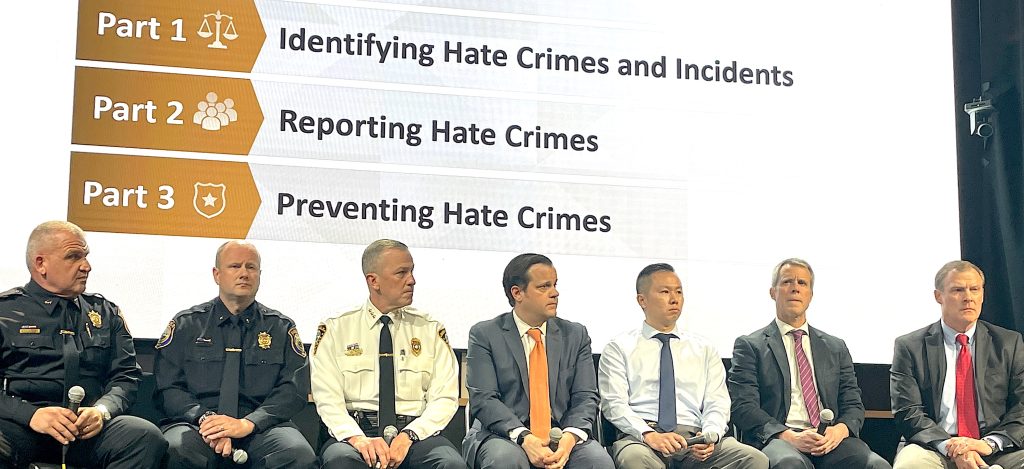
WESTPORT — If there is one word embodying the goal of “United Against Hate” — a public forum Tuesday on ways to combat the rise in hate crimes — it would be “report:” The thing anyone should do if they experience or see an act motivated by bias.
It could be a ride-service driver refusing to pick up an Asian customer, or a trans teenager being bullied by classmates – two examples cited during the forum held at the Westport Library.
“When in doubt, report,” Vanessa Roberts Avery, the U.S. attorney for Connecticut, told the more than 60 people at the program.
Westport has seen a spate of hate graffiti with racist and white supremacist content in public places over the last few months. Read about some of those incidents here, here, here and here.
Roberts Avery, appointed to her post by President Biden and the first African American woman to hold the job in Connecticut, listed “upholding the rule of law, protecting the safety of the community and safeguarding civil rights,” as the three main responsibilities of her department.
“United Against Hate: Identifying, Reporting and Preventing Hate Crimes” is a national program sponsored by the U.S. Department of Justice and presented in Connecticut by the U.S. Attorney’s Office. Westport Pride, Westport Police Chief Foti Koskinas, Norwalk Police Chief James Walsh and the Connecticut State Police Hate Crimes Unit also collaborated on the program in Westport.

A series of speakers explained that hate crimes involve federally protected classes defined as: race, color or national origin, religion, disability, sexual orientation, familial status, sex and gender, or gender identity.
Hate crimes occur when the victim is a member of a protected class, and can include comments, written statements, gestures, drawings, markings, symbols or graffiti that show bias.
Other indicators that an action may be a hate crime are: the perpetrator is a member of a hate group or has a history of previous crimes or incidents based on bias, or that the hate incident occurs in a place of worship such as a synagogue or church.
“Sometimes it may be difficult to prove that the motive is bias,” Assistant State’s Attorney Michael Nemec said during the program. “The best way is through their actions, what they say or what they have said in the past.”
It is up to local law enforcement to investigate, and to state and federal attorneys and the court system to prosecute, depending on the level of the hate crime, said Anastasia King, the assistant U.S. attorney in the criminal division, who moderated the “United Against Hate” program. And everyday citizens’ responsibility is to report incidents based on hate so that cases can be investigated and perpetrators prosecuted, she said.
Too many hate crimes go unreported, King added, because people believe the police won’t help; they fear reprisal; they don’t think the incident is important, or they handle the incident on their own in another way.
But “it may not be the first time” a suspect has committed a hate crime, Detective Alvin Chen of the State Police’s Hate Crime Unit, told the forum. Reporting incidents to police “help us to build a case,” he said.
A new way to spread hate speech are flyers with QR codes, which can be scanned to reveal messages, often distributed by white supremacists in places where even children can find them, Chen said.
Report suspected hate crimes or incidents, he told the audience, then let law enforcement and the legal system try to eradicate hate.
The national United Against Hate program was rolled out in September 2022 by U.S. Attorney General Merrick Garland as a nationwide initiative to combat hate crimes, according to the website of the Department of Justice Office of Public Affairs. Connecticut was one of the first 16 judicial districts involved in the program.
Anyone who suspects or experiences a hate crime, should contact their local police department or the FBI tip line at 800-225-5324.
____________________________________
Freelance writer Gretchen Webster, a Fairfield County journalist and journalism teacher for many years, was editor of the Fairfield Minuteman newspaper for 10 years and teaches journalism at Southern Connecticut State University.




“A series of speakers explained that hate crimes involve federally protected classes defined as: race, color or national origin, religion, disability, sexual orientation, familial status, sex and gender, or gender identity.”
This is correct. But there is confusion.
“Hate crimes occur when the victim is a member of a protected class, and can include comments, written statements, gestures, drawings, markings, symbols or graffiti that show bias.”
This is incorrect, but a common error. Nobody, but nobody is a member of a protected class.
It is confusing because in the first example, which is defined in the Civil Rights Act of 1964, as amended, class is a list of classifications that the law applies to, like race or religion.
But it is confusing because there is a second more common definition, where class describes a group of people, such as middled class, working class, etc.
So in civil rights law, a classification could be religion, but the law doesn’t protect Baptists but not Catholics.
Nobody is in or out of a protected class, because the constitution guarantees equal treatment under the law.
This is important because some people believe that minorities have some sort of special rights, because they are believed to be in an imaginary protected class.