
By Linda Conner Lambeck
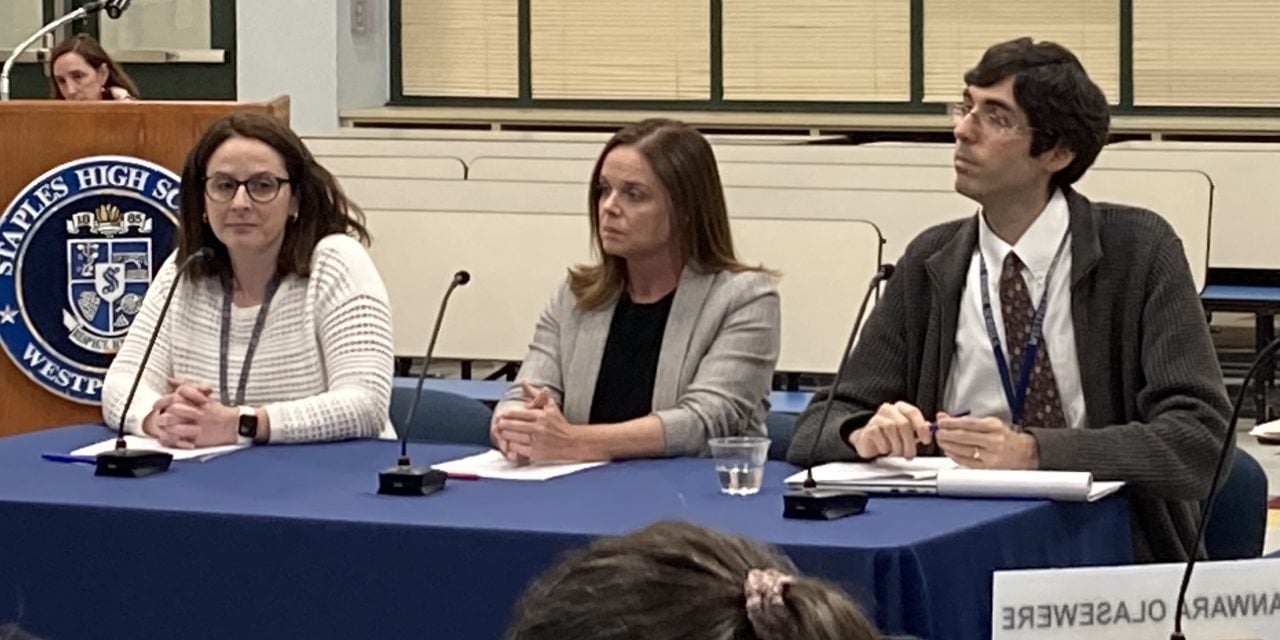
WESTPORT–Two years into a comprehensive review of the school district’s K-12 social studies curriculum, staff say they are on track to align what is taught to both district and statewide standards.
School board members, at a meeting last week, gave a thumbs up to the inquiry-based direction.
“I love the fourth-grade curriculum, think it’s great,’ said Board Vice Chair Dorie Hordon.
The fourth-grade focus is on United States geography, using tools to interpret physical and cultural landscapes and an exploration of efforts to protect the environment and places like National Parks.
Still, both Hordon and fellow Republican Board Member Andy Frankel expressed concern that students at the secondary level may not be getting the whole story.
Trusting the curriculum
“There have been some occasions where there has been some extreme one-sidedness,” said Frankel, using an assignment he said his daughter received in a 10th grade honors class as an example.
The class was tasked with listening to a daily NPR podcast for current events.
Frankel said he was shocked with how biased he found the podcasts when it came to reporting on the Israel/Hamas conflict.
“It’s probably their only source of information on the Middle East,” Frankel said. “There was no counterpoint.”
When brought to their attention, the teachers stopped the requirement, Frankel said, but he added that he knows of other examples on different topics where students are not encouraged to explore other sides.
“I have also heard stories,” Hordon told the presenters, including Lauren Francese, coordinator of social studies, grades 6-12th for the district.
Hordon said if students know teachers disagree with them it is more difficult for them to feel the freedom to think and say what they want.
“I would hope teachers are neutral in their viewpoints when they come into the classroom,” Hordon said.
Francese, who said she was involved in the discussion when the NPR assignment was questioned, said it occurred after another daily news blast teachers had been using stopped running. Once questions were raised, she said, teachers changed course quickly.
Presenting current events in a 24-hour news cycle is difficult, Francese conceded.
“It’s a real shift for teachers,” she said.
Frankel said he is not asking the district to stop using any materials but wants them to encourage exploration of other sides of issues.
“Kids should be encouraged to interrogate, challenge sources, to understand other viewpoints and perspectives,” he said, adding, most won’t do so without teacher encouragement.
Hordon asked if and how the district uses the 1619 Project when it comes to U.S. History. The Project ties the birth of the nation to the arrival of African slaves to Jamestown, Virginia in 1619 and focuses on both the consequences of slavery and the contributions of black Americans.
Francese said it is a listed resource for a state-required course on Black and Latino studies.
“We don’t use it very much,” she said. “It’s a source…. And not something informing or driving developing curriculum.”
While Hordon called for teachers to remain neutral, Board Chair Lee Goldstein said she wanted to see robust and meaningful discussions play out in district classes.
“Some teachers deliberately take opposite positions than their own,” Goldstein said.
Board member Abby Tolan agreed.
A great classroom is where students debate things, Tolan added.
“I think teachers should challenge students,” added Board Member Stephen Shackelford. Otherwise, he said Westport students would not be prepared for college.
Schools Superintendent Thomas Scarice said the district has a policy prohibiting teachers from expressing partisan political positions when instructing students.
“That is not an item for debate,” he said.
“Westport Public Schools are fabulous,” said Hordon. “We want there to be a level of trust. We don’t want parents to not trust teachers or the curriculum.”
We want to engender trust, Assistant Superintendent Anna Mahon said, adding “We can’t make changes unless we know.”
A popular subject
For a subject that does not have a standardized test and at the elementary level must compete for instructional minutes against reading and math, social studies has several ways to measure its growth, according to Francese.
At the High School, there were 2,414 requests to take social studies courses among the student body of roughly 1,600 students, she told the board. That’s more than any other subject, she added. Students are required to take three years of social studies to graduate.
Students also do well on both AP history courses and the Early College Experience courses offered at Staples which awards students University of Connecticut credits.
Next year, some 350 Staples students are signed up for UCONN ECE courses, the second highest in the state, Francese said.
As for the ongoing curriculum alignment, the focus this year has been on fourth and fifth grade but there is also a look to align the US History lessons students get in grades 5, 8 and 10–almost as if it were one course.
At the high school level, the alignment includes the use of Artificial Intelligence to enhance, not replace, student thinking.

Linda Conner Lambeck
Linda Conner Lambeck covers education for Westport Journal. She was a reporter for more than four decades at the Connecticut Post and other Hearst publications. She has covered education throughout Fairfield and New Haven counties. She is a proud member of the Education Writers Association.





Recent Comments