
By Kerri Williams
WESTPORT – A parcel of town-owned land that has been called a big part of town history may receive some updates thanks to some interested residents.
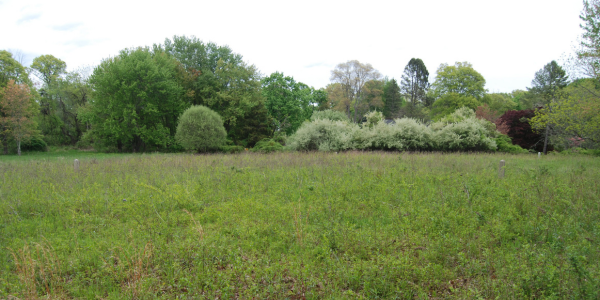
The six-acre site, on Greens Farms Road, which was once the home of the West Parish Meeting House during the Revolutionary War, has been eyed for many town uses through the years, including as the emergency facility, a dump and a refueling station.
Morley Boyd, a former member and chairman of the Historic District Commission, who has championed the land as a historic site that needs to be protected, said this week that the group of interested neighbors coming forward is a good sign. The site has been designated by the town as a historic site and by the state as an archaeological preserve.
“Perhaps after all these decades, we can turn the page on this site and interpret it properly,” Boyd said.
The group, called the Center-Green Alliance, has said it will privately fund several “treatments” to the site, which is currently an open field, according to Boyd. The improvements were recommended during a Preservation Plan and Cultural Landscape Assessment for the property, which was completed in 2011.
The plan includes: adding signage at key locations, clearing of trails, installing boardwalk areas, and removal of invasive plants in wetland areas. The plan would need cooperation from the Department of Public Works and the Parks and Recreation Department, as well as approvals from the Conservation Department.
During its Tuesday meeting, the Historic District Commission is slated to review a draft letter from the commission to town departments regarding the proposed upgrades. The letter in favor of the plan would be sent to First Selectman Kevin Christie, as well as Peter Ratkiewich, director of Public Works; Parks Superintendent Nicholas Quatrano and Colin Kelly, director of Conservation. The draft letter states that approval of the plan would be consistent with the 2017 Plan of Conservation and Development since the plan includes supporting the preservation of Westport’s historic resources.
The site is currently maintained by the Department of Public Works, Boyd said. It is not listed in the town park section of a recent Parks Master Plan completed by BL Companies in Meriden. Members of the Parks Department and Ratkiewich could not be reached Monday for comment.
Currently, Boyd said the site is inaccessible to the public because of impenetrable thorns and briars. He said that the installation of modest walking trails does not seem “unreasonable.”
The property, known as the West Parish Meeting House Historic Site and State Archaeological Preserve, was home to one of the first meeting houses built in the town of Fairfield, when Westport was still part of Fairfield, according to the town website.
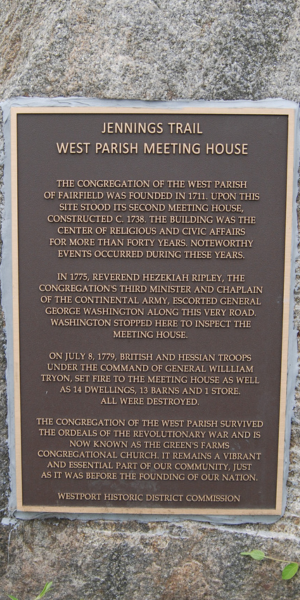
The meeting house was built in 1737 and was used both to house the town’s government and as a church. It was burned down in 1779 by British General William Tryon’s troops during the Revolutionary War.
Boyd described the burning of the meeting house as an “act of terrorism” and one that dogged Tryon for the remainder of his life.
A plaque commemorating the site was installed last fall, and concrete markers have also been put in place to show the dimensions of the original meeting house, Boyd said.
The historic property, also the site of an early schoolhouse, has been explored twice for artifacts buried beneath it. The first dig, which took place in the 1980s, uncovered that the site was also once used as a Native American campsite. More recently the site was subjected to another dig before receiving its designation as an archaeological preserve, Boyd said.








It is encouraging to see Westport residents stepping forward to help preserve and interpret the West Parish Meeting House Historic Site. Communities are defined not only by what they build, but by what they choose to remember and protect.
This site’s layered history—from colonial civic life to Revolutionary War destruction to Native American archaeological significance—deserves thoughtful stewardship, not expedient repurposing.
That principle should guide all of Westport’s historic decision-making. Whether the resource is a Revolutionary-era meeting house site, an archaeological preserve, or a National Register historic district anchored by one of the nation’s oldest operable swing bridges, historic assets should be evaluated in their full context, with transparency and care, before irreversible decisions are made.
Preservation is not about nostalgia. It is about understanding that once historic places and their settings are fundamentally altered, they cannot be recreated.
Great work being done here. Personally, I think archaeology is merited at this location. There is evidence of human habitation dating back more than 10,000 years. Kinda puts our current issues into perspective. Concerned citizenry prevail when local gov lack initiative to investigate and or make public awareness a priority..