

By Gretchen Webster
WESTPORT — The consultant’s report is in: A parking deck is not needed downtown — at least not for now.
Instead, the town should adopt a range of different parking-management strategies to help ease parking and traffic problems. That was the main takeaway from a report prepared by the consulting firm BFJ Planning, which was delivered to the Downtown Plan Implementation Committee on Thursday.
The latest study of the chronic issues was commissioned last September.
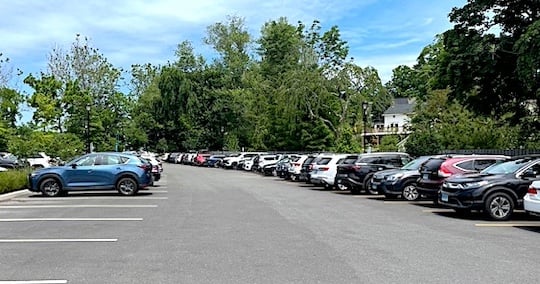
Eliminate “all-day” parking, issue permits instead
Major elements of the consultant’s report include:
- Immediately convert spaces currently designated for all-day parking into time-limited parking.
- Set up a permit system where employees and residents could pay for longer-term parking in certain lots.
- The largest number of parking spaces, which currently have three-hour limits, should instead have only two-hour limits.
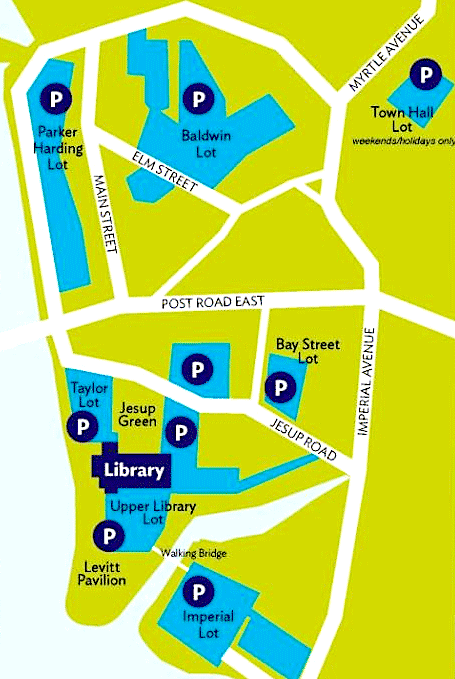
- Offer free parking in lots, such as in the Imperial Avenue lot, which are farther from the core area of downtown, and set permit fees on a sliding scale that declines the farther the spaces are from the Main Street area.
- Provide more pleasant and safer pedestrian connections from parking lots to the central business district, especially from those lots farther away.
- Use technology to manage and monitor parking. This could include parking apps, license plate readers, cameras and other technological tools to make managing the town’s parking system easier and less expensive.
More timed parking, shorter limits
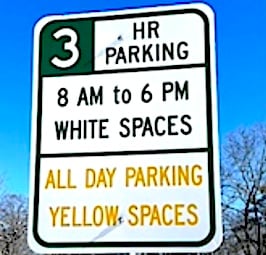
Measures that should be adopted immediately are: Eliminate all-day parking spaces and re-classify them for timed, paid parking, and reduce parking space time limits from three hours to two, said consultant Georges Jacquemart, principal of BFJ Planning, a New York-based transportation planning and traffic engineering firm.
“In fact, those all-day spaces are unregulated,” he said. “The town doesn’t enforce parking in those spaces.”
Downtown did have two-hour parking limits, as the consultants recommend, prior to the pandemic. But the limits were suspended amid COVID restrictions as a way to help support businesses, and then reimposed last May with increased limits to three hours.
The Board of Selectwomen had approved that change by a split vote, amid pushback by merchants and some Representative Town Meeting members. They complained that shoppers, and especially diners, need more time to park without fines. They also wanted to delay implementation of time limits until officials took a broader look at downtown parking issues.
Parking deck a costly project
Westport’s downtown parking layout is complicated, Jacquemart said, because of the number of lots, with a variety of locations, sizes and shapes.
Regulating parking, for instance, is more difficult with multiple lots than counting and charging fees as drivers enter a parking structure, the consultant said.
However, the cost of even a single-level parking garage can be prohibitive, he said, and there are other ways to address the area’s parking problems.
Jacquemart’s firm estimated the cost of a concrete parking structure, with a single deck, at $4.9 to $5.25 million, which works out to a possible cost of $80,000 per space, depending on the design and other factors.
Dedicate parking revenue to make upgrades
By simply managing the limited, paid parking better, the town could not only save money, but also take in revenue to make improvements, such as better pedestrian access from lots farther from downtown, he said.
Jacquemart recommended the town set up a fund right away to deposit parking fees and fines. “Whatever money will be collected … will create some financial resources to help improve downtown,” he said.
Studies done by his firm concluded the peak parking occupancy downtown is around 1 p.m. weekdays and Saturdays.
The consultants also found that parking needs downtown have not changed considerably since 2015.
Variety of short-term options
“The first priority is to satisfy the short-term parking needs,” which could be accomplished “by pushing long-term parking out of the core area” and issuing permits, according to the consultant.
Parking limits could range from as little as 15 minutes for a spot, for example, to pick up a cup of coffee, and up to eight hours for downtown employees.
Creating more parking turnover for businesses is key, he said. “Turnover is more important than free parking” to increase commerce in town.
Maxxwell Crowley, president of the Westport Downtown Association, asked how much time employees might have to spend, on average, walking from their parked cars to their jobs.
That depends on many factors, Jacquemart responded. It is dependent on the weather, how attractive and safe the walk is, and other considerations. “People will walk much farther in Manhattan,” for example, than other places, he said. About five to 10 minutes to walk ¼- to ½-mile is considered reasonable.
Positive feedback from some RTM members
Several RTM members addressed DPIC, including Louis Mall, District 2, who said, “I really like what I heard today.” District 4 member Clarence Hayes said the town should start “implementing effective parking management before spending significant money” on parking decks or plans to “reconnect the riverfront,” as outlined in the DPIC master plan.
Jennifer Johnson, District 9, which includes the downtown area, said she was “thrilled with this discussion,” but fellow District 9 member Sal Liccione, complained that “no one has talked to the employees about where they want to park.”
Speaking to stakeholders was not part of the scope of this parking survey, DPIC Chair Randy Herbertson responded. A public meeting, or charrette, for comments on the study will be planned within the next few months, he said.
Last October, DPIC had hosted a charrette on the findings of another consultant’s study focused on parking issues in the Jesup Green/Imperial Avenue area.
One employee speaking at Thursday’s meeting was Erin McGowan, the general manager of the State & Liberty clothing stores in Westport and Greenwich, where parking management procedures have been instituted.
She said that allocating parking permits per business rather than per license plate, as done in Greenwich, would work better. Her company also assists employees financially to help pay for permits in that town, she said.
Parking deck not immediate priority
“We are not anti-deck,” Jacquemart said in summarizing findings of his firm’s study.
“Start with parking-management strategies. That will definitely help make parking more available and will create some financial resources for the town,” he said. “We would not recommend now that you proceed with a deck. It doesn’t mean that you won’t build one in the future.”
Freelance writer Gretchen Webster, a Fairfield County journalist for many years, was editor of the Fairfield Minuteman and has taught journalism at New York and Southern Connecticut State universities.







As one of the many Westporters who routinely use paid parking apps in other Fairfield County towns, I was indeed thrilled to see that the DPIC is exploring them as a possible option for Westport, hopefully to help fund opening up the riverfront and supporting our downtown businesses. But on the downside, I was puzzled by the fact that the consultant’s presentation did not even address the terms of the RFP for this task as approved by the Board of Selectman last September. Specifically:
The Town of Westport (Westport) seeks to perform a structured parking feasibility study of multiple lots in downtown
including the following three (3) locations:
The study will help Westport develop a strategic plan for the provision of future public parking infrastructure by determining what sites are most suitable and cost effective for the development of a parking facility to support Westport’s downtown.
Unable to attend the DPIC meeting Thursday, I listened to the audio coverage from the meeting last night.
It is always a wise move to take stock of existing parking assets and reevaluate current thinking.
Like many other towns, Downtown parking should be paid for through a kiosk parking system. Westport residents should be compensated for the increased traffic and pollution caused by retail shoppers, many arriving from surrounding towns. When dining in South Norwalk a simple $2.00 – $3.00 fee to park is not a hardship. Shoppers purchasing super high end retail items here in Westport can certainly afford what amounts to pocket change for parking.
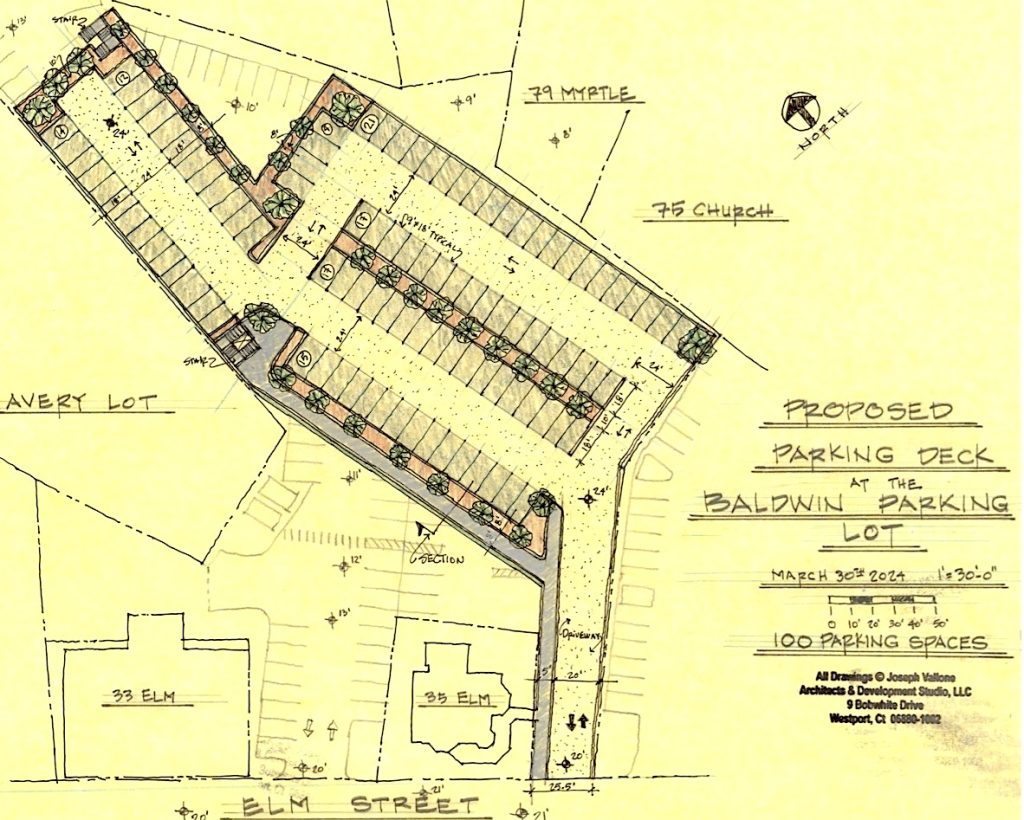
With respect to comments made regarding my design proposal for the Baldwin Parking Deck, below is my response;
First; It is difficult to believe the engineers from BJF Planning assumed I gave no consideration to the existing parking spaces and therefore they falsely assume a loss of (40) lower level parking spaces from the existing lot, in order to accommodate the superstructure for the new deck. The BJF engineers falsely assume the proposed deck would have a net gain of only (60) parking spaces.
If BJF Engineering had the courtesy and professionalism to contact me to discuss the programatic design considerations that went into the solution, prior to publicly bashing the plan they would have been better informed. The engineers would have learned I secured the existing conditions drawings from the Town and designed the solution using a trace paper overlay, on top of the current parking layout. This technique allowed the identification of potential new structural column locations, coordinated with the existing parking layout below. Care was taken to locate the proposed new access driveway over the existing driveway to the east while allowing the access driveway to the west to remain servicing the existing lower level. The proposed design program placed a high priority on a ZERO net loss of parking spaces from the existing lot. Therefore, as a design professional, it is difficult to take their presentation seriously.
Second; I stated last year the proposed cost of this new deck would be in the $3.5M – $5.0M price range, or $35,000 – $50,000 per space. Budget numbers for this new deck were circulating throughout the community, ranging from $12M, to $20M to even $80M, mostly coming from folks not in the design or construction industry.
Third; No mention of structural systems or finish materials was ever addressed in this proposed sketch, it is a concept drawing, not a construction document. Therefore listening to the audio discussion about the construction materials is premature, with its only purpose being to muddy the waters.
Fourth; YES the Baldwin deck design solution was designed by an architect, sensitive to an aesthetic worthy of our highly deserving community. Consideration was given to allowing additional space for landscaping, plantings, shrubs, trees, comfortable walkways, lighting and even signage. Consideration was also given to the view abutting neighbors would face. The deck is set back from neighbors to the north as that portion of the site is the apex of the triangle. The deck has an 8’ wide, linear planting bed to screen the cars from the neighbor’s rear yards. Care was given to NOT maximize the existing site but rather to propose a compromise solution that would feel less intrusive within the neighborhood. Westporters do not want a parking deck designed for an airport by engineers from the Port Authority, they want an architecturally sensitive, creative, functional and aesthetically pleasing solution they can be proud to use. Proceeds from a paid parking kiosk system on the deck would be used to construct and maintain this deck.
Fifth, It appears the administration hired the consultant who gave them exactly what they wanted to hear – NO DECK.
~ Joseph V. Vallone, A.I.A.
After attending the excellent presentation by consultants BFJ Planning to the Downtown Plan Implementation Committee, I am convinced more than ever that there is NO Downtown Parking problem. There might be an inconvenience problem, but there isn’t a parking problem. There is no current need for deck parking. Baldwin has been re-furbished. Parker Harding needs to be ADA and Fire Code compliant. Jesup Green needs to be re-paved and re-lined without destroying any trees.
BFJ’s first recommendation is to establish Parking Management Strategies. Starting with paid parking – let those who use it, pay for it. Commuters pay for railroad parking, beach goers pay for beach stickers, other towns charge for parking.
The goal of Downtown parking should be increased turnover through short term, hourly parking. We need 2-hour spaces that turnover for shoppers, and long term parking permits for those who work in the Downtown. Turnover is the key.
Revenue generated from paid parking can be re-invested into future parking needs and improvements along the river. The Downtown has the spaces – 1400 of them. They just need to be re-distributed more efficiently.
Now let’s move on. Just get it done.
The consultant, unless this was not the consultant who was to evaluate 3 sites for building a parking garage, was not asked to look at town parking management strategies.
They were simply asked to evaluate those 3 sites for building a parking garage.
The RTM and BOF approved monies for this consultant to do the job asked of him and with the money approved for THAT job. Did you not vote Lou on that appropriation, and if you did, have you forgotten that consultants job ?
That job is outlined very clearly in Jennifer Johnson’s comment.
In my opinion this consultant ( if this was the consultant tasked with the evaluating parking deck “sites”- there are so many at this point I may be confused) went completely rogue, listened to the administrations wish list and likely verbatim gave it back to us in that irrelevant presentation, which was kindly recorded by a concerned and caring citizen.
I liken it to being given moneys to evaluate the construction of a shed, but then doing a study on pickle ball courts. Or simply giving a consultant money to buy a house but they buy a car instead.
As for parking in any downtown, where it relates to turnover, most people do not come to downtowns to spend 2 hours. They shop and dine, and drink coffee and shop some more. They get their hair done, they visit spas.
The idea that you would suggest they be kicked out of town after 2 hours just simply in my opinion shows you to be out of touch with the realities of running a brick and mortar business.
The planning and zoning commission in a close vote sent a very clear message to this administration, and that was quite simply find 40 more spots.
Only way to find 40 more spots is to build a parking garage.
There is a disastrous problem in this town with parking. Acknowledged by all but a handful with an agenda, since the 1940’s.
It is my opinion that this administration is anti business, anti merchant, anti staff and instead of listening to the businesses in downtown is hellbent on attempting to bully through their agenda for whatever reason.
ANTI business is not a good look.
Not in Westport, not anywhere.
Dissing the bread and butter of the central core of this downtowns commerce is not something voting folk in Connecticut will approve of.
All of these delays could have been avoided by simply listening to the merchants who pay the property taxes in the downtown.
In less than 3 short years we have seen many businesses shutter on Main Street and unfortunately some of them large tenants, 2 restaurants, and 2 very big furniture stores.
Seems they just got tired of the BS. We will soon be back to ghost town status.
Vengeful agendas do not solve the core issue here and that is nobody ever asked us, the merchants, what we thought could be a solution for parking and adding to green space. I will bet nobody asked the businesses who came and left in 3 short years either.
Bullying staff to park 15-20 minutes away from their jobs, in a lot still not designated legally for parking as it has never had an 8-24 ( residence zone) solves nothing, because businesses will not retain staff. And businesses need staff to open their doors and serve customers.
Plain as the nose on our faces nobody in this administration has ever owned a business in a downtown.
And nor I believe have you.
Maybe everyone needs to stay in their lane here.
Let the businesses tell the ANTI BUSINESS administration ( IMHO),
What it is they hear from their customers. Let’s survey the customers and ask them what it is they need and want in order to bother coming to Main Street.
After all we have a captive audience.
Instead of one inept study after the other, costing an absolute fortune over the years, let’s hear it from the horses mouth.
The consultant says the $4.9 million estimated cost of a parking “deck” would be “prohibitive.” Come on. if the Town of Westport can spend $5 million to refurbish a tidal gate and private walkway for the handful of residents at Compo Mill Cove, surely it can allocate a similar sum to build a transformative structure that could finally eliminate the intractable mess at Parker Harding Plaza, open up the waterfront along the river, and enable our downtown business community to thrive.
Evan, let’s not forget the preposterous and bewildering not to mention out of touch with reality attempt at securing $7 million for the proposed shed at Longshore to house lawn equipment etc. at an average cost of $100,000 per piece of equipment stored.
That shed even at double its current size — more than enough space to house maintenance equipment should cost an average of $80 per square foot putting it closer to a $500,000 ticket item.
Perhaps the $7 million dollar suggestion/request was a typo and in fact $700,000.
Far be it from me to suggest anybody spending the tax paying residents and therefore owners of Longshore park would be pulling a fast one.
Everyone knows when a builder sees an 06880 zip code, to add an extra 0 to their proposal.
Why is the administration so bent against a parking garage? Give us a workable solution already, or let someone else run the town. If you don’t want credit or blame, why even be a public servant?
Build the parking garage at Baldwin using the aesthetic plan graciously provided by Mr. Vallone. Put the all-day spots in the back of the top deck and give the businesses a crack at leasing them for their workers on an annual basis – this subsidizes the 3-5 hour spots at the front of the garage. Make the Main St. on-street and Elm St. lot 3 hour paid parking.
Make 1/4 the Parker Harding free 30 minute spots, so we can run in and grab take out from our restaurants, do quick returns at stores, and make the other 3/4 paid 1-3 hour spots.
Use Park Mobile or Premium parking apps along with the kiosks. Just get it done already, PLEASE.