
By Kerri Williams
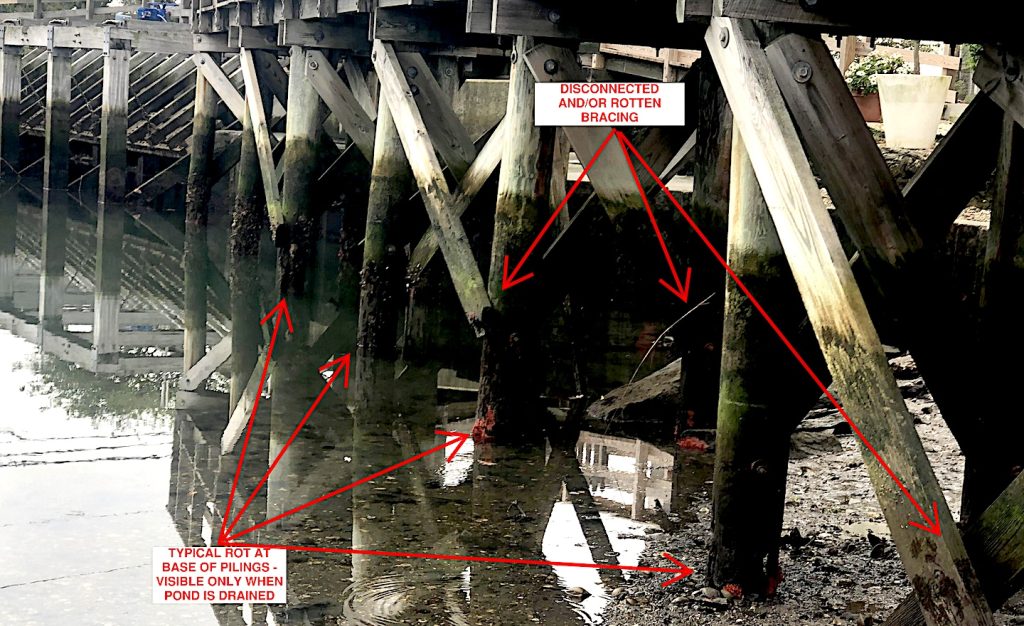
WESTPORT – Town officials are seeking $5.58 million to repair Old Mill Pond’s tide gate and walkway, which are “starting to fall apart.”
The deteriorating conditions of the 36-year-old installations were described Wednesday by Public Works Director Peter Ratkiewich as he asked the Board of Finance to appropriate money to replace them.
Finance board members plan to get a first-hand look at the problems during a Friday tour, and are expected to vote on the appropriation at their next meeting. If approved, the project is slated to get underway in October 2025.
The proposal has gotten some scrutiny from Clarence Hayes, a District 4 member of the Representative Town Meeting, who questioned whether other options for Mill Pond’s future might be better than the proposed repairs.
In an analysis published by the Westport Journal, Hayes suggested the town investgate alternate plans, such as removing the barriers and letting the basin revert to a natural tidal estuary or using the tidal flow to generate electricity.
Ratkiewich, however, told the board that neither of those options is viable.
He said the two feet of tidal difference in the pond would not provide enough energy to generate electricity. Based on his calculations, he said the power that could be generated from the tidal flow would power just two houses. And, he added, there is no place to locate the equipment needed for such a project.
Removing the barriers is also not a good option, according to Ratkiewich, because it would eliminate the pond and create a tidal flat filled with various grasses. The result would likely be objectionable to nearby residents whose properties would no longer front on a body of water, he said. “All the people who surround that pond benefit from it.”
Another District 4 RTM member, who lives on Grove Point Road, spoke in favor of the maintenance project as proposed.
“The design is not broken,” said Andrew Colabella. “If it’s not broken, why would you fix it?” Residents enjoy the pond, Colabella said, adding that it provides both substance and purpose. “What is there works.”
During his presentation, Ratkiewich gave a brief history of the pond and tidal gates, which first were installed there in the 1700s. The original gates were manually operated and well maintained for many years. But later, he said, there was a period of neglect from about 1955 to 1982, when the water quality was greatly diminished. In 1988, the town went forward with building the current structures.
While most marine structures have a life of about 20 to 25 years, Ratkiewich said these have lasted an extra 10 years because of yearly maintenance by the town. “But now it’s beyond what we can do,” he said.
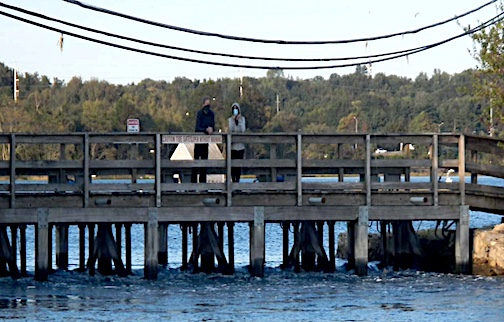
The process for rebuilding the tide gate structure is complicated because of the unique features of the property, including electrical wires overhead, Ratkiewich added. The project will involve building a trestle to get around those restraints. “Half the cost of this project is mobilization and demobilization,” he said.
The other way to accomplish the project would be to dredge the pond, which was how it was done in 1988. At that time, the state’s requirements for testing sediment and storing the material were less stringent, Ratkiewich said. “Just one test today costs $62,000,” he said. “And this would require a lot of tests.”
Kerri Williams is a freelance writer.







Are we really saying there is a compelling reason off spending $5.58M is to prop up a small number of residents property values?!
Shouldn’t we be asking questions like “how does this impact wildlife if we revert to a tidal grass area, how could this option impact the ground under of the nearby roadways, what additional maintenance and ongoing preservation would be associated with this alternative?”
We all contribute taxes to maintain common areas and transportation areas in town and these residents should have a safe path, but the rebuilding of a dam for the pond as an aesthetic choice seems to be the least compelling of any reason to be stated.
Those questions are not free to ask (consulting dollars, time, etc.)
Additionally, you should consider any lost real estate taxes for lower assessments (and less new builds/etc in the area) over the next 30+ years. Just a 5% decline for the dozens and dozens of houses in the area to the mill rate would more than cost that to taxpayers.
Old Mill Pond is one of the most beautiful parts of all of Westport (and is probably the best place to kayak); this is a lot of money, but anything that would materially alter the landscape would be a travesty to not just the residents nearby but all over the area