
By Meghan Muldoon
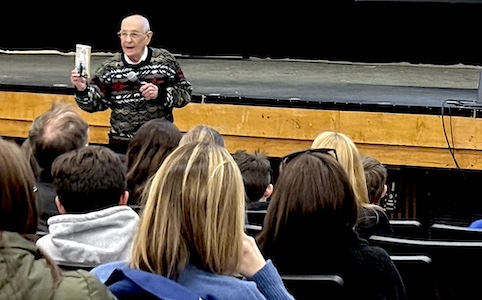
WESTPORT — Nearly 200 people, many of them students, gathered Wednesday at Coleytown Middle School for a powerful night of storytelling as Holocaust survivor Endre (Andy) Sarkany shared his life story and his message on the importance of understanding history to fight prejudice and hate.
Over the past 10 years, Sarkany, a New Haven resident, has been speaking to students about his personal experiences during the Holocaust, living under the brutality of the Soviet regime in Hungary and finding a home in the United States.
Sarkany’s journey began in 1930s Budapest, Hungary, where as a young child he experienced firsthand the horrors of the Nazi regime. He recounted the “Kristallnacht”attacks in November 1938 where Jewish homes, businesses and synagogues were ransacked and destroyed.
“The Nazis wanted to get rid of everybody who they thought was undesirable to society,” Sarkany told the audience.
Sarkany and his family were forced into the Budapest ghetto, where he described the living conditions as “miserable.”
He emphasized the importance of remembering the Holocaust, invoking these guiding principles among the Jewish people — “never again” and “never forget.”
“We were locked up 24 hours a day, seven days a week,” he said. “We were always hungry, always cold and always very afraid.”
Sarkany also spoke of the bravery of a Catholic kindergarten teacher who helped him escape the ghetto to receive medical attention, and the quick-thinking of his grandmother, who spoke German to a Nazi officer and convinced him to spare their family.
“My grandmother’s good thinking and soberness saved everybody’s life,” he recounted.
His father was forced into a labor camp and returned home after the war weighing only 70 pounds. Sarkany said it took his mother over a year to nourish his father back to health and that he would often wake up screaming and crying from the horrors he experienced in the labor camp.
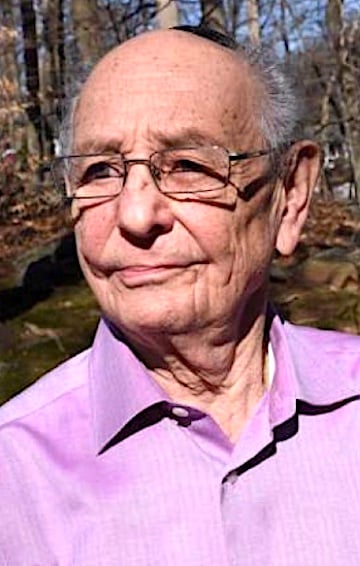
After the war, Sarkany faced new challenges under Soviet occupation. Denied access to higher education because of his Jewish heritage, he was forced to pursue a trade.
In 1956, Sarkany made the difficult decision to flee his homeland and immigrate to the United States.
“I told my parents, ‘I have no future in this country.’ We barely survived the Nazis and lost everything. Then we tried to rebuild and we couldn’t, because the Soviets came and took everything away,” he said.
Sarkany recounted how he started to cry when, upon his arrival in the United States, he saw the Statue of Liberty for the first time. “Because I noticed in the distance the most beautiful woman in my life,” he said.
He encouraged the young students in the audience to make the trip to New York City to see the Statue of Liberty for themselves and to always appreciate the freedoms and opportunities that Lady Liberty represents.
The 88-year-old Holocaust survivor also emphasized the importance of being an “upstander” — someone who speaks up against injustice and he urged the audience to remove the word “hate” from their vocabulary permanently, as it is used too casually.
Sarkany spoke passionately about the swastika, emphasizing that the symbol represents “hate and killing.” He said the ideology of Hitler and the killing it represented did not disappear after World War II and that the symbol continues to hurt and divide society even today.
He pointed to the Oct. 7, 2023, Hamas attacks on Israelis, highlighting the sharp rise in anti-Semitic incidents and drawing a direct connection between past atrocities and the ongoing persecution of the Jewish community.
He recounted his tears when he saw the Statue of Liberty for the first time, “Because I noticed in the distance the most beautiful woman in my life.”
Sarkany emphasized to the audience the importance of remembering the Holocaust, invoking these guiding principles among the Jewish people — “never again” and “never forget.”
“Please remember, bear witness, understand what the Holocaust did and try to prevent it forever,” he urged.
Meghan Muldoon is a freelance writer.




Recent Comments