
By Gretchen Webster
Editor’s note: The article has been updated to correct the statement that state elections officials have “endorsed” use of the electronic “Voter Checklist” pollbook. The Secretary of the State has “the authority to approve one or more ePollbook products for use to check in voters. However, to date, the secretary has not authorized any ePollbook products for official use … Towns are able to use an ePollbook product of their choice, but only as a pilot that they can test in the background, while also using the official, physical paper pollbook to check in voters,” a spokeswoman for the Secretary of the State’s Office said.
By Gretchen Webster
WESTPORT — A licensing agreement for software designed to make elections less labor intensive and expensive, as well as to help eliminate human errors, was approved Wednesday by the Board of Selectwomen.
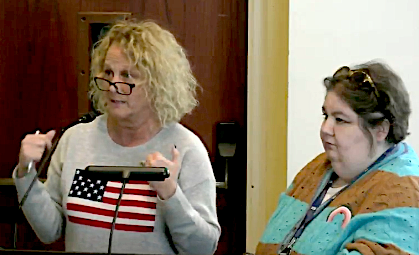
Democratic Registrar of Voters Deborah Greenberg said the electronic “Voter Checklist” is used in 40 Connecticut towns, including Greenwich, New Canaan and Stamford, and “will be used in conjunction with all the new tabulators and the new software that we will be getting from the state.” She was joined by Republican Registrar Maria Signore in making the presentation to the selectwomen in Town Hall.
Elections are very labor intensive, Greenberg said, requiring staff to gather information from each polling station about who cast their ballot during the early-voting period, who voted on Election Day and the names of voters using absentee ballots to prevent people from voting more than once.
“It takes us about 50 man hours,” she said. “Without the software we would have spent over $7,000 [to perform that task]. With the software, it would take less than an hour.”
Each polling station also must be called every hour during an election to gather numbers on the voters who have cast ballots, which helps candidates and others determine turnout, she said. “We’ve been trying to come up with an easier way — there is absolutely no other way to do it other than software.”
“Real time” election statistics
Another benefit of using the software is that it reduces human errors, Greenberg added, since the software loads the election statistics directly onto the town’s website.
“All day long, Maria and I are tied up on the phone with the polling places. This software will give us in real time who’s voting and where.”
The software, from Coastal Business Technologies in Bethlehem, Conn., will cost the town $2,590 for a one-year license agreement, renewable annually at $1,925. It has been endorsed by the town’s director of technology, Eileen Zhang.
Funds for the software are already in the town budget, Greenberg said.
In response to Selectwoman Candice Savin’s question about whether Westport officials had checked with other towns using the election software “to see if it’s going well,” Signore said that she had observed a recent special election held in Stratford, where the new software was used. The election went smoothly, she said, “and it took them 10 minutes to download” information.
Greenberg stressed that the Westport registrars have made sure the software is compatible with the state’s election software, and have been working on choosing and testing the product for six months.
Selectwoman Andrea Moore asked how long the software has been used in other Fairfield County towns. Greenwich has been using it since 2014, Greenberg said.
The selectwomen voted unanimously to accept the software license agreement, pending approval of the contract language by Assistant Town Attorney Eileen Lavigne Flug.
Freelance writer Gretchen Webster, a Fairfield County journalist for many years, was editor of the Fairfield Minuteman and has taught journalism at New York and Southern Connecticut State universities.








Recent Comments