
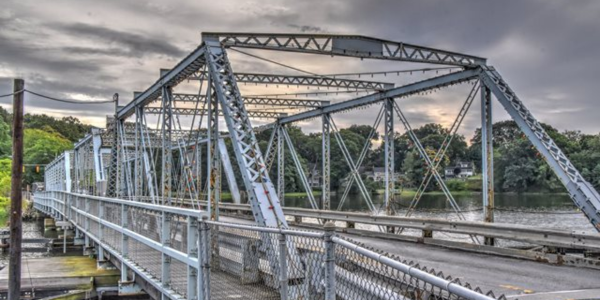
Editor’s note: following is an opinion submitted by Werner Liepolt, a longtime resident of Westport. The Federal Highway Administration named Liepolt a recognized consultant on the Cribari Bridge Project in 2017.

A simple question
Before government decides the future of the William F. Cribari Bridge, the public deserves an answer to a simple question:
Who owns it?
At first glance, the answer appears obvious. For years, I assumed it was the state. The Connecticut Department of Transportation is managing the project. The bridge carries a state highway. Surely the State owns it.
But recent historical research suggests the answer may not be so straightforward.
In 1869, Chloe Allen deeded the right-of-way for Bridge Street’s crossing of the Saugatuck River with the understanding that the Town would construct fencing on both sides of the roadway to protect her livestock. The deed still exists.
Fifteen years later, in 1884, the Town of Westport constructed the bridge that stands today at a cost of approximately $28,000. The Town’s role in building the bridge is well documented. Historical accounts further indicate that local officials later sought to have the State assume ownership, but that request was declined.
Whether subsequent events changed that legal relationship is precisely the question that deserves a clear public answer.
Why ownership matters
For more than a year, the future of the William F. Cribari Bridge has been the subject of an extensive federal review under Section 106 of the National Historic Preservation Act. Consulting parties have participated in meetings, submitted comments, reviewed technical documents, and debated alternatives that could permanently alter one of Westport’s most recognizable historic landmarks.
Reasonable people can disagree about the bridge’s future. Some believe replacement is necessary. Others believe rehabilitation deserves greater consideration.
But before irreversible decisions are made, everyone should agree on something more fundamental: the public should understand who has the legal authority to make those decisions.
Ownership is not merely a technical matter. It determines legal authority, responsibility, and stewardship. If ownership has been correctly understood all along, confirming that fact should be straightforward. If the historical record proves more complicated, the public deserves to know that before major public decisions are finalized.
Assumptions are not answers
During the ongoing federal review, information has emerged suggesting that the bridge’s ownership history may be more complex than generally understood.
At the same time, CTDOT has announced that, should the replacement alternative ultimately be selected, the existing bridge would be made available for relocation and reuse by another owner. Before any public agency conveys a historic bridge, however, the public deserves to understand the legal basis for its authority to do so.
These are not abstract concerns. Ownership defines who possesses legal authority, who bears responsibility, and how governmental decisions are made. In any major public infrastructure project, those are foundational questions.
One of the other consulting parties participating in the federal review recently summarized the issue succinctly:
“If the state does not actually own the infrastructure at issue, it immediately raises major procedural and legal issues.”
That observation does not presume an answer. It simply explains why the question deserves a clear public response.
Seeking clarity
To obtain that clarification, I recently wrote to First Selectman Kevin Christie, copying the Town Attorney, the Assistant Town Attorney, and the Westport Historic District Commission, asking the Town to explain the bridge’s ownership history and the legal basis for the current project. I have also raised the issue with the Advisory Council on Historic Preservation and informed Congressman Jim Himes’ office as part of ongoing discussions concerning the federal review.
To date, I have not received a substantive response.
Silence should not be mistaken for evidence one way or the other. It may simply mean additional historical or legal research is underway, or that the answer is more complicated than generally understood. But when legitimate questions remain unanswered during an active federal review, continued public inquiry is entirely appropriate.
There is also time to answer them. The Federal Highway Administration has indicated that a revised Environmental Assessment is being prepared, with completion anticipated in May 2027. That continuing review provides an opportunity to clarify the historical and legal record before significant decisions are finalized.
More than one important question
The ownership issue is only one of several procedural questions that have emerged during the consultation process. Consulting parties have also raised concerns regarding the adequacy of the Area of Potential Effects, the evaluation of indirect and cumulative impacts, changing traffic patterns, and the relationship between local planning initiatives and the bridge project itself.
Those issues have been submitted through the Section 106 process precisely because federal law anticipates that difficult questions should be examined openly before decisions become final.
Section 106 was never intended to predetermine outcomes. It was designed to ensure informed decision-making. That process works best when agencies respond fully to significant questions and when the public has confidence that all relevant facts have been carefully considered.
Good government begins with transparency
The William F. Cribari Bridge is more than a piece of transportation infrastructure. It is the historic gateway to the Bridge Street neighborhood, a contributing resource within the Bridge Street National Register Historic District, and an important part of Westport’s civic identity.
Whether the bridge is ultimately rehabilitated, replaced, or addressed in some other way, that decision will carry consequences for generations. It should therefore rest upon a complete and transparent understanding of the historical, legal, and procedural record.
It is also important to understand what the ownership question does—and does not—mean. Determining ownership would not, by itself, decide whether federal funding remains available for the project. It could, however, affect questions of legal authority, governmental responsibility, and the respective roles of the State and the Town in the bridge’s design, implementation, and long-term stewardship. If the Town were ultimately determined to retain ownership, that finding could have implications for those responsibilities even while federal participation in the project continued.
Those are precisely the kinds of questions that deserve clear public explanation rather than assumption.
The question of ownership is not an argument for one outcome or another. It is a request for clarity.
Before government decides the future of the William F. Cribari Bridge, the public deserves clear answers about who owns it, who has legal authority over it, and how those questions fit within the ongoing federal review.
Transparency is not an obstacle to good government.
It is one of the conditions that makes good government possible.
Werner Liepolt
Westport






Werner, if I may address you by your first name, you have sprinkled magic dust upon an otherwise too hot potato. Not unlike a big gulp of fresh water, it gets in there and starts cleaning the fuzzy thinking. Clarity of thought can bring much to light. Such as, things come to mind, if the town owns it then the town actually has authority over the decisions made about the historic landmark of Westports cherished past and future. Big trucks can never be made to find that bridge or narrow roadway as a shortcut from the highway, because it is that, it is a perfect excursion from I 95 between two of the busiest exit ramps in the northeast corridor. I have thought about this new information and have come to a conclusion, and it is thus…. —the bridge shall remain— full stop. The town shall proceed with a full restoration without closure … to be paid for by the Federal Government of the United States of America on the grounds of its historic nature and good looks, plus functionality, allowing cars but not semi trucks. Saugatuck shall be saved from those futurists who only want development without a proper knowledge of the consequences, unintended, or otherwise I wouldn’t want to speculate. Werner — thank you for your steadfastness in magic wanding clarity on the importance of political transparency.
Todd — thank you. I especially appreciate your emphasis on clarity and transparency. My hope in posing the ownership question is not to presume what the answer will be, or what decisions should follow from it, but simply to establish the documentary facts before decisions about the bridge’s future are made. If the Town still owns the bridge, that could have important implications. If it does not, there should be a record showing when and how ownership passed to the State. Either way, I think Westport deserves to know.
1869 — Chloe Allen conveys right-of-way for Bridge Street; town authority over roadway established
1884 — Town of Westport constructs present swing bridge; ownership documented in town records
1895 — State Highway Department created; provides assistance but no broad transfer of town bridges
1900–1912 — State highway planning expands; towns continue to own and maintain roads and bridges
1913 — State Trunk Line Highway System established; question remains whether Cribari Bridge was legally transferred
1913–present — Route 136 becomes part of state highway system; legal instrument transferring bridge ownership or jurisdiction remains unclear
?????
2016–2027 — FHWA Section 106 consultation ongoing; revised Environmental Assessment scheduled for May 2027; ownership question remains unresolved
Werner
1. If federal funds are used for the bridge, it will require restoring access to all legal loads, regardless of ownership.
2. Federal funding will also trigger the 100-year flood requirements. Maybe some engineering feat could keep the electrical motors above that elevation, but the span itself would still be at risk during a major superstorm, leaving us to fund repairs or replacement if we “own it” — estimated at $125 million or more.
3. Even the most basic repair of the sagging or failing electrical control box, whether town-funded or otherwise, would restore the current bridge’s clearance to over 13’6″, allowing tractor trailers to cross.
4. The last attempt to influence the state’s plan, the state and feds agreed to pay, but only if the town took ownership afterward. That would mean all future costs, upkeep, repairs, manpower, and more — forever. Makes you wonder what a specialty bridge crew of 4 might cost us. Something to think about.
Several of these are legitimate issues, but the project documents make the picture more nuanced. CTDOT has indeed proposed restoring the bridge’s load capacity, although federal law itself does not simply require every federally funded repair to eliminate every weight restriction. The current EA also specifically evaluates federally involved Conservation and Rehabilitation alternatives that do not raise the bridge or its machinery above the 100-year flood elevation. And CTDOT’s present replacement estimate is $78–86 million, not $125 million.
Most interestingly, the fourth point reinforces my concern to have a documented answer to the question, “Who owns the bridge?”.
If the State owns it, producing the record that transferred ownership from the Town to the State should settle the matter. If no such record exists, then the implications of Town ownership—including funding, maintenance, design standards and liability—deserve careful examination.
I’m not advocating Town ownership. I’m asking that ownership be established before decisions about the bridge proceed on an assumption that may or may not be correct.
In 2017 CTDOT proposed repairing the bridge and then transferring ownership to Westport—which demonstrates that ownership has consequences and therefore should be established clearly now.
None of these questions tells us whether a legally effective transfer of ownership from Westport to the State ever occurred. That remains the question I asked.
One additional point has emerged from reviewing CTDOT’s draft 2027–2031 Statewide Freight Plan and its technical appendices.
CTDOT has conducted an extensive statewide analysis of freight corridors, truck bottlenecks, bridge conditions, restrictions and future freight needs. Yet I have found no identification of Route 136, Bridge Street or the Cribari Bridge as a significant freight corridor or truck bottleneck. The formal truck-bottleneck analysis instead concentrates overwhelmingly on Connecticut’s major interstate and highway corridors.
That seems relevant to this discussion. If restoring unrestricted heavy-truck access across the Cribari Bridge is considered an important objective or requirement of Project 158-214, the public should be shown the transportation analysis establishing that need.
This is especially important because the same Freight Plan emphasizes preservation, resiliency, state of good repair and balancing freight mobility with community needs. WestCOG’s input emphasizes preservation and respect for local residential neighborhoods, as well.
So perhaps another question belongs beside “Who owns the bridge?”:
What documented freight need requires this historic local crossing to accommodate heavy through-truck traffic?
Werner, your letters in the Journal sounded familiar and sent me to one of my old high school history books, where I became reacquainted with Pastor Thomas Hooker and his famous 1638 sermon in Hartford, declaring that “the foundation of authority is laid in the free consent of the people.” That sermon inspired the Fundamental Orders of Connecticut — the first written constitution founding a government by the consent of the governed — and the Orders themselves built in a right of petition for the people. It is entirely fitting, then, that Westport’s Charter carries forward that same right of petition, and invoking it here would be the most democratic thing you could do.
The question at the heart of the Cribari Bridge matter — whether the Town of Westport ever actually conveyed title to the State of Connecticut — remains, so far as the public record shows, unanswered. No deed has surfaced. Until one does, the presumption ought to run in favor of the Town’s continuing ownership, not against it. That is not a small technicality; it determines who has the authority to decide the bridge’s fate, and it is precisely the kind of question that belongs before the body that represents Westport’s citizens directly.
I have proposed, in these pages, that the Town consider donating the bridge to a self-perpetuating, tax-exempt memorial foundation — a structure that would preserve this 1884 span for the public in perpetuity, free of the uncertainties that come with unresolved title and with State DOT priorities that may not align with historic preservation. Reasonable people can debate the merits of that particular proposal. But the ownership question that precedes it should not be left to languish in correspondence and op-eds. It belongs on the RTM’s agenda, where it can be examined, debated, and resolved in the open.
Westport’s Charter, at Sec. A162-6, gives you and any nineteen of your fellow electors exactly that power: a petition of twenty electors, with fourteen days’ notice, is sufficient to place a matter on the RTM’s agenda. I would urge you to use it. Let the RTM take up the question of who owns the Cribari Bridge, and let it do so on the record, with the town’s elected representatives accountable for the answer. That is the kind of government by consent Hooker preached about nearly four hundred years ago, and it is available to you now, in writing, in the Charter itself.
I should disclose, as I have before: I write as an interested party — a lawyer with a fondness for old bridges — and not as a member of the Connecticut bar. My legal reading of the title question is offered for what it is worth, and I would welcome correction from anyone better positioned to trace the deed history than I am. PS It is tempting to ask the Journal to publish a form which prospective petitioners can clip and sign individually however prudence suggests that you host a small cocktail party with a notary present and invite at least 20 guests to come over, listen to our story and sign the same document. Once is sufficient but if you are serving, say Tito’s in a Seabreeze, the signatures need to be legible.
Richard D. Rogovin