
By Ken Valenti
WESTPORT–Residents discussed ideas for saving the town’s beaches in a Zoom forum last night, touching on dredging, dunes and trucked-in sand.
The Westport Parks and Recreation Department led the discussion, a continuation of a community conversation that began July 13 with a presentation by RACE Coastal Engineering of Stratford, Conn., which produced a study on the beaches’ conditions and potential solutions.
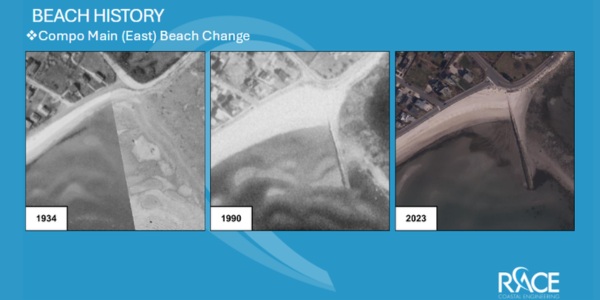
Erosion and storms have taken their toll on the beaches, said Parks and Recreation Director Erik Barbieri.
“Unfortunately, they are wasting away,” Barbieri said in the two-hour Zoom meeting. “The beaches are going away and we have address it…The beaches are one of Westport’s greatest assets and assets…need attention and they need investment.”
Azure Dee Sleicher, RACE partner and vice president of coastal engineering, ran through three potential solutions for “nourishing,” or replenishing the beaches with added sand. For four beaches – Compo Main, Compo South, Old Mill and Burying Hill – RACE explored three options. Restore them:
- to their 2014 condition;
- to a healthier state seen in a 1949 US Army Corps of Engineers report; or
- to a version between the first two.
For the smallest beach, Canal, they proposed two alternatives, one with a gradual slope and another with a steeper profile.
Projected costs range from $14.1 million if all the least expensive options are chosen to $54.5 million for all the costliest options.
Chris Tait, chairman of the RTM Parks and Recreation committee, said the project would benefit the town for decades.
“We have to remind ourselves this is a one-time cost for over maybe 40, 50 years,” and would likely be funded with bonds paid back over 20 or 30 years.
The session was not intended to reach decisions, but as another opportunity to involve the community in the discussion, said David Floyd, chairman of the Parks and Recreation Commission. Any proposed solution will be brought to several town boards and committees, including the Board of Finance, Planning and Zoning Commission and Conservation Commission, Floyd said.
He hopes to see construction on a chosen solution in late 2027, he said.
In the beach nourishment project, sand would have to be trucked in because the state and federal agencies are unwilling to grant permits to dredging sand solely for that purpose, Sleicher said. As an estuary, Long Island Sound contains sensitive areas not seen in open-ocean areas such as Miami or the Outer Banks, she said.
“For now, it’s just not on the table,” she said.
She noted, however, that the town is on a US Army Corps of Engineers list to be notified of dredging projects for other purposes, such as increasing navigation in a channel that Westport might be able to use.
She rejected an idea to reclaim low tide sand that had washed out, saying it was too silty and would wash back out. What’s more, state regulations do not allow it, she said.
“If you were able to get a permit to bring it back onto the beach…you would be doing it every year,” she said. “It’s just not going to last very long.”
Creating dunes was not a practical solution, she said, because the beaches do not have the space needed to support them.
“In order to be a dune, it needs to be out well above the normal range of the tides,” she said.
Two phenomena RACE’s plans did not account for were sea level rise and severe weather events such as 100-year storms and worse.
Sliecher said it is “futile” to try to design beach nourishment projects to withstand such strong storms. But she showed slides of breakwaters as another plan to protect beaches from waves. The issue with breakwaters, however, is that they are expensive and change the aesthetic of the beach.
Planning and Zoning Commission Chairman Paul Lebowitz, who raised the issue of the storms, said the project would have its limits without defense against them.
“Whatever you do, recognize that you’re doing it short-term,” he said. “Because in the end, Mother Nature does win.”
Find the Parks and Recreation Department’s Beach Resiliency report here.

Ken Valenti
A career journalist and lifelong resident of the New York City region, Ken Valenti has enjoyed decades of reporting local, regional and national news in New York and Connecticut. Topics of special interest are development, the environment, Long Island Sound and transportation. When not reporting, he’s always on the lookout for the perfect coffee shop or used book sale.











Recent Comments