
By Andy Brophy
The Representative Town Meeting voted 23-0 Tuesday night to approve $185,000 for a new Plan of Conservation and Development, but not before several RTM members criticized the Board of Finance for approving a lower funding request than initially proposed at the expense of more public engagement.
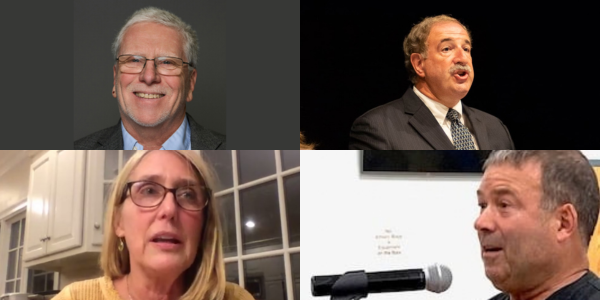
“The Board of Finance failed the community,” said state Rep. Jonathan Steinberg, who has represented Westport in the Connecticut General Assembly for 16 years.
Steinberg said the current Plan of Conservation and Development (POCD) was really 20 years old because it was not adequately updated in September 2017. “We cannot afford another half-assed effort,” he said. “We have really short-changed ourselves.”
Public engagement in creating a POCD was “critically important,” he said.
A POCD, which the state requires municipalities to update or create every 10 years, is a long-range planning document meant to guide a municipality’s land-use and housing decisions.
BFJ Planning of New York City, which has done work in Fairfield County for 40 years, initially wanted $250,000 to create a POCD for Westport by October 2027, but its fee was reduced to $185,000 at the expense of more public engagement, according to several RTM members.
Jennifer Johnson, RTM member, D9, said she was “very frustrated with the Board of Finance.”
“Not all plans are the same. This is our town plan,” she said. “I just think we all have to be a part of making sure our community is engaged.”
Matthew Mandell, RTM member, D1, said the town was about to battle the state regarding developments, and, referring to a chess game, he said the Board of Finance had laid down its queen before the game began.
He said the Board of Finance had practiced “penny pinching where it shouldn’t occur.”
“What a major mistake they have made,” he said. “The state is coming to develop our town, period … When the state starts to come after us to densify us, we want to make sure we do it the right way.”
Mandell was referencing a state law–PA25-1, formerly known as HB8002–that allows developers to build more housing than a town’s zoning regulations allow, if some of that housing is set aside as affordable housing.
Another state law, 8-30g, also attempts to facilitate affordable housing construction. An application drawing on 8-30g is currently before the town’s Conservation Commission and would also have to be approved by the Town Planning and Zoning Commission before construction could begin.
That application calls for demolishing one of two three-story, 60,000-square-foot office buildings at 55-57 Greens Farms Road and building a 250-unit residential development in its place. Thirty percent of the residential units would be set aside as affordable housing.
Another 8-30g application–for an 18-unit, 100% affordable development on Compo Road North–was filed last week.
But Jimmy Izzo, RTM member, D3, said the POCD “will do absolutely nothing to prevent development” and that Westport’s fight with the state should have taken place in Hartford a long time ago.
“Hartford, to Westport, is a bigger issue than Washington,” Izzo said, adding that “far left people in cities want to take our money and blow up our town.”
Steinberg said he wished the RTM could increase the funding request back to $250,000, but Jeff Wieser, the RTM’s moderator, said the RTM cannot increase a funding request by the town’s administration or Board of Finance.
Earlier in the meeting, Michelle Perillie, director of the town’s Planning and Zoning Department, presented slides about preparations for the new POCD, and the slide about public engagement included in the $185,000 funding request called for:
- A town survey.
- Five neighborhood topic-based sessions (topics were natural resources and coastal areas; business and economic development; connectivity and mobility; and arts, culture and community.)
- Online visioning tools, which consisted of idea walls that allow posting of digital sticky notes.
- Three or four “pop up events,” where residents’ opinions are solicited at places like farmer’s markets and Parent Teacher Student Association meetings.
- Two town-wide workshops.
- Stakeholder interviews that consist of gathering information and opinions from town department heads, elected town officials and community representatives.
After Tuesday night’s meeting, Perillie said while public engagement had been restricted, “I do believe there is enough.”
Perillie said the reduction in funding led to the cancellation of a charette, which is defined in an online dictionary as “a multi-disciplinary workshop where experts, stakeholders, and community members meet over several days to co-create actionable project solutions.”
Amendment: the updated version of this article refers to the state laws affecting local zoning decisions.

Andy Brophy
Andy Brophy is an experienced Fairfield County journalist. Andy was a staff writer at The Connecticut Post for 10 years. He also wrote for the Norwalk Hour, Fairfield Minuteman, Fairfield Patch and weekly newspapers in Westport, Fairfield and Norwalk. When not reporting, Andy enjoys playing chess and listening to pianist Art Tatum. .









Fiscal oversight is essential— But there is a difference between financial oversight and attempting to manage the Town from the Board of Finance table.
Since December 2025, we have repeatedly watched the Board of Finance scrutinize matters well beyond the simple question of whether an expenditure is financially responsible. At times, the discussion has drifted into how departments should operate, how projects should be designed or implemented, and what policy choices other elected or appointed bodies should make.
Spending money today prevents spending substantially more tomorrow. Deferred maintenance does not get cheaper. Aging equipment does not become more reliable. Infrastructure problems do not disappear because an appropriation is delayed.
Consider what has actually come before the Board: $3.329 million to replace eleven Public Works highway trucks, a study and design for a dilapidated Maintanence Facility already located on Longshore, disrupted by our chair acting as Planning & Zoning Chair rather than Board of Finance Chair, and now this. These are exactly the kinds of capital needs where delaying necessary work can simply transfer a larger bill to future taxpayer.
And Westport is hardly operating without fiscal discipline. The Town finished FY2025-26 with departments collectively about $595,000 under budget, while property tax revenue came in approximately $1 million above projections. Public Works alone finished roughly $707,000 under budget.
Question expenditures. Demand documentation\. Challenge assumptions. That is precisely what a Board of Finance should do.
oversight should not become administration, and fiscal review should not become a substitute for the judgment of the departments and elected bodies actually charged with doing the work.
Saving $1 today only to spend $3 tomorrow isn’t fiscal conservatism. It’s deferred responsibility.
Stay in your lane.