
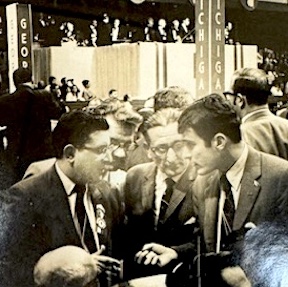
Editor’s note: Westport attorney Alan Neigher recounts being a campaign staffer at the tumultuous 1968 Democratic National Convention in Chicago, where 56 years later Democrats are poised to nominate Kamala Harris to be their 2024 presidential standard-bearer. The ’68 convention, in contrast with this year’s unified gathering, unfolded with sharp divisions among delegates in the convention hall while widespread disarray erupted in the streets as police violently suppressed anti-war protesters.
__________________________________________
It was rainy and cold the night of March 31, 1968, in Cambridge, Mass., and the tavern was full and smokey.
Joining friends at the bar, I’d been working in the legal department of a Boston corporation, but found myself longing for D.C., where I had worked in government two years earlier, right out of law school.
Many friends were working for President Lyndon Johnson’s re-election campaign, some for Robert F. Kennedy, who had just announced his candidacy in the wake of Gene McCarthy’s strong showing in the New Hampshire primary.
Somewhere in mid-evening, the TV over the bar showed LBJ addressing the nation from the Oval Office. He was speaking slowly, and as he did, the bar quieted down. More than a half-hour into the speech, the embattled president spoke these historic words: “I shall not seek, and I will not accept, the nomination of my party for another term as your president.”
The bar slowly erupted. RFK and McCarthy supporters were everywhere, and each in their own anti-Vietnam war sentiments, saw possibilities for their candidates.
More than a half-hour into the speech, the embattled LBJ spoke these historic words: “I shall not seek, and I will not accept, the nomination of my party for another term as your president.” The bar slowly erupted.
The stage was set for a tumultuous political year ahead, and a deeply divisive time for the nation.
When I went home that evening, phone calls began. Friends in the LBJ campaign were unshaken: Vice President Hubert H. Humphrey would be announcing his campaign shortly, they said. Come back to D.C.
I had always admired Humphrey, the “Happy Warrior,” who transformed a moribund Democratic Party into a vibrant coalition of Farm-Labor organizations that became dominant in Minnesota politics, joined by two notable senators — Walter Mondale and McCarthy. But the Vietnam war and HHH’s loyalty to LBJ, had relegated him to a back room in Johnson’s White House torn by daily news reports about the conflict and its growing toll.
The younger, vibrant progressives in ’68 were with RFK and McCarthy.
I slept on the offer (sort of). When I awoke, it came together: I believed Humphrey could better match up to Richard Nixon, the odds-on favorite for the Republican nomination. Enough corporate law. Two days later, I gave notice. Two weeks later, I was back in D.C.
When I returned to D.C., although Humphrey had not officially announced his candidacy, I joined the Citizens of Humphrey and United Democrats for Humphrey operation, and was assigned a small office to help with campaign research led by Stu Eisenstadt, a brilliant young lawyer who later became a key White House staffer for Jimmy Carter..
The assassination of Martin Luther King Jr. in April cast a pall over the campaign. Riots broke out out in numerous cities …
I subsequently was dispatched to various states — Delaware, Maryland, North Carolina, Virginia and Texas among them — to line up Humphrey delegates for the summer nominating convention.
The assassination of Martin Luther King Jr. in April cast a pall over the campaign. Riots broke out out in numerous cities, including Newark, Detroit, Chicago and New York. Rampant racial tensions, combined with growing anti-war, anti-LBJ sentiments among younger voters, and Nixon’s imminent nomination by the GOP, triggered a chaotic late spring and summer.
But RFK’s campaign was gathering steam, while McCarthy — whose strong showing in the New Hampshire primary was a factor in LBJ’s decision to drop out — took himself out of primary contention. HHH, however, had not entered any primaries and was relying on delegate hunters and state officials to line up support for his candidacy.
Humphrey traveled in the first week of June to Miami for Florida Democrats’ state convention, while the California primary — where RFK was expecting a strong performance — was scheduled that Tuesday.
We were exhausted from the day’s activities, and I was in my room ready to go to sleep when I got a call from our command center: RFK had been fatally shot in LA.
McCarthy dropped out of the race, leaving HHH as the party’s presumptive nominee amid a backdrop of violence and protests throughout the nation.
The Democratic National Convention, scheduled for the last week of August in Chicago, lay ahead.
Chicago Mayor Richard Daley had a well-known reputation for being a tough guy. More than any other large American city, Chicago bred a pugnacious type of politician that Daley embodied.
The California primary — where RFK was expecting a strong performance — was scheduled that Tuesday … I was in my room ready to go to sleep when I got a call from our command center: RFK had been fatally shot in LA.
He had prepared for expected disruptions of the convention for weeks, anticipating protests by groups such as the Black Panthers and the Student Nonviolent Coordinating Committee.
The Democrats’ convention was to be held at the Stockyards amphitheater, located away from downtown in the heart of the meat-packing district. It was rumored that Mayor Daley thought the Stockyards would be easier to ensure convention security than venues closer to Michigan Avenue.
The Humphrey team arrived days before the convention was to begin, and we soon learned the party’s anti-war factions were turning to Sen. George McGovern of South Dakota, a WW II veteran and outspoken opponent of LBJ’s policy in Southeast Asia.
But after meeting with various state delegations, we were reasonably confident that HHH would have enough votes to win the nomination on the first ballot. We had no idea who would be his choice for the second spot on the ticket.
On the convention’s opening day, I introduced myself to Sen. Ed Muskie of Maine, who was sitting alone. I introduced myself and he brightened when I told him that I had entered Colby College the year he became mayor of Waterville. We exchanged stories about central Maine. He gave no sign that he had any idea that within hours he would be selected as HHH’s choice for vice president.
Later, aboard a bus taking us back to the Hilton after the first night of the convention, we witnessed the first signs of chaos that would haunt the convention, and the campaign, until Election Day. Groups of young people on the streets were chanting anti-war slogans, surrounded by groups of police officers with shields and clubs. Closer to the Hilton, odors that haunt me to this day were in the air. Several protesters had decided the best way to get attention was to drop stink bombs in the lobbies of hotels where convention delegates were housed.
One campaign official, sitting behind me on the bus, remarked: “Mayor Daley has decided to temper sadism with brutality.”
The next day, there were more speeches in the convention hall and more protests throughout Chicago. (The movie, “Chicago 10,” provides vivid background about what was happening in the city’s parks and streets). Traveling back and forth to the amphitheater, we could see police with raised clubs and shields; at one intersection, we saw a group of protesters being pushed by police through a plate glass window of a store. Elsewhere, protesters were sprayed with tear gas.
One campaign official, sitting behind me on the bus, remarked: “Mayor Daley has decided to temper sadism with brutality.”
The unrest, violence and smells pervaded the next day as the nomination process for president unfolded between Humphrey and McGovern.
Those of us on the convention floor will never forget the lead speaker on behalf of McGovern’s nomination: Sen. Abe Ribicoff of Connecticut, a supporter of the anti-war movement. Ribicoff’s speech included the following, although not verbatim, essentially made this point: “… When George McGovern is president, we won’t have vicious police officers clubbing innocent people on the streets.”
Uproar ensued in the convention hall — mostly boos, but loud cheers from McGovern supporters. And there was the unforgettable image of Mayor Daley standing up, shaking his fist at Ribicoff and (reading his lips from a recording) clearly directing an antisemitic slur at the Connecticut senator.
Later, after Humphrey won the nomination, another noxious odor was evident wherever crowds gathered — mace. Combined with stink bombs and tear gas, it was a manifestation of the despair and futility that clouded convention week.
There was the unforgettable image of Mayor Daley standing up, shaking his fist at Ribicoff and (reading his lips from a recording) directing a clear antisemitic slur at the Connecticut senator.
Things appeared calmer the next day when Humphrey delivered his acceptance speech. Coincidentally, that day — Aug. 29 — was a special one for my family since it was the shared birthday of both my parents.
Humphrey was greeted warmly by the convention crowd, although many McGovern and former RFK and McCarthy delegates had already left. HHH gave a rousing speech, exemplifying the best of the Happy Warrior spirit that had endeared him — before the Vietnam War — to so many progressive Democrats.
After the speech, I snuck out to call my parents. When my father answered, instead of thanking me for the call, he asked: “Alan, have you seen what is going on in Chicago?” I said I hadn’t, having been inside the convention hall since mid-morning. He told me to turn on any TV news, and along with several colleagues, I located a set. What we saw took our breath away — street violence was engulfing city streets.
News coverage on all TV channels showed police clubbing demonstrators, peaceful and non-peaceful alike. Sirens and ambulances were everywhere. It appeared to the American public that Chicago was hosting a political event marked by unfettered violence and anger.
Coverage on all TV channels showed police clubbing demonstrators, peaceful and non-peaceful alike. Sirens and ambulances were everywhere.
We didn’t board the bus back to our hotel until much later that night. Fewer people were out on the streets then, but police vehicles, ambulances and fire trucks were everywhere.
Whispered conversations among Humphrey campaign staffers were filled with despair and uncertainty. How could the Democrats’ standard-bearer overcome the horrendous optics of these four days?
We went home for the Labor Day weekend uncertain of whether we’d be called back for the campaign. The early polls were discouraging — Nixon was leading by double digits in the states Humphrey needed to win. We had no clue then that in nine weeks Humphrey would lose one of the closest presidential elections in American history.
Alan Neigher is a graduate of Colby College and Boston College Law School. He has practiced entertainment and media law in Westport since 1980. He represents production entities, acting talent, authors and journalists. He has represented numerous news organizations in defamation, FOIA and newsroom subpoena matters. He served from 1992-95 as co-chair of the Connecticut Film Commission. He was president of the Fairfield Theatre Company upon its opening in 2004, and has served on the boards of the Fairfield Museum and the Klein Memorial in Bridgeport.



Recent Comments