

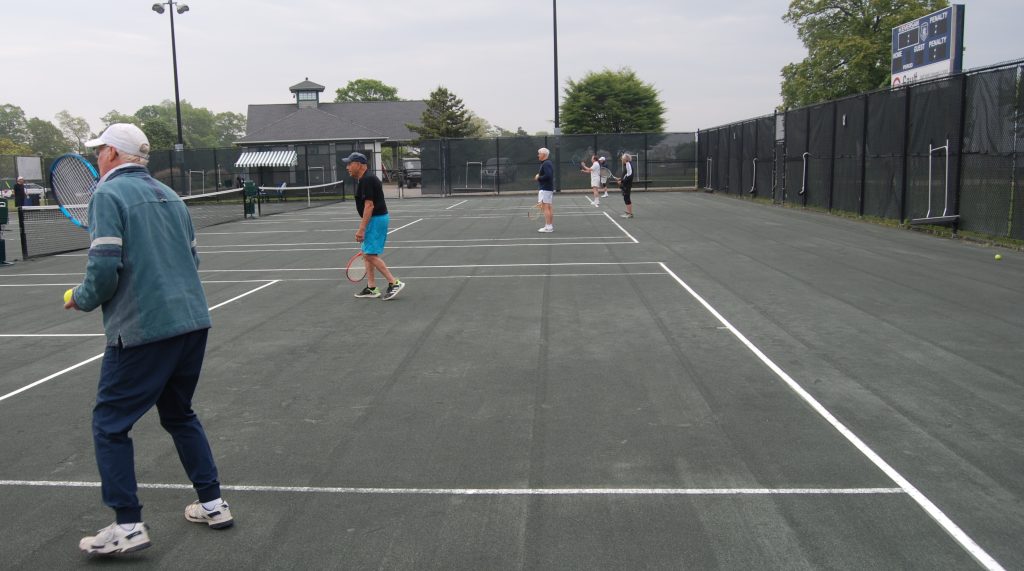
The Westport/Weston Y’s Men play tennis twice a week on The Longshore Club’s courts May to September. Many of them warm up beforehand to protect themselves from getting musculoskeletal back pain.
By Gina Zammit, on behalf of Nuvance Health
Let’s talk about one of life’s less pleasant inevitabilities: back pain. Back pain happens to about 80% of adults. Besides being a real pain, it can prevent you from staying active, which can take a toll on your family, work and social life.
I spoke with two experts who work right here in our backyard at the Neuroscience Institute at iPark in Norwalk: Dr. Scott P. Sanderson, a neurosurgeon, and Dr. Huma Naqvi, a physical medicine and rehabilitation specialist. They offered tips and recommendations for things you can do to prevent and manage back pain, no matter what your pain level or stage of life.
Here is a breakdown of how to prevent back pain and the steps to treating it.
What are the most common causes of back pain?
The most common causes of back pain are degenerative conditions of the spine and facet joint arthritis. As we age, the discs and joints of our spine can break down, and even tear.
“The aggravation of underlying degenerative conditions tends to be a tear in one of the discs, and it is excruciating,” says Dr. Sanderson.
These conditions can result in:
- Chronic soreness and stiffness
- Acute episodes where the back “goes out,” often triggered by a minor movement.
What’s the difference between musculoskeletal and neurological back pain?

It’s important for you as well as your doctors to know the underlying cause of your back pain, musculoskeletal or neurological. Dr. Sanderson explains:
“If the symptoms radiate to the leg, we tend to say it’s related to a neurologic issue.”
The two main differences can break down into the following:
Musculoskeletal back pain:
- Musculoskeletal refers to muscles, bones, joints, tendons and ligaments.
- Localized to the back.
- Usually relates to structural degeneration (discs, bones, joints).
Neurological back pain:
- Neurological involves the nervous system: the brain, spinal cord and nerves.
- Radiates down to the buttocks, thighs or calves.
- May involve numbness, weakness or bowel/bladder changes.
- Indicates possible nerve involvement or compression.

What can be done to prevent back pain?
Practice spine-friendly fitness habits
Fortunately, Westport is a highly active community. However, it is possible to have too much of a good thing. If you’re noticing pain after participating in physical activities, that could be a warning sign of an overuse injury. Stay active while considering incorporating friendly-back exercises into your routine.
- Spine-friendly exercises (when done with proper form): Rowing, biking and walking.
- Less spine-friendly exercises: Running (high impact), tennis, paddleball and pickleball (involve twisting, reaching, lunging).
Activities like tennis, which “involves a lot of twisting, arching, reaching and lunging isn’t an ideal back healthy exercise,” says Dr. Sanderson, “but it keeps you active and engages your core, so moderation is key.”
- Mindfulness. Activities such as yoga, Pilates and acupuncture all have a positive effect on managing back pain.
“We have a lot of evidence-based information on medical acupuncture,” says Dr. Naqvi. “It is a very effective holistic treatment.”
- Good posture. Sitting too long and poor computer positioning are major culprits in back and neck pain:
- Use sit-stand desks and avoid hunching over.
- Your monitor should be at eye level and directly in front of you — not off to the side.
- Avoid staying in one position too long. Get up, move around, and stretch regularly — just because you can sit all day doesn’t mean you should.
When should you seek medical care for back pain?
It’s important to seek medical care if you are having persistent back pain. There are some warning signs to look out for if you’re unsure, including:
- Nighttime back pain, especially if it wakes you up.
- Arthritic-type pain, including stiffness after sitting that eases with movement.
- Seek immediate attention if pain radiates down the leg or causes bowel or bladder incontinence.
As back pain results from back usage, the more you use your back, the likelier you are to suffer from back pain. And, as much as we’d like to decelerate the aging process, there are steps you can take to prevent back pain from occurring and to keep it from becoming debilitating.
“Age and your physical fitness play a big role in what your pain is going to be and what can be done,” says Dr. Naqvi. “So, I think a comprehensive and individualized program is a way to go.”
Nuvance Health Neuroscience Institute doctors and providers, including neurosurgery, neurology and physiatry, are located at a brand-new office at iPark in Norwalk. Learn more about the Nuvance Health Neuroscience Institute, now part of Northwell Health.
Nuvance Health, part of Northwell Health, has sponsored this content for Westport Journal. Visit nuvancehealth.org for more information.
For more health advice from Nuvance Health, check out these Westport Journal articles:
- Alcohol and Cancer: What Westport Needs to Know
- Nine diet hacks Westporters use to get back on track
- Westporter overcomes chronic pain, returns to active life
- How Westporters exercise in spite of seasonal allergies
- How new habits and medicine can help Westporters lose weight
- Embrace summer in Westport: Managing pain for active living
- Tips for staying hydrated, healthy and happy this summer
- What you need to know about breast cancer screening guidelines
- Keeping yourself and Westport healthy this Earth Day
- How Westporters can enjoy a healthier St. Patrick’s Day
- New ways to support heart health
- How Westporters manage stress sans alcohol
- Winter is here, time to exercise outside!





Recent Comments