
by Gretchen Webster
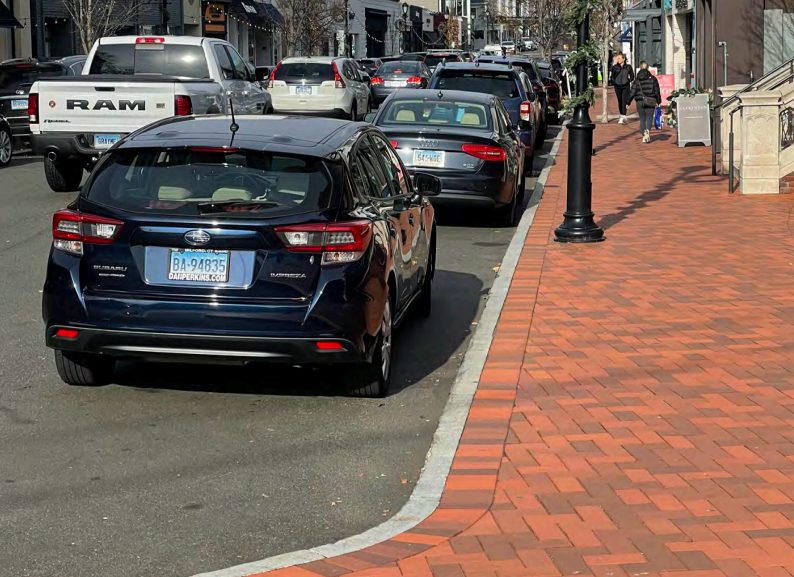
The Board of Selectwomen voted unanimously on Wednesday to adopt Phase One of the Downtown Parking Management Plan, which will limit on-street parking to two hours on Main, Elm and Bay streets and on Church Lane and Jesup Road.
Merchants / representatives protest
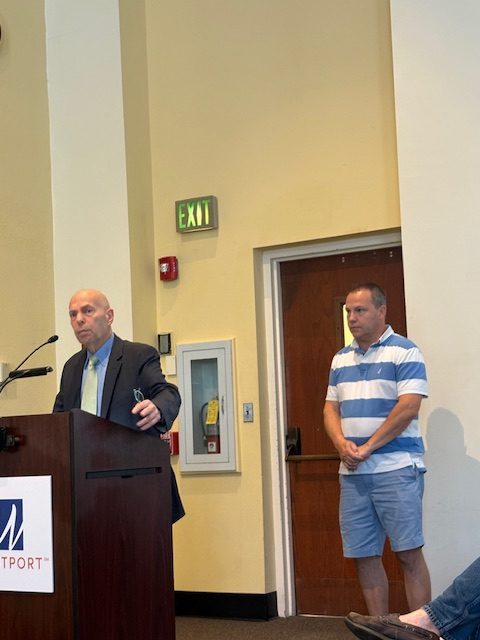
Downtown merchants and some RTM members attended the twice-monthly Board of Selectwomen meeting to protest the new limit. Randy Herbertson, chair of The Downtown Plan Implementation Committee (DPIC), assured the selectwomen that the plan will help, not hurt, parking downtown.
The new parking regulations will be under review for six months to a year, Herbertson said. Reducing the time limit from three to two hours will help increase turnover of customer traffic downtown, as the town’s consultant recommended, he said.
Only 8% of spots affected
The 115 on-street spaces affected represent only 8% of the town’s three-hour parking spaces downtown, Peter Ratkiewich, director of Public Works told the selectwomen.
The merchants speaking at the meeting had several complaints, but many focused on what they said is a lack of merchant input throughout the whole parking management project.
“Marginalized”
“I’ve been bewildered at this process from the beginning,” said Alan Cohen of ElixirSpa, 163 Main St. “Merchants who have a livelihood stake in whatever the outcome is, have been marginalized, sometimes labeled, because they opposed the plan. Why weren’t the merchants, from the beginning, one of the core resources?”
Patrick Jean, general manager of Nômade Restaurant said, “We’ve been set aside. You don’t hear much about merchants. You don’t hear much about employees … yet hundreds of people run through our business every week.”
Herbertson said the changes in parking limits for on-street parking are just “a specific, small part,” of the four phase Downtown Parking Management Plan put together by BFJ Planning, the town’s consultants.

Objective: better inventory management
The consultant’s review determined that the downtown parking crunch was limited to the core parking area in the town’s business district at peak times of the day and year, Herbertson said. Therefore, parking issues in Westport’s downtown are more a result of how use parking spaces, rather than a lack of inventory of enough spaces, the study concluded.
“Their recommendation was to try to encourage all-day parkers to move out of the core and provide more opportunity for short-term parkers – shoppers and diners – to park within the core,” he said.
The four-phase plan also includes adding metered parking in Phase 2, permit parking for employees in Phase 3, and building a parking structure in Phase 4 if the parking management strategies in the first three phases were not successful enough.
Representatives weigh in
Several RTM members spoke at the meeting, including Jimmy Izzo of District 3 who said, “I like the idea of trying this,” about the Phase 1 time limit change from 3 to 2 hours. But he thought that electric car charging stations in town should not be restricted to electric vehicles. “Leave those spots open to everyone,” he said. “Until we go permanently electric, these spots should be open.”
Jennifer Johnson and Sal Liccione, two RTM members from District 9, encompassing the downtown area, said that merchants should have been consulted more during the planning stages of the management study, and that residents who live downtown are also part of the parking equation. “There is a lack of real engagement with the merchants,” Johnson said.
But Matthew Mandell, a member of the DPIC and executive director of the Westport -Weston Chamber of Commerce said the plan may not be perfect, yet but, “The bottom line is we’re trying.” One of the first steps taken in the parking project was to remove all-day parking from the Parking Harding lot, he said, which has been successful in making spots in that lot more available.
Trial balloon
Taking the steps recommended in Phase 1 would be kind of a trial balloon. “Let’s try something and see it if it works,” he said. “Let’s give it a shot. All of us are trying to make a situation better.” Mandell also recommended adding a merchant to the DPIC.
Unanimous approval
All three selectwomen concluded that imposing the shorter time limits for on-street parking was a good first step in parking management. “This is an experiment that’s worth a try,” said Selectwoman Candice Savin, attending the meeting remotely.
Selectwoman Andrea Moore said that the various phases in the parking management plan were recommended by a consultant who had studied the issue extensively. “If we’re going to spend money and not use the information – why do studies?” she asked.
“I view this as the promise that we have made to the public including the merchants and the residents and visitors to downtown Westport,” said First Selectwoman Jennifer Tooker. “We promise all of you that we will continue to look at parking and make parking more accessible to everybody.”
Westport Journal’s recent articles on downtown parking
- DPIC recommends plan to improve downtown parking
- Westport Journal roundtable: Crowd explores downtown’s future
- Downtown planners wrestle with parking time limits, garage issues

Andy Brophy
Andy Brophy is an experienced Fairfield County journalist. Andy was a staff writer at The Connecticut Post for 10 years. He also wrote for the Norwalk Hour, Fairfield Minuteman, Fairfield Patch and weekly newspapers in Westport, Fairfield and Norwalk. When not reporting, Andy enjoys playing chess and listening to pianist Art Tatum. .







I have a question for Gretchen Webster the journalist or anybody else. What happened to the Fairfield Minuteman newspaper? All of a sudden it disappeared. That was an interesting newspaper.
Gretchen Webster
The Fairfield Minuteman and its sister newspaper, The Westport Minuteman, were acquired by Hearst Newspapers in 2017. The papers were merged, and then ceased publication shortly after, the fate in recent years of many community publications. The newspapers had been published for approximately 24 years.
That is what I thought. The Hearst conglomerate has bought out all the community newspapers from Greenwich to Bridgeport. They all print the same articles. The Westport News and Fairfield Citizen News used to be good papers that covered local news thoroughly. It is a shame that independent papers like the Minuteman are forced out of business by the Hearst monopoly.