

By Thane Grauel
WESTPORT — As part of the school district’s long-range strategic planning, a guest speaker came to town Wednesday night to share about his book and philosophy relating to government and the future.
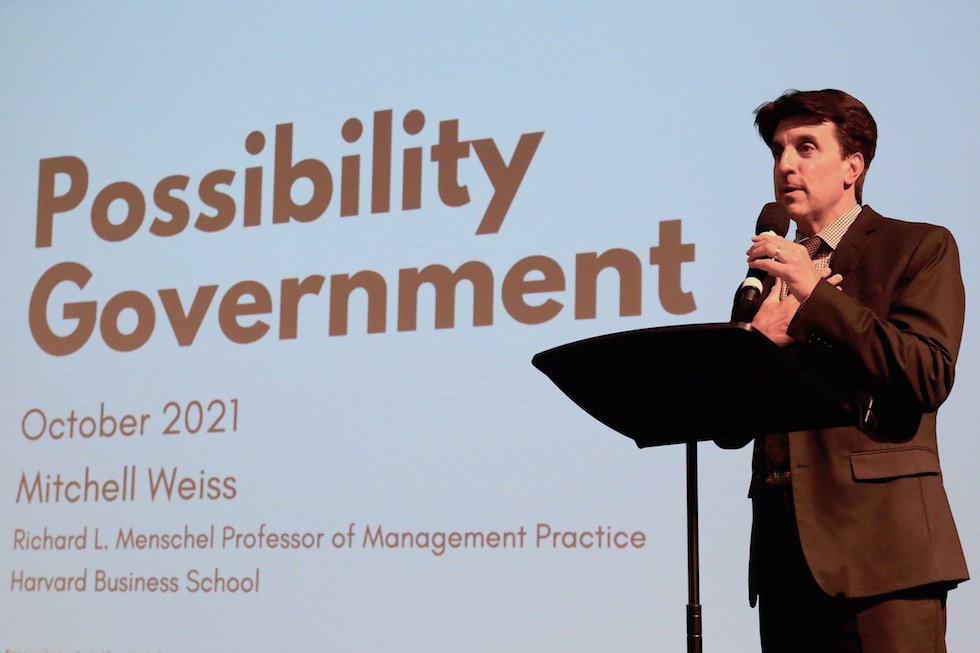
Harvard Business School professor Mitchell Weiss, author of the book We the Possibility, spoke at Bedford Middle School’s auditorium to a crowd of about 80 people, with others watching online.
Weiss’s philosophical talk centered on shifting from “probability” to “possibility.”
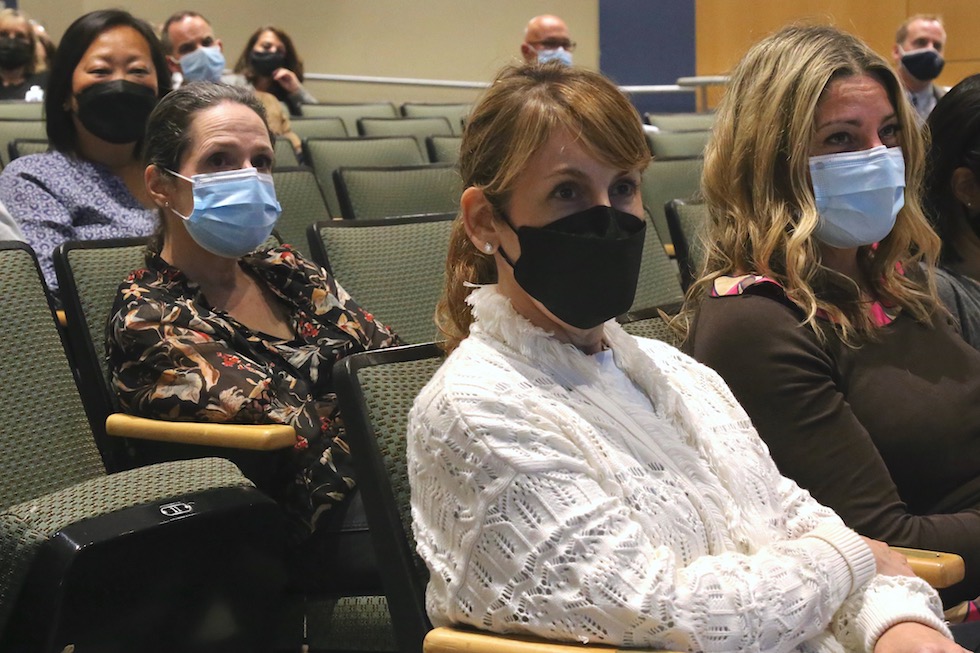
“Can we solve public problems anymore?” he asked. “If we shift from what I describe as mainly a mindset and skillset or probability government, (where) things will probably work but lead toward mid or mediocre outcomes (to) a possibility government.”
This, he said, is “where we do things that will only possibly work. Which means they probably won’t. Yikes. But that’s what it would take, I believe, if we’re going to solve problems anymore.”
Supt. of Schools Thomas Scarice indicated Weiss’s talk was relevant to the district.
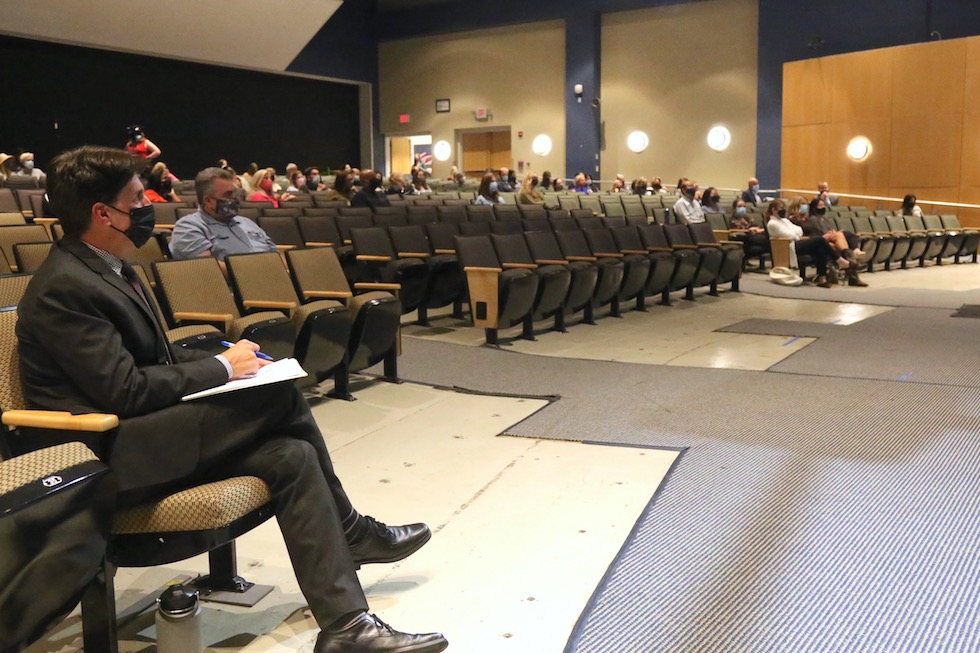
“As a school system that has had decades of success, this can be an inflection point in long-term planning, in what we do here — in how we serve our students, in how we equip them with the capacities, dispositions, habits of mind, ethics, to thrive in the world that they will inevitably inhabit as adults,” he said.
Weiss urged more entrepreneurial thought in government, and said the answer to some problems isn’t known until you’ve acted on them.
“The other question that looms large here, as we think about the future of your school system and your children, as we think about the strategic planning process — ‘What does the future hold?’”
“I don’t know,” Weiss said. “We live in a massive age of uncertainty. How do we lead in an age of uncertainty? How will they lead in decades and decades filled with uncertainty? In part, my answer is, with possibility government.”
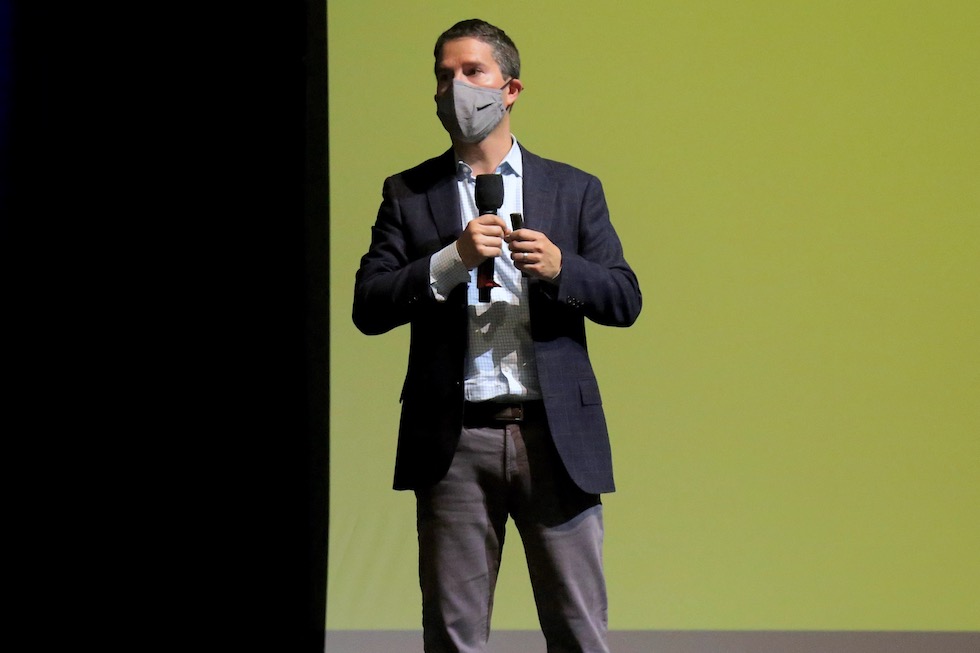
He said government is short on new ideas.
“Much of our public apparatus has become expert at basically making choices, deciding. And we’ve lost somehow the skillset that’s required to basically create choices,” he said.
“We’ve gotten too homogeneous,” he said, quoting a military procurement official who said, ‘What I need is not people who are expert in the past, I need people who are expert in the future.’”
Asked about his “homogeneous” comment, Weiss spoke about having more diversity, and including more people in a conversation leads to better ideas.
He gave a very old example of crowdsourcing for a solution, sharing the story of how an English clockmaker came up with the idea of creating a grid with longitudes and latitudes after the country had lost many ships at sea.
“Not somebody who’s expert in stars, not someone who’s expert in seafaring, (but) a clockmaker,” he said.
“When I hear the homogeneous piece, I think about the skillsets,” Scarice said. “If all of our kids come out with the same exact skillsets, pathways, and haven’t been drawn to where their passions are, in developing other kinds of skills, I think we could be underserving our kids that way.”
The last question of the evening was how do you envision “possibility government” working in this age of vitriol.
He said there are many reasons people have lost trust in government at different levels.
“I think instead of not working on problems and protecting the status quo, and sort of fibbing about the results when people are smart and they know, and then losing trust,” he said, “we’d be better off being clear about the problem that faces us (and being) honest about the results.
“I’m really hopeful and I think our next generation can help us here … We can maybe build back up trust again in our governments and we then can have the society we want,” he said.
A second summit is set for Wednesday, Nov. 10, at 7 p.m. in the Bedford auditorium. Christopher Bishop, a workplace futurist and Inside Quantum Technology official is the speaker.





Recent Comments