

By Gretchen Webster
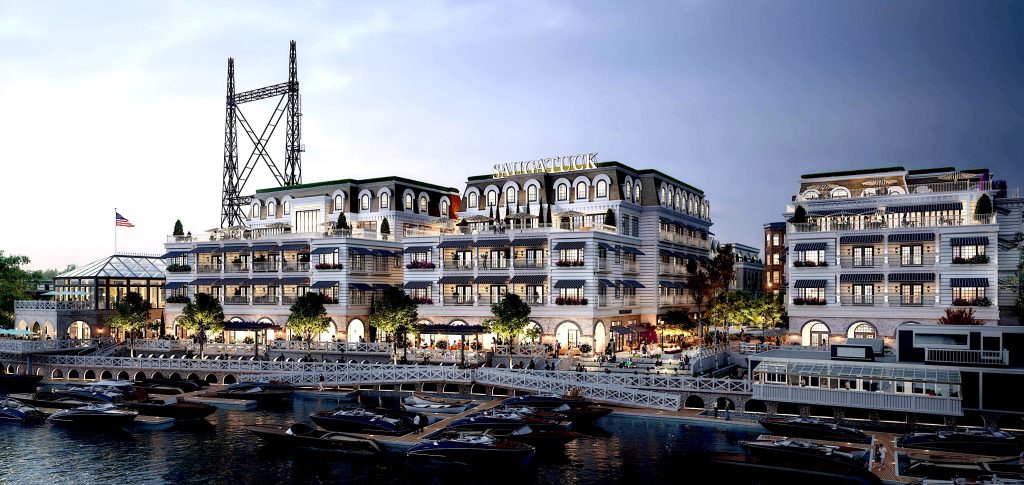
WESTPORT — The future of Saugatuck, one of the most historic sections of Westport, hangs in the balance as town boards scrutinize the “Hamlet at Saugatuck” plans to transform the area with a mix of residential, commercial and recreational buildings.
On Wednesday, a Westport Journal roundtable discussion of that project, attended by nearly 100 people, reflected a mix of views and questions about the complex application. Three panelists leading the discussion, held at Veterans of Foreign Wars Post 399, were:
Rodrigo Real, co-founder and partner of Roan Development Ventures, LLC, the Hamlet applicant.
Jennifer Johnson, a Representative Town Meeting member from District 9 and former co-director of the Westport Transit District.
Kathryn Braun, a Fairfield Town Plan and Zoning Commission member and founding member of FairPlan, an environmental nonprofit.
The roundtable was moderated by Journal publisher Doug Weber.
Developer: We listened to community
Calling Hamlet “a hospitality-anchored project that the community can benefit from,” Real began the discussion saying the development team has listened to the community’s concerns and scaled back the project’s footprint. “Our goal is to create a pedestrian realm,” he said. “We really think people are going to love it.”
He said he thought the applicants probably made a mistake by releasing renderings of Hamlet structures from a perspective that made people think the five-story buildings would be too high. “Our focus is on the pedestrian,” he said. The upper levels of the buildings “won’t be visible to the pedestrian.”

Not enough parking, too much traffic
Johnson, whose RTM district encompasses downtown, said she is concerned about a lack of additional parking provided under the Hamlet plan, which abuts the town’s main railroad station. Although Roan withdrew its plan to use one of the railroad station’s lots, there still will not be enough parking in Saugatuck, Johnson said.
“Access to Metro-North determines the property values here,” she said, and that includes both sufficient railroad station parking and a manageable amount of traffic to and from the station.
The number of parking spaces in the plan “seems very, very low for a project of this magnitude,” she added.
When Real described how the Hamlet project would attract tourists and out-of-towners, Johnson said, “I don’t see how that benefits the average Westporter.”
She did, however, agree that the developer’s plans for the riverfront, including an expanded marina, would benefit Saugatuck, if the plans ever come to fruition.
“The water informs everything we do,” Real said, adding that Roan has purchased two islands in Norwalk, which will become part of the project.
Braun, who is knowledgeable about the state’s controversial 8-30g affordable housing legislation, explained how the law affects communities that don’t want large, out-of-scale buildings.
Audience wants answers on safety, traffic, environment
When the discussion moved to questions from the audience, a range of different concerns about the project were expressed.
Sal Liccione, a District 9 RTM member, began with a question about the importance of more safety measures with the prospect of additional development in Saugatuck.
With more population and commerce in the area, another Fire Department ladder truck and police substation would be needed, he said. Emergency vehicles’ travel times to Saugatuck from the center of Westport or Norwalk could be too long, he added.
“It’s outside the scope of this project,” Real responded, adding that the town’s fire officials are reviewing the development plans. Adding emergency services could be part of longer-term planning, he added.
Dara Lamb, a leader of the Westport Alliance for Saugatuck, which opposes the project as it now stands, was concerned about what she feels would be a lack of Hamlet parking, particularly for employees of the proposed hotels, restaurants and other commercial outlets.

She estimated there could be as many as 700 employees at the Hamlet complex, creating a huge parking problem for commuters. “One of our biggest assets is our direct line to New York City,” she said, “and anyone — you don’t have to be a Westport resident — can buy a parking permit.”
Real’s response to Lamb prompted several attendees to shake their heads. The developers, he said, would require that no employees of Hamlet’s commercial tenants be allowed to park in the Saugatuck area. If an employee lives in Bridgeport, for instance, they would park at Bridgeport’s railroad station and take the train to Westport. Their jobs would be in jeopardy if they tried to park in Saugatuck, he said.
In addition to parking, traffic was another major topic of discussion.
Hamlet developers have said at various town meetings that they will upgrade Saugatuck’s traffic patterns that will resolve the currently congested conditions. That would be done, Real said, by coordinating traffic signals to improve the flow through intersections, and creating turning lanes, especially into the rail depot area. “All these taken together will make traffic better,” he said.
But several people in the audience weren’t buying it.
“I’m struggling to understand why we have to build this project to make the traffic better,” said Rick Leonard. “With the enormity of this project, to me, it just doesn’t make sense.”
Johnson agreed. “The [traffic] flow could be improved,” she said. “But it’s not by tweaking traffic lights. It’s the volume. It’s a volume issue.”
Braun said her review of the Hamlet plans raised concerns about groundwater contamination. The drainage system proposed by the Hamlet developers “will not cleanse the river,” she said. “I’m very concerned about the parking underground.” The Hamlet plans call for two underground parking garages with a capacity of 277 spaces.
The entire project “is too big,” Braun said.
Sam Levenson also cited concerns about environmental issues among other problems. “This is an unbelievably difficult project … digging down in the water to get to a contaminated site,” he said.
“These are amenities that will serve guests, but not Westport,” he added about the proposed hotels. “We have a disconnect with what will work economically for you and what will work for the quality of our life in Westport,” he said, which could negatively affect local property values.
Real, however, responded the Hamlet project “will increase property values in a dilapidated area of town. We’re creating a hub for the community.”
To see a video of the roundtable, CLICK HERE.
Other topics for future Westport Journal LIVE roundtable discussions include: Consider Weston, An Expert’s Guide to Summer in Westport, Westport Civics 101 and Fall Culture Preview.
Westport Journal LIVE is underwritten by the KMS Team at Compass.
_______________________________________
Freelance writer Gretchen Webster, a Fairfield County journalist for many years, was editor of the Fairfield Minuteman and has taught journalism at New York and Southern Connecticut State universities.








Great job Journaling
There are many many issues, some , if not more important than lack of parking, as important.
CONTAMINATION
To list a few, contamination, which surely residents would want adressed per the state regs.
State regs are strict. If you discover an underground oil tank on your property, it can cost as much as $500k plus to correctly remediate it. Compare a small oil tank with the size of these troubled sites.
PUBLIC SAFETY AND FIRE AND POLICE
As indicated at the meeting on Monday, density, public safety, which they suggest can be part of long term planning, yet if the density and building height should require a ladder truck in the vicinity as well as a new fire station to house it, and a new police substation, those are immediate needs. Those are a day 1 need.
And those must not be paid for by the tax payers.
After all it would be as a result of this far too large project that they are required.
I certainly have no interest in paying as much as $1 of my taxes to build a new fire station to house a ladder truck and a police substation. Not when the reason they are required is this project.
TRAFFIC AND RAILROAD PARKING FOR COMMUTERS
Traffic will not be alleviated by changing some light signals. Despite the feigned enthusiasm by supporters of this project.
There will be an inevitable knock on effect. When one light is longer, another will have back ups. And now we are talking about a deluge of cars especially at rush hour. And while commuters are trying to get home at night, the hamlet is anticipating patrons arriving to their many restaurants as well as the 23 existing restaurants.
That will be a traffic nightmare.
I drove past the train station at 7.30 pm on Tuesday. The popular lot across from rikos pizza- im not sure which lot that is, but it was still 70% plus full.
So at that time there are still many commuter spots unavailable.
Nobody seems to be talking about the patrons of these 40 establishments who during the day need to try and find parking to frequent the same 40 establishments.
The train station 3 and 4 years ago was hardly utilized because of covid. That was temporary. Sure it looked like there were 1300 available spots. But not any longer.
Commuters from surrounding towns as well as Westport use this extremely busy station to commute using the railroad.
They should not have to compete with the hamlets “24 hour” valet parking crew feverishly emptying their parking garage into commuter parking spots the moment cars arrive.
Our parking lots for commuters must not be treated to musical chairs games as the parking garage they plan with multiple valets, receive cars and immediately bring them back out to railroad parking to maintain availability at all times in the garage.
Same thing early morning. I have zero doubt their plan is to spend the early morning hours emptying their underground parking into choice railroad spots once again dis accommodating morning commuters.
It does not take rocket science to know what the plan is.
This development with 277 parking spaces in reality needs 1500 PLUS PLUS parking spaces.
Under current rules that only works at weekends when parking down there is a free for all.
The idea they would ask/expect/ staff to adhere to parking at surrounding towns railroad ( Norwalk is $13 per day) and take the train to Westport is laughable.
And the moment those staff start working at the hamlet they will all get parking permits, if there is no waitlist. And they will literally “hog” the commuter parking and they are not railroad commuters.
The town cannot discriminate and ANYBODY with a car, doesn’t matter where they live, can apply for a permit.
And let’s be frank, on top of what is likely to be far in excess of 1000 employees. Because existing businesses I presume plan now on their employees getting permits, at least if they do not I’d be surprised after all existing businesses employees can apply now, hamlets cannot for 3 more years, but where do they expect the patrons Monday to Friday 10am- 6pm to park.
HAIWATHA
Add to that haiwatha which is huge and certainly has not got sufficient parking built in, will be finished ahead of Hamlet and all their residents can apply for parking permits.
About the 40 retail spots 70% retail, 30% restaurant.
Just to hazard a guess that means 10 plus new restaurants and 30 shops.
Where are the guests parking to frequent those places ?
Typically at lunch time( Monday to Friday) it is one person to a car, not 2/3/4.
With the mix of retail shoppers and restaurant diners there is NO parking for them.
STATE OWNED LOT 7
And that is why they wanted lot 7.
To do the musical chairs game, of car arrives to parking garage, car gets moved immediately to lot 7.
Freeing up parking garage and filling a railroad lot.
And it will not only be into lot 7. It will be a “grab” any spot.
Constant shuffle, constant potentially dangerous moving of cars in and out. Adding to the traffic nightmare.
PLANNING AND ZONING
Nope this does not work and PZ members who voted on this text ammendment change allowed the developers to for want of a better word and in my humble opinion sell them on empty covid parking. And an outrageous FAR given. 1000 square feet to 1 parking spot. In what universe does that work for a busy railroad commuter hub.
FAR should have been directly tied to the development NOT availing themselves of our commuter parking. They should be required to provide adequate parking for the amenities in the development.
This mind you was all very vocally pointed out to PZ back in 2022.
It was also passionately presented to the RTM who should have overturned this.
This text amendment needs to be scrapped and a new zoning plan put in place.
What was presented in 2022 to dupe the “very few” residents who supported it then, was unacceptable and still too dense, and then to add insult to injury they come back with something denser, and of course far more profitable.
Is that so we are now duped into accepting the first plan ? With a sigh of relief ?
One would wonder if that’s the sneaky psyche.
PUBLIC OPEN SPACE
Since the text amendment was very specific, (adding 75% patio space allowable under PZ regs) I sincerely hope not a single chair or umbrella is going to be on public open space areas counted in the required square footage.
Restaurant patios are NOT public open space.
NARROWING OF ROADS
Adding no bicycle lanes but widening pavements of course amongst other things to create 75% patio dining space ( very clever, I must say) does not fool us.
No doubt that’s how they got the railroad place tenants on board, by suggesting getting rid of off street public free parking there, and widening pavements in order to accommodate dining patios. Widen the pavements in places there is not free parking and use their own land to do so.
And account in another parking plan for the over 150 spots which will be lost because buildings are now going on top of them.
Come back with a petite version. Gault height buildings in New England style with parking that makes sense.
“The developers, he said, would require that no employees of Hamlet’s commercial tenants be allowed to park in the Saugatuck area.”
I’m going to assume that Mr. Real is a smart person and he knows that this is a bold faced lie. The developer knows that were he to add this clause to the leases for all commercial tenants, then he would have no commercial tenants. No store, restaurant or hotel operator would agree to that clause. The labor market is tight enough and adding such a burdensome restriction would make hiring much more difficult.
Do better Mr. Real and don’t insult us with such nonsense.
The developers are looking for a reason to give PZ the excuse to pass this.
Such a good point John, these won’t be staff of the hamlet, they will be staff of the businesses who lease these 40 spaces.
If I asked my staff, not to mention – demanded of my staff that they had to arrive to work by bus or train my business would be closed in a matter of weeks.
It’s neither practical, nor enforceable, nor I suspect legal to tell staff they cannot park in the area, especially when, should there be no waitlist, they can simply buy a permit.
It would be illegal to stop them.
Presently most of the staff of saugatuck businesses park on the grounds of many of the building lots hamlet is going to own.
But as with the attitude they had towards a police substation, a new ladder truck and consequently a new fire station in Saugatuck being needed, as a direct result of their development, but that it could wait., I believe they are just hoping against hope that in 3 years we will have all forgotten.
And who will pay for that ? Us ? I should think NOT !
If this development gets scaled down and passed but requires a ladder truck and consequently a new fire house, that must be built first, and paid for by these investors.
Past area projects the fire Marshall weighed in on.
Wilton road and haiwatha.
Wilton road they said was too tall to fight a fire with our trucks.
Haiwatha too dangerous.
The hamlet is both.
Props to Rodrigo from Roan to sit in that group and take a berating.
So, I’ll ask this of the readers. Moving forward,
#1 What do YOU want to see in this area?
#2 Why?
And please, the more details the better.
Thank you.
I would like to see a remediated site. A gorgeous boardwalk with a few retail/restaurants not taller than 3 stories. On the upland I’d like to see scaled down retail/ residential with a green town square — green with trees and flowers and shrubs planted in the ground. I’d like to see the neighboring park/field ameliorated. A train-depot looking market for vendors would be great — think a small version of Detroit’s Eastern Market. Housing that accommodates both affordable and high end, and looks red-brick vintage.
No hotel. Build this for Westport, not for tourists.
Robbie
It is not so much that people want something different. It is the likelihood of failure that concerns residents.
Quite a few private equity prospects have done due diligence on the Hamlet and turned down opportunities to invest.
Remediation of brownfields is risky and could cost far more than projected.
Luxury hotels are not only market dependent but also subject to whim and fashion.
Development of the site depends on major civic upgrades to roads, sewage, emergency services, etc. none of which are up to the level of service required.
There are so many similar uncertainties…
In short, success could be elusive, Failure could be hugely expensive… to the Westport taxpayer. And nobody should be gambling with the Westport taxpayers’ money.
Werner who will pay for the civic upgrades ? The developer ? Or the tax payers ?
Thanks for responding Werner, I understand the fear of change. I am uncertain which civic upgrades you are referencing, as they are already in place, except for a firehouse upgrade in the slice which no one has suggested Hiawatha or the existing Sloat building needed one.
If this endeavor fails, the properties would be sold off like any other development and values would be adjusted accordingly. Please clarify how taxpayers would be impacted, and if your able, please address my question regarding what you believe this area should become.
No fear of change, here, Robbie. Healthy skepticism of politicians and developers who have promised the moon while us poor residents are swamped in traffic, chocked by pollution, and ignored when we want our voice heard.
Excursions to Betts Island and Little Cafe Pasture and a view of the Westport Sewage Treatment plant do not add up to the Hamlet being as desirable as Little Dix or Caneel Bay. A ferry skippered by a local captain to downtown Westport is not the equivalent of a Nile cruise to Luxor.
Westport was a destination when nobody knew it was a destination. The famous came here because Westporters treated them like everybody else. Equally famous to Paul Newman and Joanne Woodward were Esther Kramer, Julius Gold, and William F Cribari.
Marketers and developers can’t bestow cool because they’re the complete opposite.
I don’t begrudge anyone success but I don’t want their success to swamp me in traffic, let loose a flock of drunken drivers every night, endanger the kids at bus stops or crosswalks, impair the health of the elderly and vulnerable, or raise my taxes without benefitting me, my family, and my neighbors.
The Hamlet is Budweiser not Bordeaux.
Thanks for listening, Robbie.
Unfortunately, for some, it’s changing, whether Bud or Bordeaux. see you at the bridge meeting.
BTW. Long neck Budweiser from Purple Feet was Paul Newman’s go-to… though he and AE Hotchner were known to pair burgers with first growth Bordeaux.
I would like to see a remedsated site. A gorgeous boardwalk with a few retail/restaurants not taller that s stories. On the upland I’d like to see scaled down retail/ residential with a green town square — green with trees and flowers and shrubs planted in the ground. I’d like to see the neighboring park/field ameliorated. A train-depot looking market for vendors would be great — think a small version of Detroit’s Eastern Market. Housing that accommodates both affordable and high end, and looks red-brick vintage.
No hotel. Build this for Westport, not for tourists.
Thank for your response, Toni Did you review “Gottlieb” from some time ago? While it excluded the water lots, it was somewhat aligned with your vision, though it lacked affordable housing. Unfortunately, it proved financially unviable and was subsequently abandoned. Your vision seems to lean more towards a taxpayer-funded development. Was Eastern Market municipally funded? I wonder if the town would support such a plan. IF it were a possibility, all the issues of development would still lie ahead of us.
Robbie, Eastern Market is unique in that is is a public-private partnership, grounded in history.
IMO, The biggest challenge in Saugatuck is environmental remediation and a development that better comprehends the flood zone, traffic, transit hub.
Unless you are a Bill Gates or Michael Bloomberg with altruistic intentions, economic viability is important. But it is going to take a lot of creativity to do it right. The town can play a role in supporting – even helping to subsidize— the right ideas.
All of the discussions of density, traffic and parking pale in comparison to the very real possibility of economic failure. If people don’t buy the condos or stay in the hotels, who is on the hook for that? I agree that development of the area be consistent with classic New England architecture and not higher ( or much higher) than what is there now. Many residents have expressed opposition to the concept of Westport as a “destination”. We are not the Jersey shore or Coney Island or (God forbid) Atlantic City. We are a residential community whose property owners should be the main beneficiaries of the improvements.
As for the affordable housing component of the project, it is somewhat confusing to be told that if we don’t agree to this Hamlet we will get 8 30G instead but when I directly asked about that I was told this will not fulfill any affordable housing demands from Hartford and no answer as to what will. Despite much virtue signaling about the “need” for affordable housing I suspect that most expressing such open mindedness don’t want it near them. Affordable housing should be, quite simply, what you can afford. I have always lived where I could afford to live without the government subsidizing me. Many times that has been in marginal, if not down right blighted neighborhoods. It is your responsibility to improve your circumstances, not the government’s. The prospect of devaluation of Westport properties due to failed policies that have ruined communities all over the state is depressing to say the least. Affordable/ low income housing and poorly conceived developments will only hasten the progression of the decline.
Sharon, we get it. You think this is about “the poors” getting something they don’t deserve, while you have worked hard and lived simply.
You are ignoring the elephant in the room, that as this stands it will be wealthy developers putting the taxpayers on the hook for the success of their project which is currently a boondoggle. Just like every other developer in town, they use the threat of 8-30G as a bludgeon to get their way. You’re ignoring the forest for the trees here. You need to focus on the quality of life hit all of us in the area will take, caused by the profit maximizing overdevelopment that relies on taxpayers to subsidize the more expensive municipal services this scale will require. Development isn’t a problem, overdevelopment is.
Also, since this is a theme in every comment you make on posts… Affordable housing in Westport allows for income levels that start at $83k up to $123k for 1 person in Western CT. (https://portal.ct.gov/-/media/doh/2025-doh-combined-income-limits.xlsx?rev=343dacc4dce6453b8443e14ccdd67e62&hash=1F8979FAF1D8DB8D0C16AC0F72126983) you are yelling at the clouds in a misperception of what you imagine. Focus on the actual situation at hand.
I believe I said in this and other posts that the project is too dense and the condos and hotels too expensive vis a vis their ability to attract enough people willing to pay the estimated prices we have been told to expect. At previous P&Z meetings I have been told that police and other town employees probably are paid too much to even qualify for the 8 30G income levels. So we are not really sure who the lucky winners will be. The point is that one should not pay more than someone else for the same apartment. How is that fair? I know people who are paying market rates in such buildings and deeply resent the ones in their building that are subsidized. Whether you are in a low income housing project or a subsidized 8 30G you are receiving something you didn’t earn. BTW, at previous meetings of P&Z there was clamoring for “deeply affordable” housing to be part of Westport’s housing agenda. Don’t be surprised if that is in Hartford’s agenda as well. I grew up in NYC in a part where there is no forest or trees, just big ugly NYCHA housing filled with criminals and drugs.