
Editor’s note: Following is a statement by the Westport Alliance for Saugatuck, submitted in response to a recent opinion essay published for the ROAN Ventures development team about its proposed “Hamlet at Saugatuck” project.
____________________________________________
The Westport Alliance for Saugatuck thanks ROAN development for opening this discussion to the public, whose need for more information has been clearly voiced.

Unfortunately, the developers’ op/ed reads like a travel brochure. It lacks substance, specific data points and solutions our residents, P&Z and specific committees tasked to protect our community deserve. What follows is a detailed and substantive view of the problems we refer to in brief on the Westport Alliance for Saugatuck website.
- The developers made a proposal in 2022 whose scale, look and feel many were in favor of. However, problems still needed to be solved around parking, traffic and safety. The expectation was the developers would come back with thoughtful and realistic solutions to these concerns. Instead, the developers rewrote the zoning regulations, got them approved and increased their original proposal, yes, by 800 percent.
- Concerns around this proposal are a direct result of the increased scale and mass. They include:
- Increased traffic: Zoning regulations, including the new text amendment allowing for this development, clearly state any development must not have a negative impact on traffic. Note: The Traffic Peer review relied on traffic studies done and paid for by the developer during the pandemic. The peer reviewer was transparent that he would shortly have other business in Saugatuck coming before the P&Z. He posed many questions and concerns around the solutions proposed by the developer. Among other concerns, he repeatedly pointed out the Franklin Avenue garage entrance and stacking system as a potential cause of problems whose back-ups could cause tie ups on Railroad Avenue, Franklin Avenue and Charles Street.
- Traffic problems fall into two categories: Access and public safety.
- Access: Cumulatively, the traffic issues this development will cause are impaired access to Metro-North, educational, medical and the unique other resources of Central Westport merchants that will impact every Westport resident. To wrap your mind around the problem, imagine the Norwalk Italian festival occurring in Saugatuck every day of the week.
Residents in every district north and east of the station will experience mounting delays accessing Metro-North and the merchants of Saugatuck. District 1 residents will have decent access to Metro-North and Saugatuck, but these 1000-plus households will be effectively cut off from the educational, medical, arts and cultural and merchant/culinary resources that convince people to choose Westport over other communities.
Many have said they will dine and shop in Norwalk and points south. Some spoke about moving. This is sure to have a negative impact on Main Street, Post Road and the existing and future merchants of Saugatuck itself.
Drivers through Saugatuck now experience traffic delays of 20-30 min or more at peak times. Parents of school age children are terrified that should the development go through as planned, they could experience interminable delays getting to their children if an emergency arises at their school.
The developers’ own estimates include roughly 500 cars per hour will be parked/re-parked via the Franklin Street garage entrance during peak hours.
Anyone transversing Railroad Avenue (the southbound side) for drop-offs and pickups will be sitting behind these cars as they try to exit the area.
- Public safety: With only two main arteries for access to and from this area, District 1 residents are rightfully concerned that emergency vehicles could be delayed when minutes can literally make the difference between life and death.
Given the density of the proposed development, questions also remain as to whether future Saugatuck residents can be adequately serviced with current fire station equipment and the narrow streets proposed. Will the developer or the town take on the liability for a fatally or a life-changing disability resulting from delays in emergency vehicle access?
- The garage entrance for the hotel is located on a blind spot along the curve under the railroad trestle as Ferry Lane becomes Riverside Avenue.The developers propose narrowing Riverside Avenue, envisioning it as a pedestrian thoroughfare.
The thing is, it will still also be a vehicular thoroughfare. The potential for impaired drivers leaving the garage, after dark, after celebrating, causes great concern. Saugatuck has already experienced an increasing occurrence of automotive accidents, including a recent fatality.
- There are no bike lanes and/or other pedestrian safety options planned. Bikers and pedestrians along Saugatuck Avenue have already experienced safety incidents from road rage because of traffic back-ups due to construction. What will happen when this becomes an everyday occurrence?
- Event and truck traffic: In addition to increased traffic due to regular guests, weekday events of up to 300 people at the over 100,000 square feet of hotel event space will require large food service, laundry, refuse and other commercial vehicle access plus traffic from event attendees. It’s not inconceivable these truck movements could backup traffic on Ferry Lane extending all the way to Saugatuck Avenue, blocking RR parking and emergency service vehicle access.
- Reductions in commuter, resident and patron parking: There is no question this development, as proposed, has woefully inadequate parking. It lacks enough parking for its proposed residents and hotel patrons, without accounting for parking for large scale events.
To be viable, it relies on RR parking, which is against town regulations, relying on a covid era provision that can change at any time allowing free parking after 3pm in commuter lots. There are two problems with this:
- These lots do not belong to the town, they belong to the state and are leased to the town. The leases come up for renewal in 6 years but can be revoked at any time. The state of Connecticut has begun a process of re-examining its leases and how towns manage them. The state’s view, and we agree with it, is that these lots are for commuters. What happens if the state decides to revoke the town’s leases because it disagrees with the use?
- Once commuters are parked, very few of them leave at 3 p.m. In fact, most remain until 5, 6, 7 p.m. or later. Surveys of the parking lots in the last two weeks, even during school break, found they are almost full to capacity and the cars remain there until well after 3 p.m.
- Elimination of current free parking and usurping of permit parking.
The current site plan eliminates 42 free parking spaces and over 150 paid for surface parking spaces that commuters, restaurant and merchant patrons currently use.
The developers also plan to enter a long-term contract with the town to purchase at least 70 parking permits for their employees, thereby taking them off the market for Westporters. In addition, they estimate their development will have 650 employees, many of whom will need parking. Where will they park? More importantly, since any of the remaining 575 employees can buy a parking permit, where will commuters park?
Westport is blessed with a direct shot to Grand Central — a very attractive asset that helps maintain property values and the growth of our community. What happens when commuters can no longer reliably find parking and have to navigate through increased and unpredictable traffic tie-ups due to trucks servicing the hotels, banquet areas and event spaces?
- Environmental impacts: Although by no means a complete list, three major issues include:
1. The “wet” garage below the hotels at the river’s edge and below the water line
2. Flood water runoff
3. Need for close, technical supervision and highly skilled personnel to execute the brown fields remediation.
The “wet” garage: Although the technology of so called “wet” garages is well known, it’s expensive, complicated and relies on assumptions about the experience level of the developers and their ability to maintain it’s systems and structural components well into the future. Should anything arise that incumbers this development to thrive financially — a not uncommon occurrence in development, the town could inherit this responsibility. If there is no plan or ready expertise to do this, the impacts to the river and harbor we all recreate in could be catastrophic.
Even if successfully implemented, commercial garages built below the waterline can have several environmental impacts, including:
Groundwater disruption: Construction can alter the natural flow of groundwater, potentially leading to changes in local ecosystems. Dewatering systems may lower groundwater levels, affecting nearby vegetation and wildlife.
Water pollution: Runoff from vehicles, including oil, grease, and heavy metals, can contaminate surrounding water bodies if not properly managed. Inefficient drainage systems can exacerbate pollution risks.
Energy consumption: Maintaining waterproofing and dewatering systems often requires significant energy, contributing to carbon emissions.
Habitat loss: Building below the waterline may disturb aquatic habitats or wetlands, leading to loss of biodiversity.
Flooding risks: Improper design or maintenance can increase the risk of flooding, which may harm nearby communities and ecosystems
Flood water runoff: More cars, activity and density inevitably lead to less absorption of flood water runoff and the potential for more contaminants within it. As anyone living in Westport at or near sea water levels knows, flooding is not predictable and can even occur as “sunny day flooding.” To date, we have not seen a complete and viable plan for this.
Need for close, technical supervision during the brownfields’ remediation: A Hamlet supporter who spoke at the P&Z zoom meeting last month indicated that we’re making “a big deal out of nothing” in the brownfields’ remediation. He said it will just be a couple of weeks of excavators and trucks to haul away contaminated soil. We disagree. The development includes three areas which contain an untold number of feet of highly contaminated soil that need to be remediated.
While we welcome this area being cleaned up, our residents need to be assured this will be done right, not rushed through, and every safety precaution taken. The state awarded grants of up to $8 million for the remediation and their technical expertise could be used to monitor it. However, the awards and supervision would only occur if the developer agrees to build affordable housing on site — not off site as proposed.
Many questions surround this aspect of the development. The public deserves to know and understand the plan to keep the public safe during and after remediation.
Contaminants from this remediation could affect residents in the town and surrounding areas health and well-being well into the future. This plan needs to be completely revealed and assessed by experts before this project is approved — not as a conditional requirement.
- The veiled threat of 8-30g and massive redesign after 2022. According to many RTM’s who voted for the text amendment to increase zoning by 800 percent, the developer used the veiled threat of an affordable housing development (state regulation 8-30g) that could bypass town zoning to convince them, and residents, their plan was the best option to maintain control. There are several problems with this:
- Their plan does not solve or stall the 8-30g threat. In fact, it makes Westport’s 8-30g problem worse, leaving the town at the mercy of other developers who may demand even bigger increases. There are other properties in Saugatuck abutting this property that could still become 8-30g affordable housing.
The scale of this development is now closer to what could be built within 8-30g
This developer has no substantive plan for affordable housing. It has promised 14 off-site units, but hasn’t specified where they will be and has said they may be delayed up to three years from coming online.
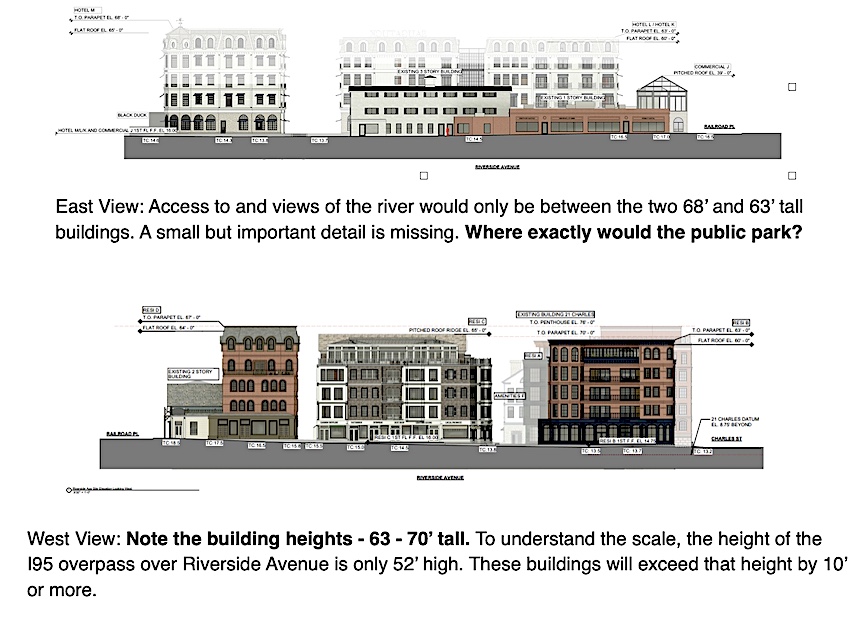
- Lack of open space, sky and access to the riverfront: At the most recent Architectural Review Board meeting, board members repeatedly asked for a scale model, but the developers refused. Board members said they could not “wrap their arms around” the ramifications of the development and questioned why the developers’ renderings did not offer views depicting the height of the buildings. After some back and forth, the board was able to get the developer to agree to provide street level elevations of Riverside Avenue.
Here they are:
- Viability of the project and the developers: Westport is blessed with a community of accomplished and successful residents, many with extensive experience in development, business strategy and marketing to high-end luxury consumers. Many question the underlying assumptions around this development.
The forecast room rate ($900/night) of the hotel rooms (located directly across from the sewage treatment plant) is more than twice that of the current average room rate of any other hotel property in Westport. The forecast selling price of the condos from $1 million to $3 million could be difficult to sell to high-end consumers — whose means give them unlimited choices — on a former brownfields site located at a train station with trains arriving/leaving every half-hour or, including Amtrack service, more frequently.
- Finally, our comfort level with the experience and expertise of the developers is hard to ascertain because of their limited track record.
Developments are always risky and not for the faint of heart. The ambition of ROAN is certainly laudable. However, experience has shown even developers with extensive experience and a lofty track record can be tripped up. Think South Street Seaport in Manhattan, where many small retailers and restaurateurs lost their life savings, or closer to home, Southport’s Village Green.
- Why should residents care if the developers’ dream doesn’t come to fruition and local investors lose their investment? Aside from being “a neighborly thing” to care, the town and residents have a very real stake in this development succeeding. Especially because it is so complex.
Although the developments above eventually were resold and redeveloped, the long periods of bankruptcy and change in ownerships presented manifold problems for the communities, merchants, city services and tax rolls. With this development, the town would have the added problem of ensuring the complex systems remain operational and don’t end up causing environmental and/or other damage.
- Who will pay the tab and keep the complex systems operating and maintained should the developer experience financial difficulties? Who will ensure merchants and other stakeholders don’t get hurt in the process? Who will pay for remediation of the river and harbor should contamination occur?
Sometimes, developers with the best intentions simply don’t know the community well enough to understand its needs and concerns.
As one of our Saugatuck residents with extensive experience in development put it “in any public/private partnership there is a period of open communication between stakeholders followed by changes to accommodate the publics concerns.” There is good reason for this on both sides.
In the final analysis, the developers want a successful, financially sustainable project they can be proud of and that offers returns on their investment. To achieve this, they need residents to support it — not turn their backs on it.
Town residents want a development that meets their needs, preserves access to the unique and important features and essentials they moved here for, and the sense of place Westport and Saugatuck offers.
As one resident put it in their petition comments “If I wanted to live in a place that was as dense and urban as Stamford, I would’ve moved to Stamford.”
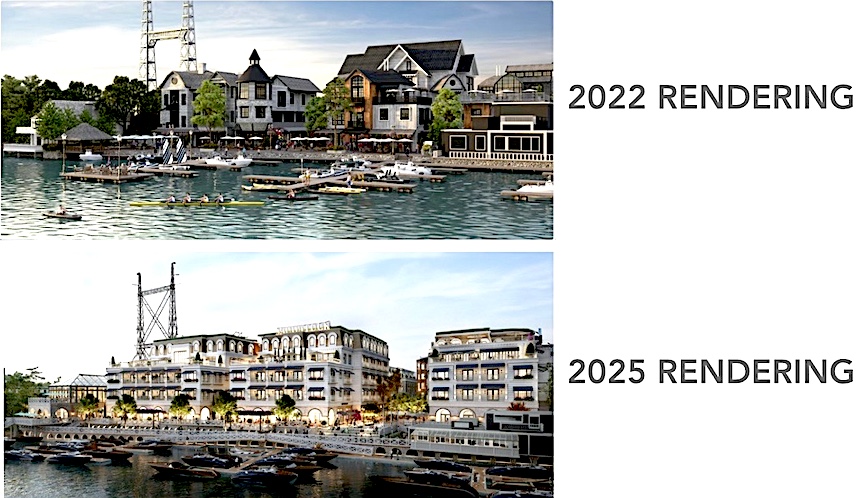
- Going from the proposed 2022 rendering to the 2025 rendering above says it all. A charming New England Coastal Village we could all enjoy and support to ensure its success, to densely packed urban hi-rise development that forever loses the “unique sense of place and soul” that Saugatuck and Westport are known for.
For more information, please visit Westport Alliance for Saugatuck.
Dara Lamb, on behalf of the Westport Alliance for Saugatuck
“A neighborhood association formed to urge smart development in Saugatuck”







In 2022 most of Westport was horrified by the decision of PZ to allow imho, the hamlet with whom 18 months of un transparent meetings had been taking place with many town officials who while remaining nameless should be ashamed of themselves for rewriting town zoning rules for saugatuck.
Of note the rtm voted 33-1 to uphold the PZ decision.
FAR OF 1000. -1
That means for every 1000 sq feet of retail space, only 1 parking spot was required.
Just to put that into perspective, a 3000 sq foot restaurant with an extra 75% seating allowed on outdoor patios.. would seat 200 inside, and 150 outside with a staff of at least 30 per shift on average, requires 3 parking spots.
380 people. At least 200 cars. For that 1 restaurant, the FAR requires 3 parking spots.
It is imperative folks understand these numbers.
There are 100,000 sq feet of non residential space so retail/restaurant from my understanding
That’s 70,000 sq feet retail, and 30,000 sq feet restaurant, bar, tavern and cafe.
Those 200 car parking spots for new restaurants alone is 2000. 3000 x 10 = 30,000 sq feet.
The remaining 70,000 sq feet of retail merchants with staff will require 500 car parking spaces unless they plan on being deserted.
That’s daytime 400-500 car parking spaces( staff and customers)
Let’s dispel the fallacy that staff will not be parking onsite.
In other words, by onsite they mean in their underground parking.. because all of their staff will be required to buy parking permits for using at the railroad.
Hamlet will not be valet parking their staffs cars.
By far the biggest argument 2 years ago during the petition to rtm to overturn this ammendment change was parking.
An rtm member had been told parking was “in the bag”. Not in those exact words but certainly that meaning.
That set off many letters to PZ and town about the legality of such.
We were all assured that the information we had was incorrect. The chief of police assured us that no such promise was made and that hamlet was given no such assurances. Yet attorney bernheim appears to say that the whole project hinged on that same “promised parking” that was allegedly never promised.
Quite confusing.
I’ll say !
This project which appears to have doubled in size, has every opportunity to build in its own parking.
And that need is 2000 plus parking spots.
But I have other concerns not just railroad parking.
57 keys. To what hotel rooms of what size?
Are they rooms, 250 sq feet with small bathrooms. Are they suites with adjoining rooms ? Are they going to be deeded in perpetuity as hotel rooms only ?
Are they going to morph into either long term leases or even apartments for rent ?
Did you know that to gain non resident status in Westport in summer, you need only rent/lease/book a room(s) for over 30 days and under 1 year to qualify for any and all parks and rec facilities( no exemptions) at a residents current rate.
That means golf, tennis courts, activities, camps, kids camps, sailing school- likely all organised by a concierge.
Won’t it be ironic when our own children cannot get into a camp etc, because some bored New Yorker tired of the Martha’s Vineyard commute leases a room at the hamlet for 31 days and has the same priveledges as a tax paying resident in this town.
I wonder how the golfers will feel when they cannot get a tee time and watch hamlet hotel guests heading out to tee off, at preferential times.
Or tennis games, or pickle ball.
It will be too late to do anything about it.
These are the towns regulations.
This project is twice too big, 2 floors too high,
It expects/needs railroad parking, and that’s simply not viable.
I was at greens farms train station this morning.
There were 15 available spots . That is a half of 1%. At 9am.
I’m not a commuter, but I used be.
I well remember the 5 year waitlist.
Paying what is now boat storage lot, $15 a day and happy if I found a spot.
Oh that lot is going to be gone because there’s an event space for 300 planned.. so we lose 60 parking spots and gain 300 person event facility that wants to use railroad parking.
This is insanity.
Not withstanding the 19 already existing restaurants in Saugatuck which already fill the railroad lots all except the south lot far enough away it’s a last choice when going out for dinner, now the proposal requires lunchtime dining parking, as do the other 19 restaurants, requires retail parking for copious numbers of retail stores staffed by I assume humans and not robots, all who drive cars.
It’s suffocating to think about these proposals.
Asking us the residents to give up curb side street parking and requests for narrowed roads, with ZERO bicycle lanes so hamlet can screw the residents over and not use their own land to widen pavements.
The list goes on and on and on.. traffic is reason enough to turn this down out of hand.
Affordable housing offsite,likely ghetto style IMHO, is not ok.
Handing out our commuter parking is not ok.
Bankrupting many of the 19 existing restaurants is not ok. :- and this should be part of planning … and zoning.
The hamlet is not ok.
Bottom line, end of story.
Just my humble opinion – of course.
Perfectly stated, Mary. Saugatuck should not be converted to Co-op City in NY. Town officials, committee and board members should be ashamed of themselves. There is a definite stink to this.
About 3, maybe 4, years ago Selectwoman Tooker stated that she wanted to make Westport a destination.
A DESTINATION? I realized immediately that we were in trouble.
Why? Why would our lovely little town need to be a destination for out-of-towners? For tourist income? We’re hardly lacking for funds here.
We’re a suburb – not a destination.
The 2022 rendering is in keeping with Westport. I know it seemed large at the time, and there were infrastructure issues with that proposal as well – but easier to figure out than what we’re looking at now.
The two concepts are so radically different that it makes me wonder if the new version is purposely outlandish just so that – by contrast – the public and the officials will sign off on the original plan without any pushback.
A silly thought on my part, of course … except that it’s a long used business ploy: put things into the contract-budget-bill-etc. that will give people easy targets to remove, leaving what the authors intended in the first place and which might otherwise have caused a problem.
The current proposal for The Hamlet is too big and unattractive.
A mini-city in a small New England town.
It doesn’t work.
Thank you to the Alliance for this clearcut explainer.
And, Amen, India.
.
The vision of Westport as “a destination” was horrifying the first time I heard the notion.
We are busting at the seams to provide proper and efficient services to our maxed out population now. We have a long and expensive capital projects list to fix ailing infrastructure just to support the status quo. We have no land to meet our needs. Traffic is a nightmare.
We need to focus on a greater quality of life for current taxpayers and residents of Westport. Let’s not become the Atlantic City of Connecticut.
What a mess for an amazingly beautiful town. Have people forgotten why we moved to Westport in the first place? I applaud this informative piece by the Westport Alliance for Saugatuck and support their efforts.
There is new news on the Hamlet project, relevant to everything above.
On Tuesday night, around 10 pm, Westport’s Architectural Review Board unanimously rejected the current Hamlet plan. Their opinion is not binding on the P&Z, but it certainly gives guidance to the commission’s members who will eventually vote.
I’m sure Westport Journal will soon have an article about Tuesday night’s meeting. But for now, here are some direct quotes I heard from all SIX of the ARB members……
– This plan does not reflect the text amendment
– Roan’s current plan is inappropriate for Westport
– The plan does not seem to provide the unified community development (that the developers say they are achieving)
– The buildings do not have enough variation in height and massing
– It’s a case of overdevelopment….and it will compete too much with the downtown Westport already has,
– The massing is just too tight
– It seems wrong and too urban to build eight 60 ft. tall boxes
– In terms of access to river and water, the plan is undeserved
– The Roan plan has allocation for up to 38 new retail stores….that is more than we have on Main Street now
– The alley ways between some of the buildings (that they call public space) will be always in shadows because buildings are too tall.
– These building should be 3 or 3 – 1/2 stories tall, not 5.
– And, the 800% increase allowed by the TEXT AMENDMENT was a mistake
Will the proposed hotel’s garage entrance really be in a blind spot along the curve under the railroad trestle as Ferry Lane becomes Riverside Avenue? That is insane. I drive around this corner almost every day, and I am horrified at the thought of a garage entrance greeting me as I carefully round this turn. A sign should state that “only people familiar with this road should be driving here.” I hold my breath if another car is coming from the other direction. I will guess this will become a regular “accident spot” if the plan moves forward. -P&Z, did you know about this?
The developers propose narrowing Riverside Avenue, envisioning it as a pedestrian thoroughfare. Is this a possibility? Can a developer change the width of a street they do not own? Again, P&Z, were you aware of this one?
Parking spots at 1 per 1000 sq ft? -P&Z, is anyone listening?
I live in Saugatuck Shores, and I know the town is required to be able to provide emergency services within a reasonable time. How will an ambulance or firetruck ever get through the congestion caused by a 300-person event during the day, when traffic is backed up because of an issue in one of the garages or because of an accident on I-95? The days when GPS rerouted everyone through Saugatuck over the Cribari bridge? Let’s not assume that CT-DOT will fix the timing of the traffic lights, as they have not yet done it in the 35 years I have lived here. -P&Z, what did you think about this?
How will my neighbors with school-aged children get to them when they have an emergency? Coleytown Middle School is our district’s middle school. It is far from Saugatuck Shores. If a parent needs to get across town to CMS for an emergency during rush hour, adding 500+ cars (ROAN’s estimate) will make what is already challenging impossible. P&Z, are you listening yet?
Oh yes, please remember to add the extra traffic caused by the Hiawatha Lane development. P&Z, can you plan a firehouse south of the railroad to save the 1,000+ homes south of the railroad?
P & Z, please consider all the issues the proposed plan will create for your constituents. We would all love to see Saugatuck updated. Look to the Gault development, which has added so much to the area; it is tasteful and beautiful with community space and access to the waterfront for all Westporters. Let’s make this a win for everyone. It has worked before; let’s do it again.
I was at the architectural meeting and it was virtually unanimous on the part of both the board members and public that they were not in favor of the project going forward. Two important things stood out….first the head of the board shared his displeasure with the P&Z decision to allow the latest plan to be 800% bigger, at the discretion of the developers (he seemed confused as to how this happened as was I and others) and second, one of the developers, in response to a question, said the entire project would be going up simultaneously. How do multiple ( seemed like 10 or more) 4 and 5 story buildings go up at the same time? Multiple construction trucks and cranes milling around Saugatuck for 3 years( their time estimate)? Since the 2022 proposal now looks so much better than this one, I fear should this too be rejected, what will a new one look like.