
By John Schwing
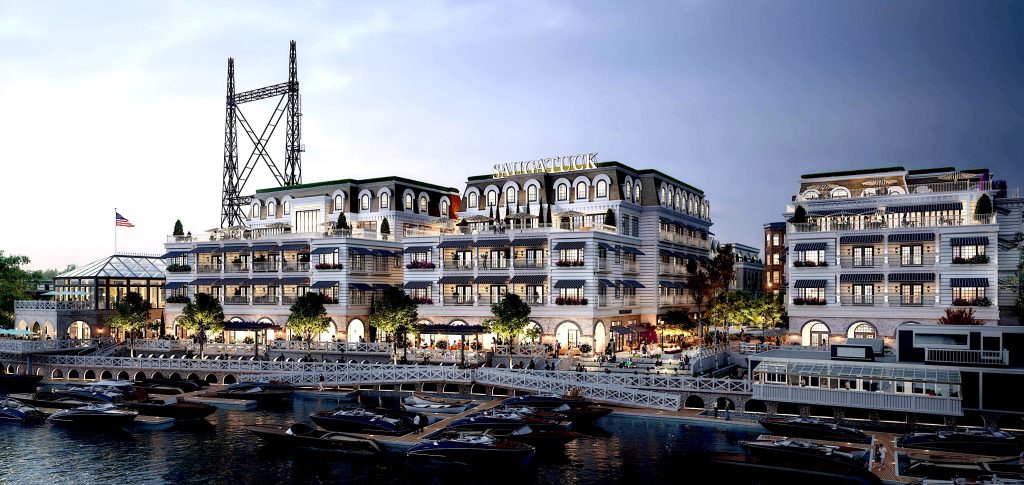
WESTPORT — Plans for a sweeping transformation of Saugatuck with a multi-story mix of retail, dining, residential, commercial, hotel and marina amenities were outlined Monday for the Planning and Zoning Commission and the public.
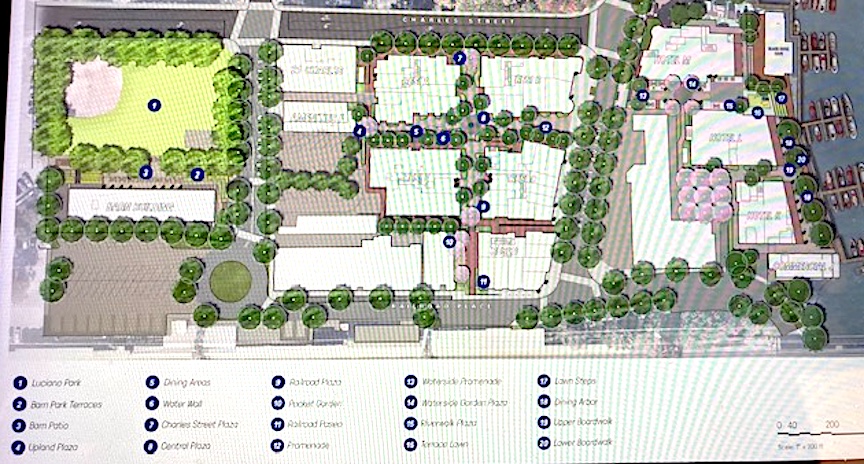
The four-hour, first look at the “Hamlet at Saugatuck” was a site-specific overview of the wide-ranging proposal to develop seven properties at the heart of the neighborhood bracketed by the Saugatuck River, Riverside Avenue, Charles Street, Franklin Street and Railroad Place, piggybacking on a text amendment approved by the P&Z for the area in December 2022.
Since then, the Roan Development Ventures team has been working on plans that, according to the narrative filed with zoning officials, will “create a welcoming, lively, sustainable and vibrant place along the Saugatuck Marina where people want to live, work, visit and explore.”
Cultivating support
The Roan team contends the application conforms with all requirements set forth in the regulations as defined by the text amendment.
The developers, who encountered critical feedback from the public ranging from skepticism to outright hostility when the text amendment was filed, appear to have been working hard to convince P&Z members that the project now has widespread public support.
As of Monday evening, at least 70 emailed letters had been filed with zoning officials commenting pro and con on the application. More than half of those letters register “strong support” for the Hamlet application using nearly identical wording, formatting and even typeface — a number from residents of Fairfield, Norwalk and New Canaan, and as far away as New York City, Atlanta, Newport Beach, Calif. and Denver, where two members of the same household urged the P&Z to approve the Hamlet application.
Seven properties, 11 buildings
The application currently before the P&Z does not encompass all the properties within the “Hamlet at Saugatuck” footprint, if the entire proposal eventually wins approval.
At issue, for now, are the following properties under contract for the developers to purchase if the application is approved: 601, 606 and 609 Riverside Ave., 2 and 16 Railroad Place, and 91 and 96 Franklin St. Not included at this point are: 21 Charles St., 40 Railroad Place, 36 Railroad Place and 611 Riverside Ave.
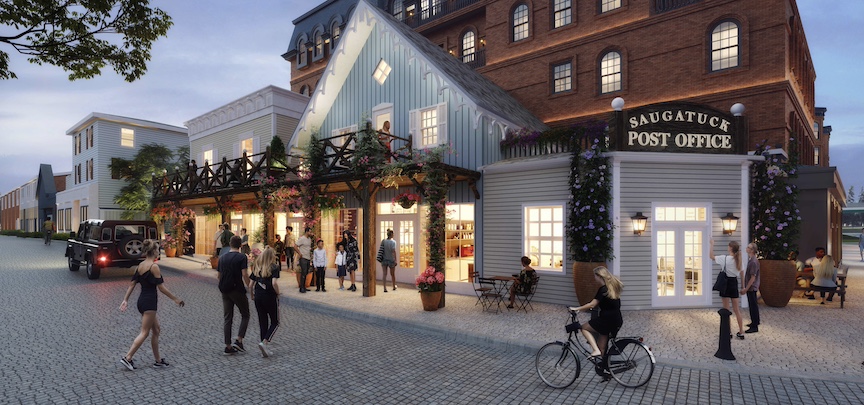
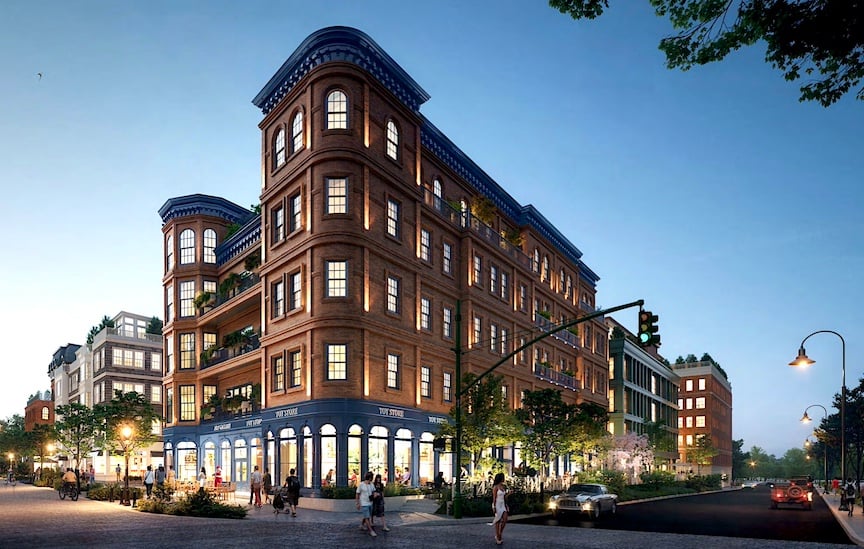
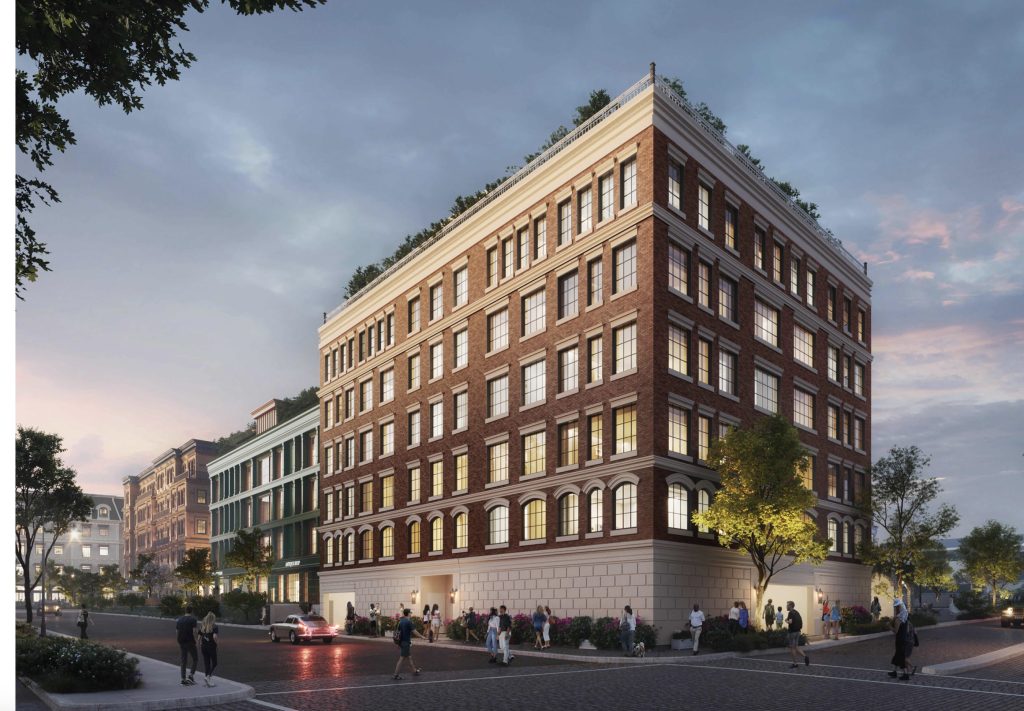
If approved, 11 buildings would be built on those properties, which according to Eric Bernheim, the developers’ lawyer, and several others from the development team, would reflect “a New England coastal aesthetic” using materials and design elements that mirror that tradition.
Roan’s application describes the area as “conveniently located and is accessible by boat, train, car or bike,” and contends the project offers the town “the opportunity to redevelop the integrated site as part of a cohesive master plan developed by one party with a mix of uses that will allow the integrated site to operate cohesively with, and without adverse impacts on, the remainder of Saugatuck.”
Read details of the development team’s application by clicking here.

Lots of moving parts
As a prelude to Monday’s meeting, P&Z Chair Paul Lebowtiz noted the proposal is a “rather large application … with a lot of moving parts.”
The commission’s review of the application would be broken into “digestible” parts, he added, so Monday’s hearing was devoted almost entirely to the developers’ presentation — including pre-recorded videos — while comments and questions were primarily reserved for future sessions. The P&Z is scheduled to resume its review of the Hamlet application March 24.
Next, the Architectural Review Board will take up appearance and design features of the project when it convenes at 7:30 p.m. March 18 in Town Hall.
Long road to a decision
Lebowitz recalled that approval of the General Business District/Saugatuck Marina amendment spanned five meetings in 2022, and said he expects the P&Z review of the current special permit and site plan will take at least as many sessions.
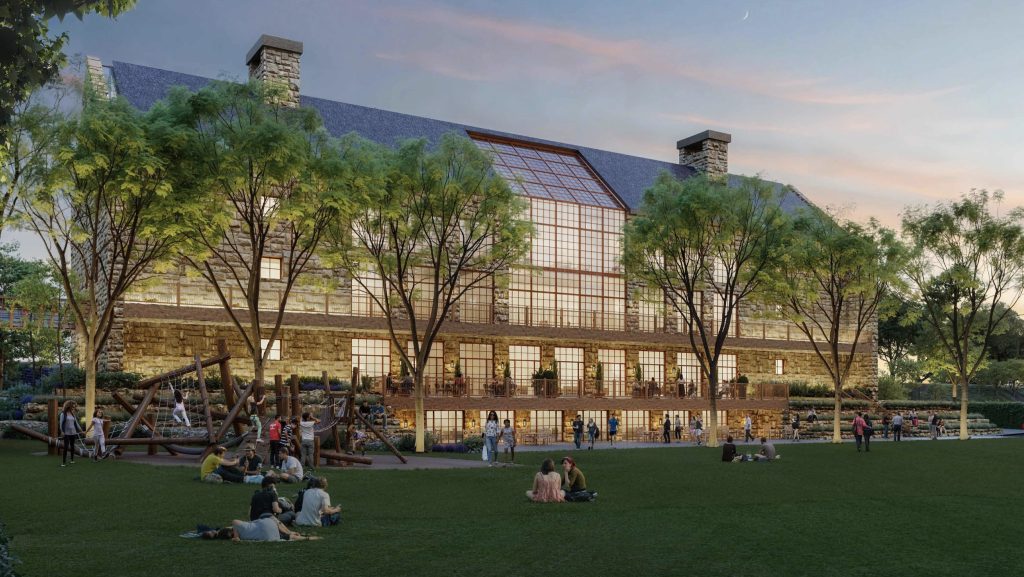

Bernheim led off the developers’ presentation saying that all the existing properties within the Hamlet footprint do not conform with zoning regulations, so prior to the 2022 text amendment the few redevelopment options would have been limited to 8-30g affordable housing projects.
He acknowledged the plans call for “taller” and “denser” structures permitted elsewhere in town, but comply with the GBD/Saugatuck Marina District regulations. In fact, he said, the proposal does not “max out” what potentially could be developed under the regulations in terms of height and coverage.
Redeveloping “rundown” area
Bernheim also argued the proposal meets the goals of the town’s Plan of Conservation and Development because it is a single, coordinated plan and not a patchwork approach to redeveloping an area that he labeled “rundown.”
Other benefits Bernheim and fellow Hamlet presenters argued would accrue include:
- Improved traffic flow through the area, which now is frequently choked by tie-ups particularly during the afternoon homebound commute.
- Underground parking in two garages with a total of 258 spaces, which he said would accommodate all parking needs for the project without adding to street-level demand. The garages would be operated with valet service.
- Enhanced waterfront access via a new riverside boardwalk.
- The project would take the contracted properties off the market for possible a “Transit-Oriented Development,” a concept for housing/commercial developments around transit hubs that has proven controversial locally because of state incentives and guidelines.
- The iconic Black Duck Café, sitting on a barge abutting one of the Hamlet’s proposed buildings, would remain as is since the property is not owned by the developers.
- There also would be pedestrian walkways and civic gathering areas.
- The development would not reduce any parking allotted in the area for the Saugatuck Railroad Station, he said, although 42 spots now used by commercial entities would be lost.
- The developers are willing to pay annual licenses for “overflow” parking in the town’s Ketchum Street lot, which Bernheim said is routinely underused.
The Roan Development team’s principals — Martin Purcell, Dan Suozzi and Rodrigo Real — introduced themselves in a brief video, but details of the proposal were handled by architects, engineers, landscape designers and parking/traffic consultants.
Traffic changes needed to “make this work”
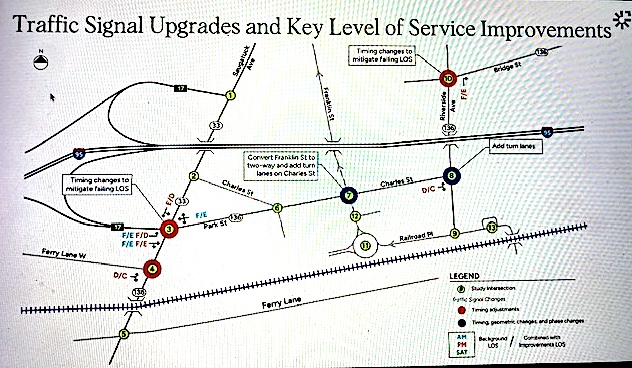
A series of traffic mitigation steps and upgrades proposed by the developers would not only improve congestion as it now exists in Saugatuck, but could also effectively handle extra traffic volume generated by the Hamlet, according to a consultant from SLR International Corp. Read that report by clicking here.
Questioned by commission member Neil Cohn, Bernheim said the cost for all the recommended traffic improvements would be borne by the developers.
Lebowitz noted the text amendment was approved with assurances from the developers that traffic upgrades would be secured — in many cases, with approval needed from the state — “or this thing does not work.”
Bernheim said that, so far, the developers have addressed only the first of three steps needed for traffic upgrades, the last of which can be secured only after local approvals are granted.
Also on the traffic front, the developers said they would adhere to Police Department recommendations that Railroad Place not be converted to two-way traffic and that Riverside Avenue not be closed during construction of a tunnel planned beneath the street.
Legacy of contamination
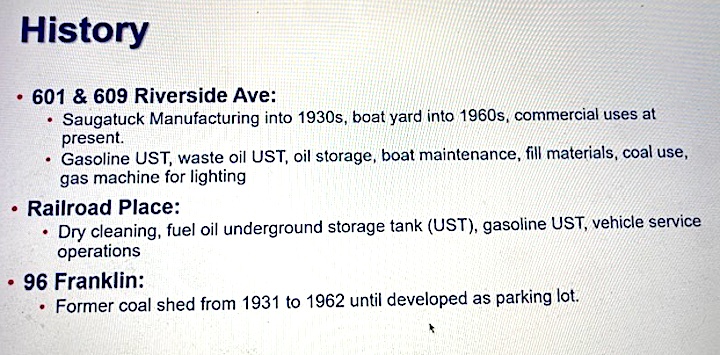
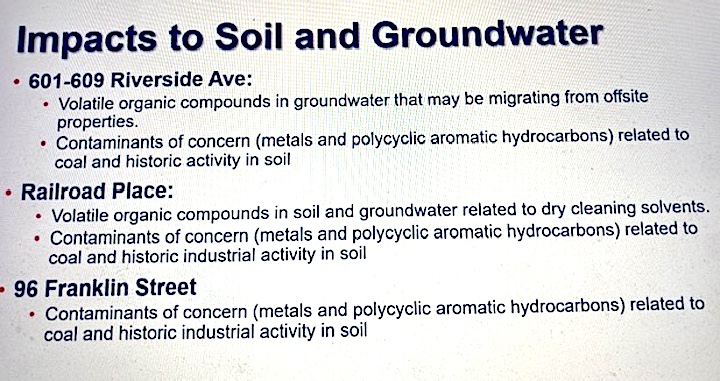
Environmental cleanup of several sites contaminated by earlier industrial and commercial uses will be required to comply with regulations set by the state and are not dictated by the town’s zoning code, Bernheim said.
A report on these issues, with a proposed remedial action plan to clean up the contamination, prepared by Loureiro Engineering Associates can be read here.
Bernheim added that because the project’s parking garages will be located underground, all of the contaminated soil will have to be removed from the property, as opposed to an above-ground parking scenario that would require only that contaminated soil be capped.
Accommodating affordable housing
Lebowitz also asked about the affordable housing component of the project, as required by the 2022 amendment approval.
Bernheim confirmed that plans still call for 25 percent of the Hamlet’s overall residential units — or 14 — to be provided off site within one-quarter mile of the Saugatuck Railroad Station. If the developers are unable to find 14 units within that radius, he added, then they will have to make space for affordable units within the Hamlet.
The meeting concluded as the chairman allowed several members of the public to weigh in with “high-level” questions that the developers are expected to address at the next Hamlet hearing.
John Schwing, interim editor of the Westport Journal, has held senior editorial and writing posts at southwestern Connecticut media outlets for four decades. Learn more about us here.







The proposed Hamlet project is too big for Saugatuck and inappropriately relies on public railroad parking to make the numbers work.
Specifically, as the developers outlined last night, they are looking to claim 40 spaces on Railroad Place and another 60 spots in Lot 7. They’re also counting on using Lot 1 “for event parking on the weekends and after 3PM.” They claim those areas can be simply used or perhaps leased from the Town of Westport. This is false: the Connecticut Department of Transportation (CTDOT), the largest landowner in Saugatuck, owns both Railroad Place and Lot 7; Westport is a lessee. And the State has a fiduciary duty to ensure those leased properties are used to facilitate mass transit, not subsidizing a glitzy private development.
You are correct Jennifer Johnson.
Who is going to enforce those rules ?
We all know that the state does not want to see railroad parking be commandeered by these ppl .
So ? What next ?
Who will make sure that the state doesn’t just turn a blind eye ?
We know how it is supposed to work.
But we also know the way it is being managed.. like it’s a private BFF fund !
If the goal is to make Westport look like downtown Stamford – they’ve succeeded.
The renderings are lovely … but these buildings are huge and inappropriate for Westport. And hotels plural? By the train tracks? And where will all these cars go? We think we have traffic issues now – just wait! We keep developing without doing anything about our infrastructure.
This makes me so sad.
Is it the twelve foot high letters (why not neon?) that promise to light the sunset sky through the wee hours of the morning for the Westporters who reside on the east bank of the Saugatuck River?
Is it the flotilla of speed boats who will intertwine with the kayakers, paddle boarders, and rowers on the narrow, still-undredged waters of the Saugatuck?
Is it the try-again continuation of failed luxury hotels ( the last being National Hall where Bill Clinton slept!)?
Is it the possibility of enjoying sleeping, dining, gathering, strolling, shouting, weaving, or sitting in traffic, basking in the the noise and exhaust pollution of America’s most congested traffic corridor?
Is it the reawakening of the legend of Westport’s illicit houses of pleasure (The Penguin!) or the hedonistic antics of famous Westport sybarites (F. Scott Fitzgerald and Zelda!) or the breath-taking possibility of piling into our own “Event Barn?”
What is it that makes The Hamlet such an ideal “destination” and yet so repulsive.
Again. This project is was too dense and way too tall. It belongs in Stamford.
I watched the developer’s latest presentation to the PZC this week with the best of intentions. I kept asking, “How is this very dense, very intensified, very complicated proposal going to make Westport a better place?
The developers refer to this tiny riverfront piece of Westport as “the last strategic piece of property in all of Connecticut.” I can’t disagree with that. But …
PZC Chair Paul Lebowitz called on Commissioners for their initial thoughts on this, the first overview, of The Hamlet at SAUGATUCK (all caps).
I have a few initial thoughts which I will relay to the PZC:
The development is so over-the-top for its location as to beg for a raison d’etre. It tries to cram high end residential quarters and private amenities with costly public quarters such as three hotel buildings and a problematic and costly paid-parking solution.
The architectural schematics and themes are absolutely lovely. The landscape architectural drawings are magical. Enchanting marketing-speak is infused in the presentation, their website, and their new magazine. It’s a beautifully crafted concept.
Yet I can’t see it as adding value to life in Westport for residents, such as myself (a 25-year resident).
As a former resident of New York City for many years, I resisted trips to Times Square. And, I don’t want a Times Square in Westport.
I suggest something far more modest; less problematic from a traffic and parking situation; and with a greater focus on serving the residential sector. A boardwalk. Some retail, residential, and a marina all sound great. Affordable housing units there would be fabulous. Buildings that are shorter in stature and far less dense. A better ball field next door.
These are just a few ideas from my personal vision for a better Westport.
A foundational challenge faced by this developer and its still undisclosed investors, was how to frame their venture as being something other than what it is, in a manner that conjures up a bucolic vision in the minds of those being impacted.
Describing something as exactly what it isn’t, is an elementary marketing tool used to deceive an unsuspecting public. An advertised description need not be accurate, nor make its assertion true.
For example, “11 tall and dense buildings that would reflect a New England coastal aesthetic” is an oxymoron stated to intentionally to fool the listener. For full disclosure tell us: Exactly which New England “hamlet” will these structures be emulating?
Furthermore, even designating this venture from the very outset as being a “Hamlet” is a public relations ploy to intentionally and continuously beguile the public – by subliminally conjuring the antithesis of the reality it’s intending to cameflauge.
For generations by definition Saugatuck has been a true “hamlet”, and by definition this proposed project is anything but.
Clearly, Saugatuck does not need these developers to define its identity. And intentionally choosing a misapplied label lends zero credence to this proposal; and if anything it establishes a foindational mistrust of those knowingly engaged in such deception.
“The McHAMLET in Saugatuck” is a more accurate descriptive; but even that is unbefitting to what this actually is: a large hotel & resort complex better suited to a city rather than a small Southern New England Town whose historic character will be forever eradicated.
Choosing a more applicable name, such as “The Saugatuck Resort & Spa”, would have accurately framed the conversation. That would have been refreshingly honest… as would releasing a list of all those who have a vested financial interest in seeing this venture approved, as well as having any relationship to individual(s) or entities that submit letters (or provide testimony) in support of this project.