
By Gretchen Webster
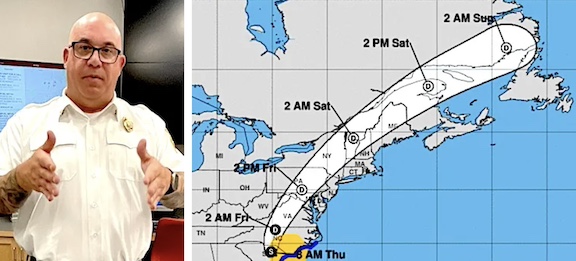
WESTPORT — Although southwestern Connecticut is forecast to escape the full force of Tropical Storm Debby as it heads north Friday, officials say it’s a warning to prepare for “above-normal” activity in this hurricane season that’s only just beginning.
The National Hurricane Center, which has been tracking Debby as it wreaked havoc with downpours and flooding in the Southeast, predicts the storm may still unleash heavy rain and potential flooding in this area Friday, but its core has shifted westward.
But the hurricane season, as measured by the National Oceanic and Atmospheric Administration, this year potentially could record an 85 percent above-normal number of storms through Nov. 30.
Westport, however, is ready for the possible onslaught, according to Fire Chief Nicholas Marsan, who also is the town’s emergency management director.
To ensure townwide preparedness for severe storms, the Fire Department has launched a public awareness campaign. Marsan, sworn in as Westport’s fire chief one month ago, has been the town’s emergency management director for a year, and has a master’s degree in emergency management and public administration from Sacred Heart University.
The demands of preparedness have changed for municipalities over the years, and storms aren’t the only emergencies towns may face now, Marsan said in an interview this week.

It’s now necessary for him — and all town and state officials — to consider what he calls “the horrible what-ifs” in emergency management, including active shooter events and cyber attacks or outages, such as the CrowdStrike system failure that shut down computer networks worldwide last month.
At Westport’s emergency center in Fire Department headquarters, a large screen looms in the front of the double-locked room. Phone lines are available to “all applicable departments” in an emergency including police, fire, emergency medical services, Eversource power company, Department of Public Works, the first selectwoman’s office, finance office, Red Cross for shelter operations, Human Services Department for family reunification and others.
“We could even have a remote meeting with the governor,” the fire chief said pointing to the large screen.
Westport is also connected to emergency operations of neighboring communities, with resources at the regional and state level when necessary for larger-scale incidents, he added.
The purpose of the classroom-sized room during emergencies is not only to connect all needed town agencies, but also to provide an organized system to take and respond to the numerous calls for help that come in from residents during a weather or other emergency, the fire chief said.
“Every year we review our emergency operations plan,” Marsan said, including equipment, response and recovery systems and emergency funding for severe weather or other types of emergencies. These could range from natural disasters, such as a hurricane or tropical storm — the most common severe weather events in New England — to tornados or earthquakes, and any other natural or man-made disaster.
Hurricanes, like Gloria in 1980 and Super Storm Sandy in 2012 which caused widespread damage, can be disastrous. Even heavy rainfall, as is in the forecast for this week, can trigger emergencies from major flooding and uprooted trees.
“When the ground becomes saturated, we’re going to have trees and heavy branches come down,” Marsan predicted. Wind is another major factor that can affect the entire community, he said, plus storm surges affecting properties on the shoreline.
But like the town, individual residents and families can be prepared for weather and other emergencies by taking precautions, the chief said.
Most important is for residents to sign up for alerts circulated through Nixle, an emergency notification system that provides immediate warnings and information during an emergency. The system will not inundate the receiver with messages, but “Nixle allows us to report to the users when there’s an immediate threat,” the chief said.
Residents can sign up with Nixle for online notifications or notifications sent to a mobile phone or landline phone at www.nixle.com or by texting the number 06880 to 888777. The National Weather Service also offers Severe Weather Alerts, with instructions here.
Marsan also offered a comprehensive list of precautions people can take to protect themselves, their families and their property in case of a hurricane, tropical storm or other threatening events:
- Trim trees to remove loose branches, especially near the house.
- Collect water for family members. One gallon of water per person per day is recommended; also non-perishable food items.
- Have prescription medications, a first-aid kit, a flashlight and batteries ready.
- Other things to supplement basic needs could include fuel for a generator; pet food and a crate for pets. Shelters will not accept un-crated pets.
- For communication purposes, fully charged mobile phones and remote power packs to keep them charged are recommended.
- Every household should have a communication plan, including a regular check-in with someone somewhere else “so they know you’re okay.”
- If a home is in an evacuated area, important documents including driver’s licenses or ID, passports, and insurance documents, should be ready to take with you.
- Move vehicles from flood-prone areas.
- And, if possible, check on neighbors, especially the elderly, to be sure they are safe, the chief said.
With planning on the personal and town levels, “we can keep problems from being prohibitive,” the chief said.
The town has prepared an Emergency Preparedness Quick Guide, which will be mailed to residents and will be available, along with other emergency information, on the Emergency Management page of the town’s website.
Freelance writer Gretchen Webster, a Fairfield County journalist for many years, was editor of the Fairfield Minuteman and has taught journalism at New York and Southern Connecticut State universities.














Recent Comments