
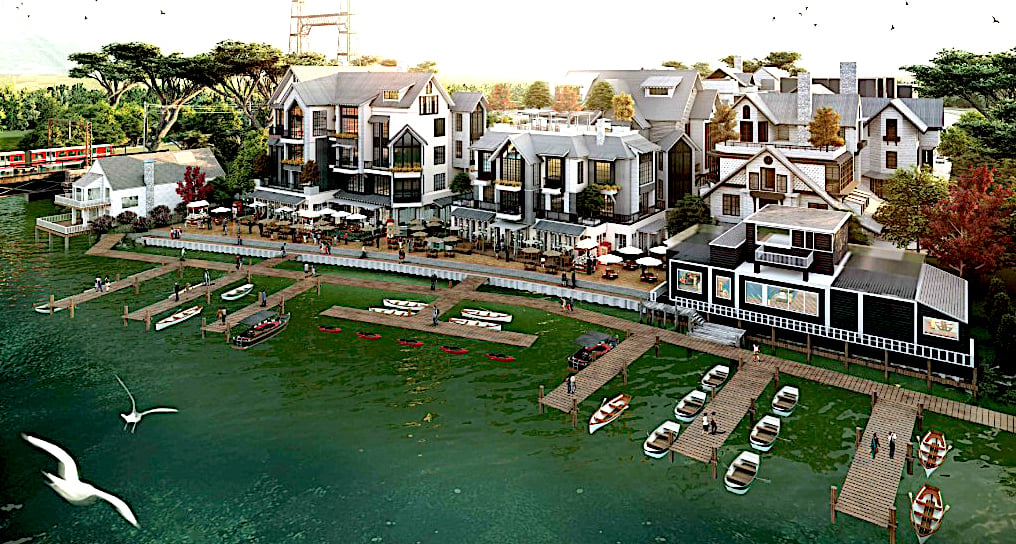
Editor’s note: The following was submitted by Save Westport Now, a political party focusing on planning and zoning issues for more than four decades, among the public comments on regulations proposed to facilitate the “Hamlet at Saugatuck,” a major development envisioned for that section of town.
____________________________________
The board and membership of Save Westport Now are pleased that there is renewed interest in reimagining and developing certain properties adjacent to the Westport train station.
It is important to remember, however, that Saugatuck is a vitally important neighborhood that serves as a critical nexus for many Westport residents, whether traveling by public transit or private vehicle. Thus, any amendment to the zoning regulations will have an outsized impact on the entire town — and we urge the commission to be extremely thoughtful and deliberative as you take up this matter.
To that end, we hope that you will turn to two existing documents as you begin this process. First, the town Plan for Conservation and Development (POCD), which provides thoughtful perspective on future land use throughout our town, including the “village-like” development of the Saugatuck area. The second is the Saugatuck Transit Oriented Design Master Plan (TOD), in which the town invested considerable time and resources and which is laser-focused on Saugatuck. Together, these two documents articulate the needs, wishes and concerns of our broad community, and should be carefully considered when the P&Z Commission functions in its legislative role, as it does when contemplating text and map amendments.
We have, in fact, studied Text Amendment 819 & Map Amendment 820 and view them as a substantial departure from the vision outlined in both the POCD and TOD, particularly with respect to:
• building height
• building size/massing
• density
• resilience to climate change
• adding impermeable surface adjacent to coastal areas, and
• uses that are priorities for the town
For those reasons alone, we would urge the P&Z to reject 819 and 820, barring significant revisions.
In addition to our concerns about height, size and density, etc., however, there are two other aspects of this proposal that we find especially concerning and believe would set bad precedents for the town.
1. The application rationalizes the requested increase in density and building size in part on the basis of an “environmental remediation bonus.” Our view is that, generally speaking, environmental contamination on a property (and hence any reduction in market value of that property) should be the responsibility of the owner or those who contaminated it — not the town of Westport and its citizens — and costs of remediation should be reflected in private real estate transactions. While we understand that in certain cases the town may want to offer something to encourage remediation at a specific site, we do not think it should be a consideration when making broad text amendments to the zoning regulations that cover multiple sites. And in this specific case, as the staff comments point out, there are significant uncertainties around the extent of remediation required, so it doesn’t make sense to permit a six-fold increase in building size or a two- or three-fold increase in building height as a result of the unclear remediation needs. Further, we do not think that the town should be offering new and increased impermeable surfaces in exchange for remediating existing contamination. In sum, our view is that what is proposed here does not provide enough benefit to the town and would essentially be rewarding polluters.
2. Westport has an urgent need for more affordable housing. You can either see this as a moral imperative or a practical need to avoid more unwanted development under Connecticut’s 8-30g law after Westport’s moratorium expires next year. Either perspective points to the same conclusion: It doesn’t make sense for Westport to allow for zoning changes that increase density without deed restricting that density in a way that meaningfully addresses the town’s affordable housing needs.
Finally, we feel compelled to remind everyone that, as nice as any specific proposal may be, when reviewing text amendments, the important thing is not the specific development proposal brought forward in conjunction with it (in this case, a small upscale hotel, luxury apartments and high-end retail), but the language of the amendment itself, as proposals can change, but the zoning code sets the standards for what can and cannot be built in the entire zone. Thus, while we may be picturing one hotel and a few dozen apartments, the reality may be something else entirely.
In fact, if adopted, this text amendment would apply to 15 potential properties, only 11 of which are included in the current plan, and only eight of which are part of the proposed Hamlet development. This means that the Hamlet might not be the only project to include 70-foot-tall buildings or 60,000-square-foot buildings. The town could conceivably wind up with many more extremely tall and extremely large buildings full of apartments in an area that is already stressed — without adequate protection to make sure that we aren’t exacerbating traffic and environmental issues and without any guarantee that a substantial percentage of these units will be affordable.
We urge the commission to take leadership on this matter and ask that you continue to be proactive in your efforts to thoughtfully plan the zoning regulations that will govern land use in Saugatuck.
Respectfully,
Save Westport Now








Recent Comments