
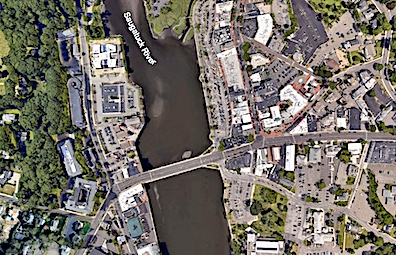
Editor’s note: Westport architect Joseph Vallone has some thoughts about the recent Westport Journal article: “Downtown parking, traffic woes defy decades of planning efforts.”
_______________________________
When I moved to Westport 34 years ago, the dominant paradigm by both political parties was to maintain Westport as this cutesy New England town, the true definition of conservatism being, this is the best it can ever be, don’t try to change it.
That logic negates the fact that communities are living and breathing entities in constant change. People simply choose to ignore the change we are incapable of stopping.
Successful communities are constantly monitoring, evaluating and amending their town. I have lived through many town administrations over the decades, some extremely proactive, contemplative, capable, creative, insightful, responsible and respectful, other administrations … not so much.
The transitions between administrations is one of the main reasons changes are not implemented. New administrations bring with them their own team and their own ideas, progressive or conservative. This is not unique to Westport. File cabinets throughout the country are filled with commissioned studies, RFPs and 10-year plans that where never enacted.
Unused ARPA funds, thanks to the Biden/Harris administration, have become the winning lottery ticket for many communities. The range of eligible uses for these funds is extremely broad and funds are used for countless projects, such as planning studies for our downtown parking lots.
One of your points that caught my attention is that, sometimes, not advancing concepts turns out to be the right move.
For example, thankfully, converting Main Street to a pedestrian mall, in my opinion, would have been a disaster. Look at downtown Ithaca, N.Y., where the Main Street was converted to a pedestrian mall. The results of that conversion have been a net loss in revenue to the retail stores, not the gain that was anticipated.
I believe there is a trilogy to addressing the downtown parking issues.
1. A parking structure on the Baldwin lot, makes sense for a host of reasons. I am attaching a sketch I prepared back in March, pro bono, of a parking structure over the Baldwin lot that both screens the abutting neighbors closest to the lot, includes substantial soft, green spaces for trees and shrubs and works exceptionally well with the site’s existing topography.
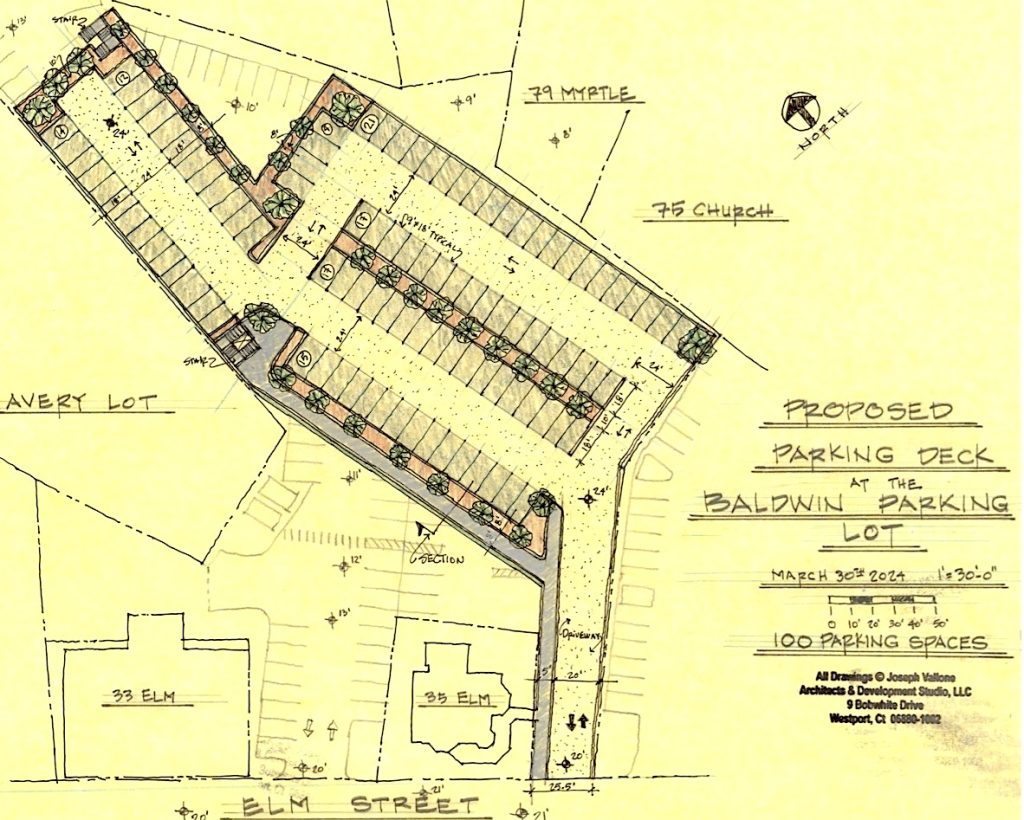
I’m not sure why the current administration wants to consider the acquisition of the privately owned adjacent lot, but why are we not moving the Baldwin lot design forward, it has been discussed for over 30 years and I think its time has come?
2. The Parker-Harding and Jesup Green debacle.
Thankfully a sufficient amount of town officials halted the destruction of Jesup Green. The limited amount of retail on the south side of the Post Road does not justify additional parking. Pedestrians crossing the Post Road are always a safety issue that should be avoided when possible.
I am attaching a sketch I prepared in June, pro bono, for the reconfiguration of the Parker Harding lot. The design solution addresses several issues that have been debated between the administration, retail owners and residents.

The town’s most recent plan for P.H. had a net loss of 40 spaces which led to the Battle of Jesup Green. Mandatory parking space size requirements, forced 40 parking spaces to be relocated to Jesup Green.
Through the reconfiguration of the lot, the same number of existing parking spaces has been saved, a rotary at the site’s narrowest point controls the flow of traffic, pedestrian access from Main Street through the tunnel to the waterfront is better defined and a center island the entire length of the parking lot with trees and shrubs has been created. I believe this is a fairly simple fix. Evan Harding’s wonderful vision of the waterfront’s development reflects a much different Westport in the 1950s.
3. Main Street parallel parking versus nose-in parking.
This is the third part of the trilogy. Contrary to what is being verbalized by the administration, the math does not lie. A typical nose-in parking space requires 9 feet of width. A typical parallel parking space requires 22 to 24 feet of width. Therefore, for every two nose-in spaces, (18 feet total ) 4 to 6 feet is the cumulative leftover, thereby guaranteeing an additional amount of nose-in spaces versus parallel parking spaces. Ignoring the fact that people are incapable of adequately parallel parking. For example, take a look at the successful Main Street nose-in parking solution in downtown Madison, Conn.
Here in Westport, the west side of Main Street should be striped for nose-in parking. Planting islands, pedestrian-scaled lighting and crosswalks should be included in the design as well. Could be my next pro bono sketch?
All of these improvements should be capitalized through a kiosk, metered parking system, despite being the third rail of the Chamber of Commerce. Businesses hate having their customers pay to park.
Our community has enjoyed a reputation for being a bastion of creative residents, a town filled with architects, designers, actors, writers, etc., skilled with vision and unafraid to share their thoughts. It’s been a blessing, not a curse for our community.
This community is in need of leadership with a better vision. Now it’s time to take some action.





Many thanks to Mr. Vallone for his thoughtful proposals and for so kindly providing, pro bono, renderings of his ideas. I strongly agree with his plan for a parking structure for Baldwin, and the conversion of to nose-in parking on Main St. makes a lot sense.
However, his concept for the Parker-Harding lot even further distances us from the one of the primary goals of the Downtown Planning initiatives–to truly re-connect us to the riverfront. No matter how thoughtful his re-design for Parker-Harding is, it does not change the fact that it is still a parking lot that will continue to dominate the town jewel of our riverfront, with only a slender, virtually irrelevant slice of green space along the river. For a bolder option, see my recent Westport Journal comment, part of which I quote here:
I believe that a parking structure would, in fact, create a parking surplus for our downtown. This being the case, my hope is that it would embolden planners to envision a more extensive, pedestrian green space along our riverfront than the one in the current design. I had previously advocated in 06880 for transforming all of the Parker-Harding lot into a large, amenity-rich, riverfront promenade–https://06880danwoog.com/2023/09/22/opinion-longshore-like-option-needed-for-parker-harding/. I still believe this to be a desirable outcome that will one day come to pass. I still also believe that the current plan for Parker Harding will not succeed in re-connecting the town and its people to the riverfront, which was the expressed intention of the current downtown planning process when it was initiated now some years ago. However, in re-considering the issue after several visits to Parker-Harding and appreciating just how large a footprint it occupies, I now believe that a roughly 1/3 to 2/3 split between green space and parking would meaningfully transform the riverfront area into a genuinely pleasurable pedestrian experience, while retaining a significant amount of parking. In this plan, the cut-through roadway can be maintained but moved closer to the stores and function as a dividing line between the parking and pedestrian areas. Two walking bridges over the roadway could connect the parking and pedestrian areas, thus eliminating the need to cross a busy road to access the riverfront. Again, my fervent hope is that the creation of ample parking for our downtown resulting from a parking structure will move us to actually fulfill one of the chief missions of the Downtown Planning Committee– to re-connect us to the riverfront in a way that can truly be felt and enjoyed by all who come to our downtown. We need, I believe, something substantively different than what’s been thus far offered to transform our downtown into a place that invites its visitors to linger longer, and of course, shop more.
Robert, you and others write about the “ primary goals of the Downtown Planning initiatives” as if they were carved into a 3rd tablet brought down by Moses from the top of Mount Sinai.
We need to remember that those goals were simply ideas put down on paper by a certain group of unelected citizens with their own personal biases and agendas and ideas, at a certain point in time. To cherry pick one idea from one document and use that as the only measure of success seems like a flawed way of looking at a complex problem.
Robert,
Thank you for your thoughtful response.
Please understand, I agree with you completely about opening the parking lot for greater pedestrian access to the waterfront.
However, the sketch for the Parker Harding Lot was created in direct response to the uproar I refer to as; the “Battle of Jesup Green”. The program for my design solution was in response to the outcry by the merchants for losing (40) parking spaces under the administration’s proposal. My sketch was created to illustrate the ability to redesign the P.H. lot while maintaining the approximate number of existing, (non-conforming) parking spaces, north of the Post Road, without the destruction of Jesup Green. That was the design program.
For now, it appears the citizens of Westport have won the Battle of Jesup Green with a retreat of the horrific design proposal that would have decimated the Green.
I generate these drawings merely to present alternative solutions with the hope of initiating dialogue. I am tired of this administration’s approach to governing being; “it’s my way or the highway, we have the votes and we will do whatever we want” ie; the current Long Lots School debacle. (which was supposed to break ground this month according the administration) Their mantra has never been my understanding of what constitutes good governance. This administration runs this town as if it where a privately held corporation. It is not, it is community with representatives who are elected to serve all the residents. Admittedly, the democratic process is messy, frustrating, time consuming, thankless and debilitating but don’t seek public office for the glory if you are unwilling to respect or respond to your constituents. There are a lot of creative and intelligent people in this community who can contribute for the greater good.
Robert, I have no doubt, it is very possible to open up the waterfront on P.H. dramatically, if the Baldwin Deck is constructed and Main Street is re-striped for nose in parking. What I am calling for is a traditional democratic compromise between the administration, the merchants and the residents of our community. Let’s see what happens.
~ J. Vallone, A.I.A.
It is not possible.
Every new business created needs a massive number of parking spots to sustain itself !
Just pragmatism.. therefore 40 new businesses on Parker Harding.. is 1500 parking spots EXTRA..
joe can flatter you Robert ! But facts are facts !
The math is simply the math !
Thank you Joe Vallone for your pro bono efforts and thoughtful insights.
What good ideas you have.
We must remember how we arrived at this juncture.
The Bedford square construction did not allow for anything close to parking requirements it should have, leaving us at about a 200 plus deficit.
The closure of church lane, the second floor retail and the mistakes made reinventing the Baldwin lot losing 50 more spaces.
Combined these have made parking in our downtown an absolute nightmare.
Before all these occurrences we already had a parking problem.
So you see this is not just about Parker Harding and 50 spaces.
Another thing to note here is that all the lost parking spaces are on the busy retail end of town, meaning a parking garage located by the library is of no use to retailers.
Another very important fact here is that the merchants back in the fifties paid 80% of the cost to reclaim the river in order to create more parking.
So while it is on the river, its goal at the time was for parking, not the view, and not reconnecting the riverfront. The goal was for parking.
You see parking was the same headache in Westport 85 years ago.
What this means is that when it came to Bedford square, to the closure of church lane, to adding second floor retail etc, more thought should have been given to parking which was already an issue.
I see no chance that any private landowner will want to partner with the town or allow them share or take away their very precious parking, especially if the town were to expect that private landowner to go along with their time limited parking.
How would that ever ever make any sense to a private landowner.
It would not.
It’s interesting that the current administration doggedly continues to cruise along with no transparency putting the cart before the horse.
Parking must be created somehow before parking is taken away.
That means finding a solution and implementing it BEFORE taking any away.
The merchants suffered incredibly during covid, those who managed to survive, are still recovering from the catastrophic effects of having to shutter their businesses on multiple occasions for lengthy periods.
It is therefore reprehensible to expect the same merchants to suck it up yet again so a very very small group can bully through their agenda.
Add parking first ! Then take a holistic look at the big picture.
In the meantime fix Parker Hardings potholes which are a disgrace and an embarrassment.
Add some much needed crosswalks and some more ADA PARKING.
Work on creating some actual conveniently situated parking for the Main Street shoppers and diners on the right side of the post road and not by the library, or the police station where we have far less need.
Maybe the solution is to put a huge parking deck on Parker Harding, then have green space beyond it. After all it was specifically created 85 years ago to be a parking lot.
It would be central and convenient.
No amount of created spaces will ever be a surplus.
They might be adequate though and that’s progress.
I read Robert Augustyns piece, and it would be wonderful IF we did not already have such a parking deficit.
Let’s do the math.
We are 300 in the hole since 2015.
If we lose another 200 at Parker Harding we are 500 in the hole.
I just don’t know where we can create 500 parking spaces and that would just get us to where we were in 2015 and that was already not adequate.
Then start creating more businesses and restaurants, now we need more extra additional parking.
If we were to see new businesses on the length of Parker Harding plus food trucks and more restaurants just for those extra businesses we need another 1500 parking spots.
So now we have to find 2000 new spots conveniently located..
I love his ideas. They would be amazing. But they just will not work for Westport. We simply and sadly do not have the space.
Is it definite that Jesup Green will not have their trees cut down so as to turn it into a parking lot? The Planning and Zoning Commission disgracefully approved the destruction of Jesup Green. Can the First Selectwoman and town attorney still try to build that disastrous parking lot at Jesup Green. Who would stop her?