
The following is an opinion submitted by Westporter Werner Liepolt.
As Westport weighs the future of the William F. Cribari Bridge, a growing number of residents are asking a different question: not what should be built—but whether the decision-making process itself has been thorough, transparent, and inclusive… especially including traffic patterns, visual and historic setting, and the scope of the Area of Potential Effects—particularly in a part of town where land use and development pressures continue to evolve.
A bridge with history—and consequences
At the heart of the concern is not simply whether the William F. Cribari Bridge should be repaired or replaced, but how that decision is being made—and whether the process required by federal preservation laws is being fully observed and the outcome determined.
More than 1,500 individuals have now signed a petition calling for federal oversight of the Environmental Assessment, currently underway. Readers can sign the petition here
The request does not advocate for a specific design solution. Rather, it asks that the review process fully and transparently evaluate potential impacts—including traffic patterns, visual and historic setting, and the scope of the Area of Potential Effects—and that alternatives be considered in the sequence required under federal law.
Recent public exchanges have underscored that there are strongly held and differing views within the community. At the same time, they have also highlighted the importance of maintaining focus on the procedural safeguards established under the National Environmental Policy Act and Section 106 of the National Historic Preservation Act.
With the public comment period open through April 17, residents have a limited window to ensure that their perspectives are included in the official record. Thoughtful, fact-based input—grounded in local knowledge and an understanding of the bridge’s role within a National Register Historic District—can and must play a meaningful role in shaping both the analysis and the ultimate decision.
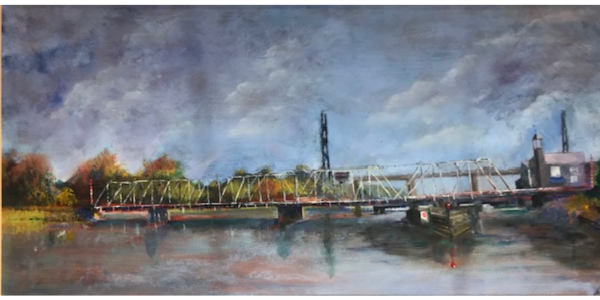
The Cribari Bridge, built in 1884 and listed on the National Register of Historic Places, has long served as both a transportation link and a defining feature of the Saugatuck River landscape. To many residents, it is more than infrastructure. It is part of the visual and cultural identity of the Bridge Street Historic District and the surrounding neighborhood.
The process question
CTDOT has identified structural and functional deficiencies, including limited clearance, weight restrictions, and aging mechanical systems. The agency’s stated goal is to improve safety and accommodate modern traffic demands, with construction potentially beginning later this decade.
Where opinions begin to diverge is not only on CTDOT’s stated preferred outcome, but on the process itself. The petition and related public comments argue that the decision to pursue full replacement appears to have advanced without sufficient early public engagement or meaningful consideration of alternatives.
Federal law calls for consultation with stakeholders before key decisions are made—particularly those affecting historic resources, long-term traffic patterns, visual character, and the potential use of right-of-way within a National Register Historic District.
“The lack of transparency undermines the principles of fair public policy,” the petition states, echoing a concern voiced by multiple residents at recent public meetings.
Right-of-way impacts come into focus
At the March 19, 2026 public hearing, CTDOT disclosed that approximately ten properties and one dock could fall within right-of-way needs—without identifying which properties or providing maps. This was the first indication that the project could extend beyond the bridge itself and directly affect private property within a National Register Historic District.
The timing of that disclosure—after the public comment period had already begun—has raised additional concerns about whether potentially affected property owners and the broader community have been given a fair opportunity to understand and respond to the project’s full scope.
Why federal oversight?
Those calling for federal involvement are not necessarily asking for a specific outcome. Instead, they are asking for a process reset.
For many residents, the issue is not opposition to change—but confidence that the process is being conducted as federal law intends.
Their argument is that federal agencies—particularly the Federal Highway Administration—should ensure that:
- All reasonable alternatives, including rehabilitation, are fully evaluated
- The Area of Potential Effects (APE) reflects the broader historic district, not just the bridge itself
- Public consultation occurs early enough to influence outcomes, not simply react to them
In short, they are seeking assurance that the review process complies not only with technical requirements, but with the spirit of federal preservation law.
A broader debate about infrastructure
The debate unfolding in Westport reflects a broader national tension: how to modernize aging infrastructure while preserving historic character and community identity.
CTDOT has noted that, if replacement proceeds, the existing bridge could be offered for relocation and reuse under federal guidelines. Preservation advocates counter that moving a historic structure diminishes the very context that gives it meaning and wonder again whether product has out-stripped process.
Meanwhile, practical concerns—traffic flow, safety, and long-term resilience—remain central to the state’s case for replacement. Yet the 2020 Covid era Environmental Assessment appears to rely on the assumption that trucks will not find the route desirable, but does not present up-to-date modeling or analysis to support that conclusion—particularly in light of modern GPS routing systems and the potential removal of existing physical constraints.
The apparent absence of updated traffic modeling is particularly notable in light of recent property acquisitions in the Saugatuck area by a regional developer planning new residential construction. Even modest increases in density can alter traffic flows in ways that compound existing uncertainties—especially if bridge constraints are removed.
This raises a central question: whether the Environmental Assessment (EA) reflects current conditions and reasonably foreseeable future development, as federal guidance requires.
The maritime. seasonal landscape and historic setting
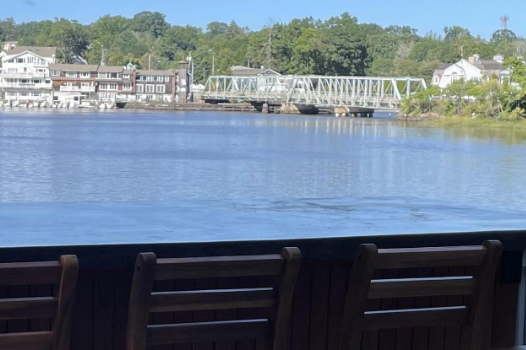
The EA also depends on an analysis of how the historic bridge sits within the landscape. CTDOT’s analysis is only supported by water level photographs taken on May 11, 2020 with the east bank of the river in full leaf. It lacks the necessary consideration of views of the river during the leaf off season (October through April) and fails to provide consideration of the upland views several of the contributing houses within the historic district enjoy.
Approximately a dozen houses have similar views from the East Bank downstream of the Cribari Bridge. Some for more than a century and a half. The report acknowledges that residential neighbors with close, static views are the most sensitive viewers. Yet it fails to identify or analyze specific contributing properties—that have direct upland views of the bridge (see photograph below, taken March 2026).
Within the Bridge Street Historic District—particularly five homes on Bridge Street and Saxon Lane:

- The Rufus Wakeman House, 1884
- The Rufus Wakeman Carriage Barn, 1884
- The Hotchkiss-Wheeler House, 1877
- The Albert U. Smith House,1917
- The Anna E. Dolan House, 1932
What happens next?
The formal public comment period remains open through April 17, following a March public hearing intended to gather input from residents and stakeholders. To lodge your comments with the CTDOT, go here.
For many in Westport, the coming weeks represent a critical window—not just to influence the fate of a bridge, but to shape how decisions like this are made.
Because in the end, the question may not simply be what replaces the Cribari Bridge—but whether the process used to decide its future earns the public’s trust.





For heaven’s sake ! Repair the old bridge in the old form – Again !, keep the weight limit intact so only car traffic can use it, and stop this incessant debate. I moved to Westport in 1977 and it has always been too many cars using the intersection. It used to be worse as Peter’s Bridge Market was there. And we had this great policeman, Bill Cribari, waving us through the intersection.