
By Thane Grauel
WESTPORT — The town expects $8.4 million in federal COVID-19 relief funding, but faces requests totaling millions more on how to spend it.
The Board of Selectmen this week began reviewing the list of local proposals seeking funds from the American Rescue Plan Act.
The federal government has already sent $4.2 million to Westport under the act, and the same amount is expected next year.
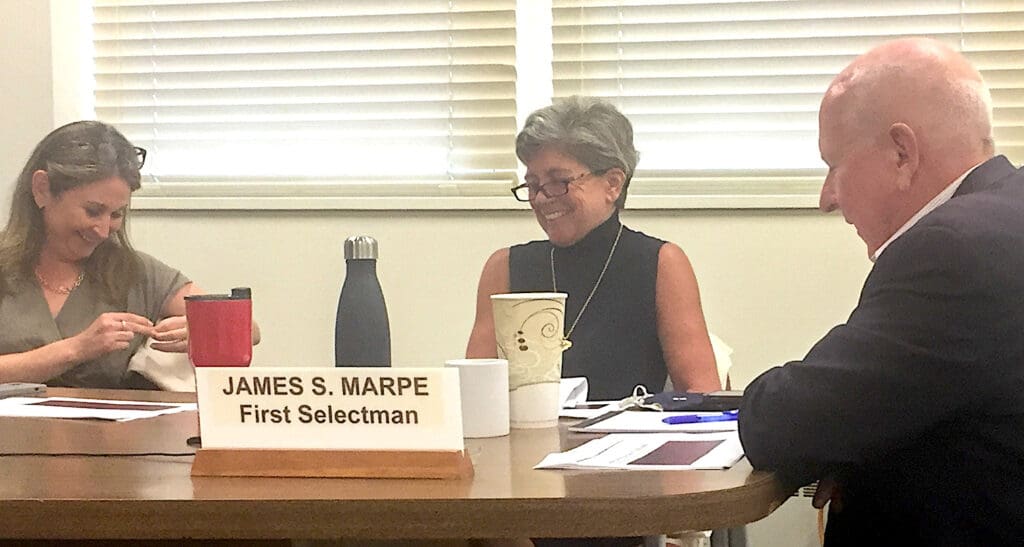
“This is the first public step in what will be many public steps,” First Selectman James Marpe said at a Wednesday morning work session.
The list of possible local projects totals $4.5 million more than the federal government is likely to allocate Westport, so choices will have to be made.
The federal relief package has rules about what the money can be spent on and when work has to begin.
Feds set parameters on how money can be spent
Eligible uses, according to a presentation by Town Operations Manager Sara Harris, are:
- To respond to the COVID-19 public health emergency or its negative economic impact.
- To respond to workers performing essential work during COVID-19 by providing premium pay.
- Government services, compensating for a reduction in revenue suffered due to COVID-19.
- To invest in water, sewer or broadband infrastructure.
The money coming to Westport is part of $350 billion being disbursed nationwide to local, state, territorial and tribal governments, Harris said.
“There are more projects than there is funding for,” Harris said of the local list.
Big-ticket items: Town Hall, Police HQ, WWHD complex upgrades
Among the big-ticket proposals is $2.5 million to make Town Hall compliant with the Americans with Disabilities Act. Public Works Director Peter A. Ratkiewich said the handicap ramp doesn’t meet current standards.
“The ramp that we have now for ADA is actually non-compliant, but until we touch it, we can continue to utilize it,” he said. “It’s grandfathered in.”
The new access ramp would be at the rear of the building.
The town would like to spend another $2.5 million to reconfigure the space inside Town Hall, in part to provide larger, more useful meeting rooms, Ratkiewich said.
Another $2 million would be used to renovate the Westport-Weston Health District headquarters on Bayberry Road.
The building, Ratkiewich noted, was part of the Nike missile base, built in the mid-1950s.
“It still looks and feels like a barracks,” he said.
An overhaul could make it more suitable for public health events, such as mass vaccinations, he said. Another $70,000 is sought to install a generator for the complex, a project that already is in the works.
Harris said $2 million could be spent to bolster the town’s broadband infrastructure. A study on the issue is planned soon, including the possibility of installing fiber-optic cable townwide, she said.
The Western Connecticut Council of Governments also is looking at the broadband issue on a regional basis, Harris said.
Marpe noted the existing broadband system in town served most people well while they worked at home during the pandemic.
“I don’t think Westport wants to be in the public utility business,” he said.
The Police Department is seeking $500,000 for technology upgrades.
“This will cover the expenses of body cameras, the upgrade of the Tasers because of the cameras and cameras in all the police cars,” said Police Chief Foti Koskinas.
“This will take care of all the storage and where the data is, the redaction hardware that we need because of FOIA (Freedom of Information Act) requests and, additionally, about $70,000 is for upgrades in the building for the cameras.”
He said the camera system at police headquarters is about 25 years old, so it does not record a continuous stream of images. Its audio is inadequate and pictures are pixelated.
A deteriorating wooden jetty at Burying Hill Beach would cost $900,000 to replace. The jetty is important, Ratkiewich said, because it keeps sand from migrating into a nearby creek.
Other smaller items on the wish list include: $150,000 to install bus shelters along the Post Road; $100,000 for tree trimming;$250,000 for the arts; $350,000 for an extension of a boardwalk to Riverside Park; $340,000 for a redesign of the Parker Harding and Jesup parking lots.
“We’re very lucky to have this $8.4 million,” said Selectwoman Melissa Kane. “It’s an incredible opportunity.”
After the Board of Selectmen gathers public input at a future meeting, it will send its spending recommendations to the Board of Finance.







I see why Mark Cooper decided to stay on board and if the current leadership does nothing about his criminal activities. I will When in office.