
By Gretchen Webster
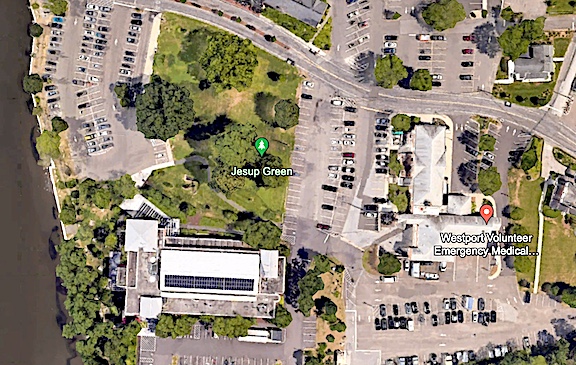
WESTPORT — After a plan to carve additional parking spaces into Jesup Green narrowly won Planning and Zoning Commission approval this week, the next steps in the process were reviewed at a contentious meeting of the Downtown Plan Implementation Committee on Thursday morning.
Several committee members said the public did not fully understand the impact of plans approved to replace parking spaces lost at a redesigned Parker Harding Plaza with new spots on upper Jesup Green near the Westport Library. They argued that better communication of the project’s details is needed before further steps are taken.
“This week has been quite tumultuous … The project will fail to win approval from the RTM [Representative Town Meeting] if it isn’t explained better to the public,” said Matthew Mandell, a District 1 RTM member. “This body needs to convince the RTM, convince the public, that this is the right thing to do.”
The plan calls for removing some of upper Jesup Green’s lawn and adding 40 parking spaces to compensate for spaces lost at the Parker Harding lot when it is renovated to comply with current safety and Americans with Disabilities Act standards.
The prospective loss of green space has triggered criticism both from some town officials and the public.
Other problems with the project, cited by residents and downtown merchants over the last year, is a lack of designated parking for downtown employees, failure to keep the public adequately informed about its evolving steps, and loss in the number of parking spaces closest to Main Street.
An online petition to have the downtown parking plans reviewed by the RTM was launched Thursday by lawyer Larry Weisman. In a related letter to the Westport Journal, Weisman called the Parker Harding/Jesup Green plan “a colossal mistake” and an “ill-conceived plan.”
As an alternative, Weisman suggests that a parking deck be built over the Baldwin lot off Elm Street, an idea echoed at Thursday’s DPIC meeting by Jennifer Johnson, a District 9 RTM member, and Laureen Haynes, a downtown merchant and resident.
Both women said a Baldwin parking deck could not only compensate for parking spaces lost by Parker Harding’s redesign, but also provide many more slots to help alleviate downtown’s chronic parking crunch.
“I’m interested in adding additional parking, not just net zero,” Haynes said.
The current plan calls for the same number of spaces lost at Parker Harding to be replaced at Jesup Green, with no overall increase in parking envisioned until later phases of the project — none of which have been formally proposed or approved.
DPIC Chairman Randy Hertbertson said officials plan to put the Jesup project out to bid soon, which elicited negative responses from some committee members.
“The idea that you will go forward now without RTM approval I think would be a drastic mistake. … Once the RTM hears that you’re going to move forward on the top part [of the Jesup Green plan], you could lose the entire decision,” Mandell said.
The RTM, a day after the P&Z approved the project, decided to delay voting on a request to spend $630,000 to design the Jesup and Imperial parking lots so members could study the plans further.
And committee member Gately Ross, a director of Sustainable Westport, questioned whether the piecemeal renovation of downtown’s parking would jeopardize funding for later phases of the plan.
“How do we guarantee that we’ll have funding” for the entire project? she asked. “That is not guaranteed to happen.”
Public Works Director Peter Ratkiewich said the RTM will have more than one chance to review the design and construction plans before funding is acted on.
“The reason we’re going to bid is because we can come in with a real number” for the project’s costs, he said. Taking bids does not mean that work will start without passing through the required town bodies, including the RTM. “The RTM has to approve this money before we can do anything,” he said.
Ratkiewich also pointed out that five conditions the P&Z linked to its approval of the plans must be met before construction can begin. They include adding the 40 parking spaces at Jesup Green, a net increase in green space at Jesup Green by the end of Phase 2, and distributing parking stickers to downtown employees.
Herbertson said using upper Jesup Green to add parking temporarily has always been part of the plan and, “The desire by the public to have net zero parking” has influenced planning, especially in recent months.
He promised that as the funding phases of the project are considered, there will be chances for the public to review and comment on the plans, and that public interaction with the plan “will inform design work. We have no desire to lose green space, but to gain green space,” he said. There also is a “Feedback” page, where the public can leave comments, on the DPIC’s website.
What can be done immediately, several DPIC members said, is to publicize the plans and educate the public on what exactly will be done. There is clearly a lack of understanding of the complicated process among many people, they said.
Committee member and developer Travis Canavan suggested physically delineating the specific areas where parking spaces and green areas will be when the project is completed – using whatever means, even balloons — to help inform the public.
And Maxx Crowley, president of the Westport Downtown Association, said that a basic list of the steps in the renovation process should be compiled — “so simple that a kindergartner could understand it,” he said.
“There’s a fear that we’re in this room colluding to ruin their town,” Crowley said.
“This is now a political issue,” Mandell said. “This committee has an obligation now to explain this to the public and to the RTM.”
Freelance writer Gretchen Webster, a Fairfield County journalist for many years, was editor of the Fairfield Minuteman and has taught journalism at New York and Southern Connecticut State universities.








Despite recent DPIC assertions to the contrary, I’m pretty sure the high level of public opposition to these plans is not due to the fact that residents are too stupid to grasp them.
Just to clarify, when I said political, I was referring to the pending decision by RTM being about the growing public discourse. The RTM is a non-partisan body which I believe is one of its strongest aspects. I should have used a different word.
Saving Jesup Green is not political. It’s an important place in the heart of our town that brings us together. And not all open space is the same. We can save the Jesup and enhance the waterfront, but the DPIC needs to chart a different course other than their current plan to cut down multiple mature trees and cut it by a 1/3 with a large retaining wall supporting the new 42 spaces. Find another way.
On a recent trip to Savannah, our group stood in Ellis Square – one of the many green spaces throughout the city that are famous for marking history, providing places to gather, and keeping abundant green spaces within the bustling city. Around the square were restaurants, retail, banks and hotel. We were surprised to learn that a parking deck existed beneath this lovely spot. It seemed so clever – creating much needed parking while also delivering more green space. This type of thinking was clearly a win-win.
The Common in Boston, oldest public park in the USA (a National Historic Park and Landmark, including a part of the Freedom Trail) now sits atop a parking structure for more than 1,000 vehicles. There is an Emerald Necklace along the river; just park at The Common and enjoy it all. I do not know how they built a massive parking lot under sacred grounds that have been in place for centuries, but where there is a will there is a way.
When I lived in Boston, I discovered its famous lack of parking, especially for residents. I called city hall to learn more about their vision for resident parking. “Sell your car,” was the response.
Eventually I moved because, well, Boston is no New York — but not before discovering what a delightful walkable city it is (in good weather).
I don’t think that resistance to the DPIC plan reflects a lack of public understanding. I think it’s a predictable response to a less than optimal plan which would leave Parker Harding with right angle parking (think Compo or Trader Joe’s) rather than angled parking which is preferable, and without a loading zone or solution to the delivery problem, and which would encroach unnecessarily on Jesup Green.
Those of us who oppose the plan realize that there is a better alternative – a deck over a portion of the Baldwin lot which could accommodate 100 spaces – an increase of 60 spaces
over what will be lost in the P-H reconfiguration .
We are reliably informed that such a deck can be constructed at a cost of 30k per space or $3 million plus soft costs, so call it $4 million which is less than the cost of the work proposed to be done on Jesup Green.
And when the dust settles, we’ll have increased available parking substantially, in a location convenient to Main St. and other downtown shopping, and we won’t have encroached on Jesup Green.
The problem the DPIC has is not a lack of understanding of its plan but rather, that there is a better, less expensive, less destructive alternative which it is hard pressed to refute on any rational basis.
This ^^^
Thanks, Mr. Weisman. You’ve clearly articulated the situation. We understand the plan. It’s not a good plan. Repeating the plan over and over does not make it better.
The communication that is needed is of a better plan.
More parking capacity at Baldwin (which I just learned has always been the unrealized plan for that piece of property) solves all the problems and makes way for your Emerald Necklace idea at. Parker Harding. Baldwin can become parking hidden among a green space if done properly, so as not to impinge on surrounding residents with undesirable views. I believe We have experts among us who know how to do this.
In the meantime, as a temporary measure, clean up Parker Harding, get some ADA compliant parking, and move this forward.
Reliable estimates for a parking deck (not a garage) on the Baldwin lot are $30 – 35K per space or $3 – 3.5M for 100 spaces, plus soft costs. So call it $4M or even $5M.
The costs which I have seen associated with the Jesup plan are just over $4.6M for half as many spaces at the further cost of a loss of a portion of the green.
Do the math and consider which is the more convenient and less destructive option.
Larry –
If the estimate that is being quoted for parking at Jesup is $4.6 million for 40+ parking spots, then as a commercial and residential developer, I would estimate the cost for a 100 spot parking deck would be at least 5x as much. The 30K estimate per space that was cited is just a google search price with no consideration of what it actually costs to design, permit and build in Westport, CT.
Results of Google search “How much does it cost to build a parking deck”.
As of May 2022, our statistical data indicates that the median construction cost for a new parking structure is $27,900 per space, or $83.21 per square foot; an 8.6% increase over 2021, when the median cost was $25,700 per space.
Bear with me on the 300+ parking shortfall:
One of the themes of the 2015 Downtown Master Plan is the impact of parking demand/supply against development strategies. By looking at the table in Figure 104, the town has checked off the first 5 strategies, producing a supply deficit of just under 300 spaces. The town did not complete items 6-10 which would have offset a portion of this shortfall, yet also closed Church Lane 8 months out of the year.
For anyone on the P&Z call on Monday, Mr. Lebowitz took the time to total all all-day parking for employees to park (and share with visitors). Where he fell short is comparing this supply against the total number of employees as provided during the call. Where he fell short is asking the DPIC where the parking shortage for 300+ employees is to be located. Where he fell short is instead demanding a net zero in parking.
Yes, interesting how the actual numbers check against the predicted 300+ parking supply shortfall.
It wasn’t lost that two developers in town who have had the greatest impact on our parking demand per Fig 104, did not support addressing the shortfall they have caused. This is aside from all merchants, restauranteurs, services, etc. who have also invested greatly.
I make the recommendation that before any new plans and funds are approved, the DPIC updates the current state of demand vs supply and produces a plan that brings our town center back in balance. Per the Downtown Master Plan, shouldn’t this be a dashboard front and center to the DPIC and our Administration?
Let’s Keep Westport Working.
Toni, to clarify, a deck on Baldwin is not “an unrealized plan”. It’s an old idea that fails every time some urbanist digs it up.
And now, after roughly 1.5 million dollars in recent taxpayer financed improvements, there’s only 8 feet of grade differential between Elm Street and the bottom of the lot. That means, with a looming deck, the sun will set a lot earlier for the homeowners whose residences back up to Baldwin.
Think about it.
If it’s the White Plains look you’re after and you want even more debt, propose a deck behind the police station. At least this way you won’t be hurting residential abutters and destroying all those expensive improvements to Baldwin which we were just charged for.
Morley – I understand why you would personally oppose a Baldwin deck.
But as long as you are suggesting alternative locations, why not over the Library’s back parking lot? It is one of the larger lots in Town, so going up with have a better than average impact on capacity. Put in two levels, put green-space on top, have a design contest for how best to design the riverside side of the building to not simply look like a concrete monolith on the river. On top of everything else, it is pretty great location for easy access downtown.
I’m not advocating for any of this creepy, urbanist garbage. But the idea of a deck behind the police station is plainly listed as an option in the 2015 Downtown Masterplan. So if the density whisperers want to get it out of their systems once and for all, go for it. Just don’t forget make the merchants prepay for all the costs.
As for the dearth of parking, I’ll know the town is serious when it quits closing Church Lane (and all the parking that goes with it) for half the year. The 2015 Downtown Masterplan specifically recommended NOT doing that.
Creepy urbanist garbage ?
With all due respect Morley, this town allowed developers , 2 of who predictably spoke at the hearing, of course and of course advocated in the administrations favor for self serving reasons.
Was lost on none of us.
This town allowed those developers to destroy town parking… continue to do it with church lanes closure…
Which should be immediately stopped. It’s rediculous.
Except to those who profit from it.
It’s causing a horrible parking conflict.
It’s the same as allowing 1 large and 3 medium sized new businesses to open.
Facts !
This town redid Baldwin and allowed the loss of 35 spots there. .
So we start from that deficit already !
Nobody wants to urbanize downtown.
We want it to stay pretty and quaint.
But then we hear words like “rebranding” Westport.
Westport “lifestyle”🤢 .
This is the enemy of our quaint family town, the rebranders, and folks promoting a new “lifestyle”
It’s not the merchants trying to survive.
Maybe ask Mandell and Crowley why they think this DPIC plan is so wonderful.
When not a single person with a retail store agrees with them. At least not 90%.
Yet it’s fascinating the rhetoric the merchants have had to listen to spewed by the 2 organizations who purport to be advocates of merchants all the while intent on destroying the very folks who “should “ be their livelihood…
Here’s the funny thing though.. Crowley DA makes more money out of the garbage collection, and holding events the merchants for the most part do not want.
Mandell does the same thing…
Holding events the merchants do not benefit from, have no say in.
The few dollars the merchants pay to these 2 organizations pale in significance to the other opportunities afforded to these organizations by sucking up to the administration.
So for that reason it’s hoist the ladder jack ! I’m on board..