
By Gretchen Webster
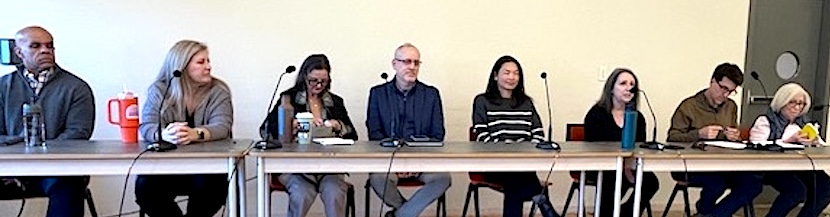
WESTPORT — The Board of Education responded to a range of issues raised by the public Wednesday at its annual “Community Conversation,” an occasion when board members invite comments on any subject.
Two topics drawing the most comments were a lice infestation at some elementary schools in town, and staffing issues pertaining to substitute teachers and paraprofessional staff. The event at the Westport Library was moderated by Velma Heller, a former moderator of the Representative Town Meeting.
The lice problem is “out or control,” particularly at Greens Farms Elementary School, Holly Jaffee told the board, reading from letters written by many parents frustrated with the problem.
“We’re so distraught by this,” she said. “There is a widespread lice problem at Greens Farms and other elementary schools as well.”
Parents’ comments from the letters Jaffee read, and by others speaking in person, included a mother who said that her son had school-induced lice infestations five times from kindergarten through third grade and another who said it cost her family $2,000 to clear up the problem afflicting her home and family.
Several parents complained about the inefficiency of the Aspetuck Health District in combatting the problem, claiming that district staff told concerned parents that policies had been followed when addressing the problem, but lice infestations continued.
The angry parents called for upgraded policies, including checks for lice by the school nurse weekly in each school. Protocols need to be changed, they said.
“The superintendent is going to look at this and work with his [policy] team,” Board of Education Chair Lee Goldstein told the parents. There is a nurse in every building, and the district follows state regulations, she said. The lice problem been a persistent issue for many years in many schools, she said.
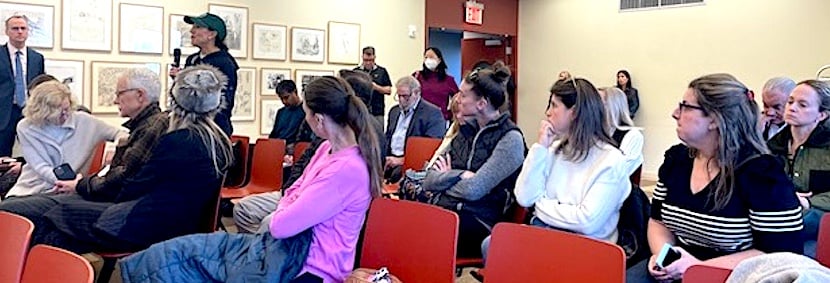
Substitute teachers, as well as paraprofessional staff, need more pay, additional training and other perquisites, others attending the gathering told the board. Rindy Higgins, a substitute teacher for 10 years, suggested a “sub club,” where substitute teachers could support each other “and feel a part of a team.”
“Subs” would like to meet with teachers, have class plans given to them that are clearer to administer and be included in events for the entire staff, she said.
“I’d like to be appreciated,” Higgins said. “Substitutes have a tough job.”
Increasing pay for paraprofessionals, allowing their jobs to be shared and giving them more training were also cited as a way to help retain both substitute teachers and paraprofessionals in the school district.
The difference between regular paraprofessionals and special education paraprofessionals, and the difference in the training they receive, was explained by Anthony Buono, assistant superintendent for teaching and learning. But retaining staff is a problem everywhere, he said.
“There is a massive shortage in our country for paraprofessionals, teachers and substitutes,” Buono said. For example, a shortage of social studies teachers currently exists in Connecticut, he said, a problem that previously did not exist.
Considering options, such as allowing paraprofessionals to job share, should be considered, Buono added.
Other topics brought up by those attending the meeting included:
- Too much focus is put on “social-emotional learning” in the curriculum instead of academic courses like science and math, and that not enough is being done to measure how successful social-emotional curricula are.
- More steps should be taken in school to reduce student anxiety, such as making homework assignments easier to understand and reducing the pressure for children to achieve high grades.
- Cut back on the number of half-days in the elementary school schedule, which pose challenges for working parents with young children to arrange care for them.
- Make grading policies in Advanced Placement courses consistent from teacher to teacher.
Freelance writer Gretchen Webster, a Fairfield County journalist for many years, was editor of the Fairfield Minuteman and has taught journalism at New York and Southern Connecticut State universities.







The first bullet point is very valid. There is too much time and resources allocated to SEL and taken away from actual sciences. Moreover, extreme concentration on one’s emotions only makes things worse. As a result, we see falling academic scores across the country but rising psychopathic tantrums which gen Z is prone to when things do not go their way. Children need to be taught to put themselves together every morning and do what they have to do regardless of their everyday mood.
While you’re scratching your head wondering why your kids are infested with lice, continue mandating we build more “affordable housing ” to welcome the great unwashed to occupy the desk next to your child.
What a vile, hateful comment. On behalf of what I believe to be the vast majority of Westporters, I apologize to our neighbors — of all backgrounds, ethnicities and income levels — for such an ignorant comment. She speaks for a very sad and lonely minority. PS: Thank you for contributing to the vibrancy, diversity and fun of our community. We’re glad you’re here.
With all due respect,Mr.Woog my comment was neither vile nor hateful. It was a statement of fact, suggesting a correlation between the advent of lice infestation and the changing demographics. Westport has welcomed busing since Project Concern in the 60s. My children attended Westport public schools 30 years later and never was there an issue of head lice.
A racist wants to make America white again. He wants to exclude all others from his community. On the other hand, those of us whom you describe as ” a sad,lonely minority” are not racist. We welcome anyone whether they are chartreuse or from Mars, to live next door as long as they can afford to live here. What we object to is a lifelong subsidy passed from generation to the next . What we object to is now feeling unsafe in our own home town.
The discussion of head lice has morphed into a volatile and controversial exchange on the topic of low income housing. It might be useful to stop calling anyone with an objection to these zoning policies a racist. If we subtract the virtue signaling and the name calling and just consider the inevitable negative results of the direction we’re going, we might be able to come up with some solutions. Because of the politicians that this town and others have sent to Hartford, we now have much less control over these decisions than we had in the past because they are mandating changes on a state level that are guaranteed to alter Westport and other wealthy towns in a negative way, so solutions will be difficult, if not impossible. Look at some old pictures of towns like New Haven, Bridgeport, Hartford, etc. and you will get a very good picture of what happens when you make bad decisions for your town. Fast forward to now; dense housing for low income people, homeless shelters, Marijuana dispensaries popping up, etc. will eventually turn this town into a much less desirable place to live. As it continues to decline it will finally become much more affordable, like Bridgeport is now compared to here. There will be no more beautiful towns to aspire to live in and that is the plan of the left….equal distribution of misery. What actually is fair is that everyone live where they can afford to live. That is what I did and most others who object to the leftist notion that other people are obligated to pay for you to live in a town you can’t afford. There is a fairly broad spectrum of housing in Westport but if the lowest end is still out of your reach then should have to live elsewhere until you can afford to live here. There is nothing racist about that. As for the charms of living in the grittier towns and cities, by all means move there and save yourself alot of money. Having lived in the worst of the worst neighborhoods myself in NYC, trust me, you’re not going to like it.
.