
By Linda Conner Lambeck
WESTPORT — One area of Long Lots Elementary School where mold was detected over the summer may soon be ready for students again.
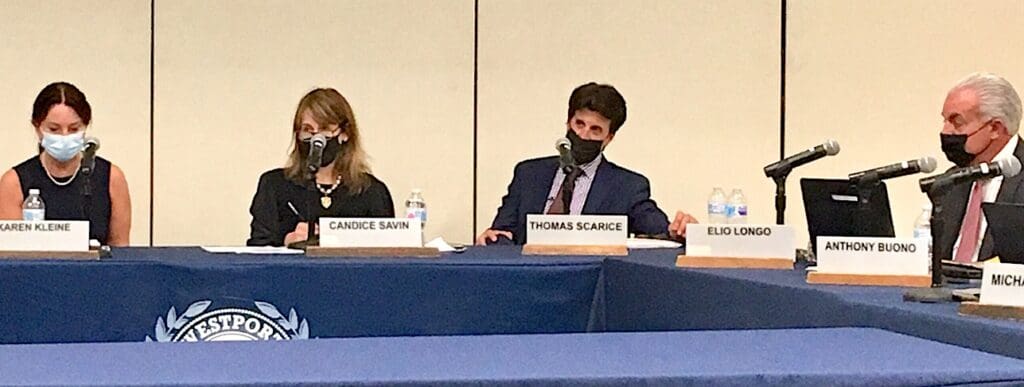
Supt. of Schools Thomas Scarice said the source of mold in the school’s auditorium has been identified as a roof-top unit.
He told the Board of Education this week the space is undergoing extensive cleaning of carpets and seats; a panel door system not used in years may be removed, and curtains may be replaced.
“Once done, we will resume occupancy in the auditorium,” Scarice said. Exactly how long the job will take is not certain.
Room 9, the other spot in the school where elevated levels of aspergillus and/or penicillium were detected in air samples, is another story.
The moisture source has been identified as a lower-level crawl space that leads to a dirt-floor tunnel system around the building, Scarice said.
“The most likely solution is to fold the system into the envelope assessment [now underway],” Scarice told the board during an update on the issue first discovered over the summer.
One possible way to address the problem would be to close off the space permanently.
In all, 26 rooms at Long Lots were tested for mold, and only the auditorium and Room 9, which is inaccessible to students, tested at elevated levels.
Scarise and other officials say the situation is much different from one at Coleytown Elementary School in 2018 when air testing found 63 areas with significantly higher levels of mold.
The school had to be closed for extensive renovations.
Last month, the school board authorized a systems study at Long Lots. Officials are awaiting results of an assessment of the HVAC, plumbing and electrical systems from Colliers International.
The idea is find ways to prevent water sources from penetrating school buildings.
Long Lots was already scheduled to get new windows and a boiler.
Scarice said some surface mold was also found and addressed at Bedford Middle School this summer, which was particularly hot and humid. He called mold practically impossible to avoid.
“Is it harmful? With healthy immune systems, not harmful,” Scarice told the board. “With a weak immune system it can be problematic and harmful … To be clear ,I don’t want to minimize this. When we find it, we do something about it.”
Areas of concern at Long Lots were identified by the school’s Tools For Schools committee, an environmental watchdog group made up of parents and others.
Parents sound off: ‘Untrained’ approach questioned; building ‘a disgrace’
Some Long Lots parents at this week’s board meeting say they appreciate the effort, but question the approach.
“I don’t know that it should be for untrained parents [to do],” said Lauren Karpf, a Long Lots parent and RTM member.
Karpf called the envelope assessment a long time in coming. “We want to be proactive,” she said.
Robert Harrington, another parent with four children and a school board candidate, called the process broken.
“We need to move beyond Tools for Schools as central early-warning system,” he said.
Harrington added that Long Lots is a fantastic school that is housed in a building that “is a disgrace.”
Parent Joe Nader, a member of the Tools For Schools Committee, agreed a holistic approach is needed. “The building is old,” he said.
Long Lots was built as a junior high school in 1955.








Nip it in the bud before the problem progresses.
I remember being a student from 94-97 and the smell in the chorus/instrument room just outside the auditorium. There was flooding in the past.
I think I speak for all parents, but Rob Harrington hit the nail right on the head. The plan is only as good as the proactive action needed to be implemented with all deliberate speed. No one wants another $34 million whoops and an elementary school unoccupied for almost two years because of an issue that would have only costed a fraction.
Drainage, pitch of the elevation surrounding the back side, water tight doors and ventilation should be assessed and addressed. It’s a very low lying area especially behind the school in that corner.