
By Linda Conner Lambeck
WESTPORT — With two full-time assistant principals, Kings Highway Principal Tracey Carbone said she could be the instructional leader she envisioned she would be — modeling lessons, running teacher training sessions and having a minute to talk to teachers passing in the hallway.
Coleytown Elementary Principal Safiya Key said she would have a better chance of sticking to a planned schedule for the day and erase inequities she sees when a part-time assistant principal can’t devote the same time to a task as a full-time “AP.”
And Saugatuck Elementary Principal Beth Messler said having five general education assistant principals instead of three would benefit the whole school district, allowing the time to collectively look at student data across the town’s five elementary schools to see and eliminate problems.
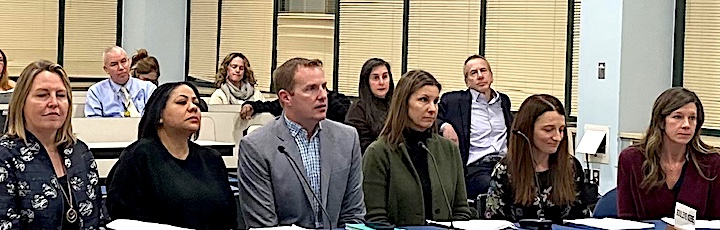
“That would be incredible,” Messler told the Board of Education last week. All students would benefit in the long run, she added.
Together, the district’s five elementary school principals and three assistant principals made the case for restoring the two positions to the 2025-26 budget.
“We believe Coleytown, Greens Farms, Kings Highway and Saugatuck are missing out by having part-time assistant principals,” Messler said.
That is not to say the work doesn’t all get done, added Carbone, but “I won’t tell you how late I work.”
Included in Supt. of School Thomas Scarice’s proposed budget, the two additional staff members would cost $405,000 between salary and benefits. It is a cost that would also be built into future budgets.
Asked to provide the board a quantitative argument for the positions that they can cite to convince the Board of Finance, the principals shared both the numbers as well as the qualitative benefits of having two assistant principals per school.
“I would argue the most important thing we do at the elementary schools is build relationships. It is at the heart of the administrative role,” Carbone said.
Currently, all elementary schools have an assistant principal dedicated to special education matters. Only Long Lots, the elementary school with the largest enrollment, has a full-time general assistant principal as well.
The other four schools lost full-time general ed APs several years ago when enrollment was falling. A general ed AP works two and a half days a week at each of those schools.
While special education APs collectively oversee time-consuming planning and placement meetings and Individual Education Plans for some 293 special education students in the district, the general APs are charged with investigating bullying complaints under constantly evolving state guidance. They oversee 504 plans developed so students with disabilities can learn in regular classrooms. In 2024, the district had 254 students with 504 plans compared to 167 in 2020-21. Each plan requires an annual meeting and ongoing oversight to make sure plans are being followed.
Restoring the full-time assistant positions will assist in that work, the board was told.
The assistant principals also oversee the district’s growing Response to Intervention Program, which identifies students who need extra support in reading and math.
The pandemic is partly to blame for the uptick in students needing help and who have behavioral challenges, the board was told.
The general APs are in charge of rolling out the district’s “No Place For Hate” initiative, as well as new curricula and the gifted program, according to Jame’el Lawrence, an AP serving both Saugatuck and Kings Highway schools.
Carbone, once an AP, became principal the first year Kings Highway switched to the part-time model.
“My vision of an instructional leader has not turned out the way I envisioned it,” Carbone said. “Under the old model, everyone knew where to go.” The divide of responsibilities was clear.
Now, during testing time, Carbone manages testing at her school when Lawrence is doing the role at Saugatuck. At times, she feels she also is doing her former job as an AP even as she became principal.
“Many responsibilities intersect,” said Erin Marschner, the full-time general education AP at Long Lots. Because she is at Long Lots every day, students know her and she knows them.
“She is the person for many people at our school,” said Long Lots Principal Kimberly Ambrosio. “It is invaluable to have her (at the school) full time when crises arise.”
The other principals describe a fractured system that lacks continuity and consistency.
Key said it sometimes feels as if her administrative team is performing triage.
Board Chair Lee Goldstein asked Key what the model was in Greenwich, where Key formerly worked before coming to Westport this academic year.
In Greenwich, each elementary school had a special education AP and five special education coordinators across the district to handle high-priority cases. That gave the APs time to perform some general education functions. There were also more central office administrators for curriculum than in Westport.
Anthony Buono, the assistant superintendent for teaching and learning, said Westport went from having a system where everyone had specific responsibilities to a haphazard one that is reactive rather than proactive.
The request for the two APs is an effort to return to a system that works, he said.
Scarice said the district did consider models other than two APs per school. The idea of making the special education AP the floater was quickly dismissed as too problematic.
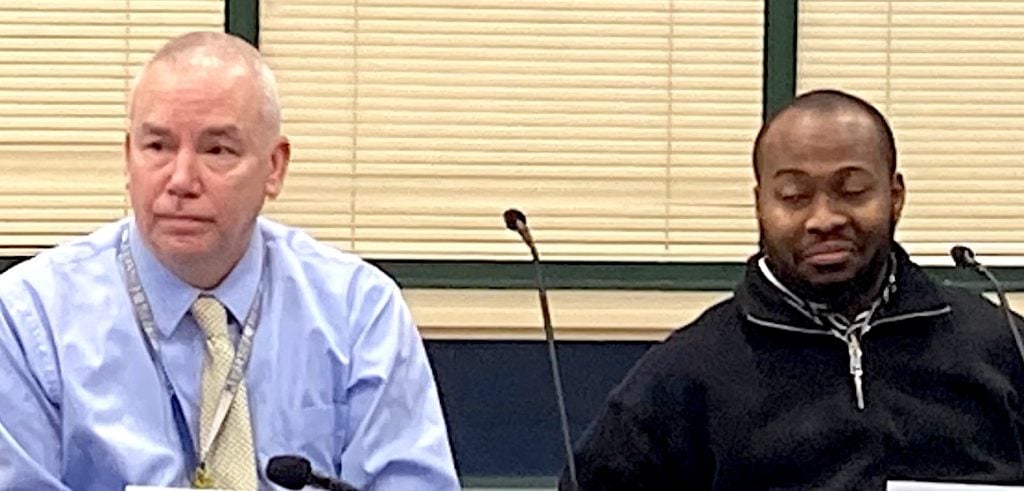
Chris Breyan, who splits his time as AP between Coleytown and Greens Farms said he feels he is playing catch up when he moves between schools.
Board member Robert Harrington called the arguments very compelling, which the town’s funding bodies should hear.
“Clearly our current system is inefficient. There are a lot of tradeoffs,” Harrington said. The district, he added, should strive for excellence, not simply getting things done.
Board Vice Chair Dorie Hordon asked the principals to explain how restoring the AP positions will help the vast majority of students who don’t have special needs.
Greens Farms Principal Brian Byrne said having an adult who can consistently form relationships with students and families benefits all. So does allowing principals to perform their instructional leadership role, the board was told.
With at least two more weeks to deliberate on a budget plan, Goldstein promised the board would have a “robust conversation” about the APs before a vote set Feb. 6.
Board of Finance member Allyson Stollenwerck, listening to the presentation from the audience, said the school board’s deliberation is something that will resonate with finance members.
Already, Harrington and board member Jill Dillon have signaled they are ready to vote in favor of recommending the AP positions.
“At the end of the day, having a leader of the school that feels really empowered … excited about what they can really achieve and do,” Harrington said. “It is a big-ticket item, but I just want it in our schools.”
Hordon said she is leaning “60-40” in favor of them.
Freelance writer Linda Conner Lambeck, a reporter for more than four decades at the Connecticut Post and other Hearst publications, is a member of the Education Writers Association.








Recent Comments