
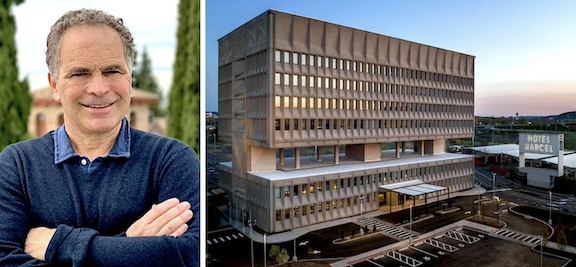
By Frank Szivos
WESTPORT — An Achilles tear of his right ankle is hobbling Bruce Becker’s plans to hike the Appalachian Trail with his wife, Kraemer Sims.
Becker lifts his walking boot onto a table in his Westport home and sips coffee. Relaxing doesn’t come easily for Becker, a nationally known architect named to the U.S. Commission of Fine Arts in May.
His schedule is typically full with architectural projects, lectures, interviews, family events, as well as biking and tennis where he recently tore his Achilles.
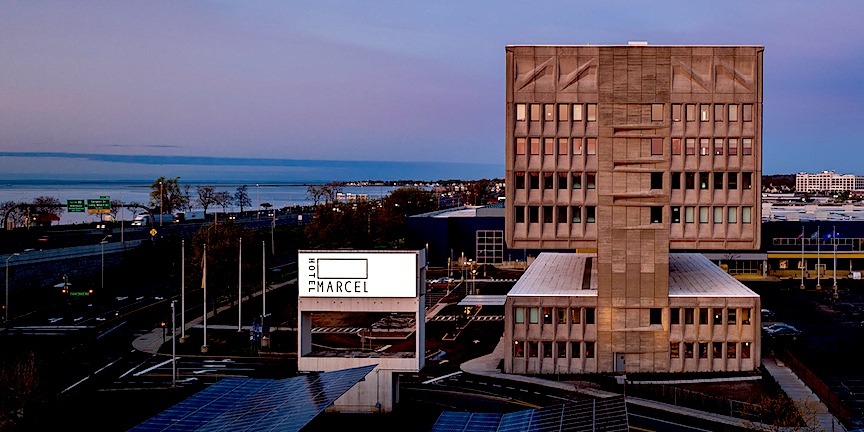
It’s ironic that the injury comes at a time when Becker, 65, was trying to decompress after several years of working 80-hour weeks while he directed and designed the renovation of the Hotel Marcel in New Haven — the former Pirelli Tire building visible from Interstate 95, sitting next to a large IKEA store.
For his revolutionary design of the first totally energy self-sufficient hotel in the nation, Becker has drawn rave reviews that were factors in his selection for Commission of Fine Arts membership.
Dressed in a pale blue chambray shirt and tan shorts, he said of this enforced break, “I’ve decided to wear the boot instead of surgery. I’m told it will heal just as well. Since my last project, I’m trying to cut down from 80-hours of work a week. I guess I’ll have to take it easy now.”
However, his torn Achilles won’t grind his schedule to a complete halt. Nominated by the White House, he will serve a four-year term on the Commission of Fine Arts, which advises on the design of public federal buildings and schools, as well as other public and private projects in the capital area.
Thomas Luebke, the U.S. Commission of Fine Arts secretary, said Becker’s architectural experience is a valuable addition to the CFA’s work. In addition to plans for public buildings, the group also reviews proposals for the design of federal landscapes, memorials, coins and medals.
“Bruce’s reputation as an architect speaks for itself,” Luebke said. “He has been a strong advocate of historical preservation in his professional projects, which fits in perfectly with our work.”

As an architect, Becker has built a career on preserving the past, redesigning and converting old and historic buildings with a modern touch. He inherited his passion for architecture — his father was an industrial designer and his mother a furniture designer.
“I care about design,” Becker said. “I’ve designed buildings both old and new. It’s a way of serving the community. Buildings have a way of defining ourselves and how we live.”
As the president of Becker + Becker Associates in Westport, he has built an impressive architectural resume that includes:
- 777 Main St. in Hartford, the abandoned Hartford National Bank, which was converted into the largest apartment building in that city with 285 units and retail stores.
- The Octagon, a 500-unit structure in New York that uses 35 percent less energy and is one of two of Becker’s apartment building designs powered and heated by a fuel cell.
- Marvin School in Norwalk, converted into affordable congregate housing for seniors, also including a child-care facility.
In all his designs, Becker incorporates a passion for the environment. His projects feature energy-conserving designs that save money with unique curbside appeal.
Consider the Hotel Marcel, which some critics have called “the ugliest building in Connecticut.”
Becker saw an intriguing structure, abandoned for the last 20 years, that featured the best of Bauhaus architecture that highlights simple, rational and functional design. The structure, originally the home of the Armstrong Rubber Co. and later Pirelli Tire Co. in New Haven’s Long Wharf area, resembles two concrete cake layers, one propped on top of the other with two stories of empty space between.
The building also features the distinctive Bauhaus elements of concrete, extensive glass, and steel with the modern touch of solar panels.
Hotel Marcel is a prime example of Bauhaus architecture, which originated in the early 1900s, focused on the merging of many artistic mediums and characterized by abstract, angular and geometric design with little ornamentation.
In fact, the hotel is named to honor Marcel Breuer, a prominent Hungarian immigrant architect of the Bauhaus design.
Since its opening in 2022, Becker’s design has transformed the structure into a luxury hotel with a restaurant, bar and 9,000-square-foot event room that is totally energy self-efficient.
“The building has so many unique features that aren’t visible from I-95,” Becker said. “From the inside of the building, the view looks like continuous glass.”
Ben Webster, the hotel’s general manager, said the 165-room hotel is thriving as word spread since its opening.
“The Marcel is such a unique place, both inside and out,” Webster said. “Bruce and his wife Kraemer have paid so much attention to detail throughout the hotel. We are self-sustainable [electrically], the only one in the country. Even our rooms are beautifully decorated in minimalist design. The hotel is a unique experience.”
Half of the Marcel’s rooms have views of Long Island Sound and are designed 12 different sizes with rates of $150 to $600 a night, depending on the time of year.
The Marcel also exhibits a unique art collection of original pieces from local artists throughout public areas and guest rooms selected by Sims, also an artist who works on many of Becker’s projects.
Becker said the Hotel Marcel is the project he’s most proud of. It makes sense since he owns the place. However, it also was his most stressful.
With an MBA as well as master’s degree in architecture from Yale, he drew on his business experience to develop and finance the project. When all was said and done, the project’s construction cost was about $30 million. In his opinion, it was all worth it.
‘It was two years of high stress,” Becker said. “I’m proud of it because I put so much of myself in it. A hotel is the riskiest business to invest in.”
Becker put together a creative financing package where he was able to take advantage of historical tax credits. He recalls the surprise intervention of the COVID pandemic posed a giant challenge.
But so far, so good, the hotel is thriving and he has restored and revived a landmark building.
As Becker sees it, designing the hotel was the logical outgrowth of all his architectural projects, including rehabbing his Salt Box home in Westport, which has been expanded and, of course, is totally electrically self-sufficient. Sixty-four solar tiles are well concealed on the home, where he and his wife raised their two sons, Jules, 26, a computer scientist, and Milo, 24, an aspiring architect.
The home is in the Compo-Owenoke Historic District. In one room hangs a photo of his original home that was later moved on the grounds — pristinely manicured, featuring two sculptures that reflect a minimalist design.
The move to an electric self-sufficient home makes sense to Becker. It reduces utility costs by at least 50 percent and creates a healthier home environment. He and his wife also drive electric cars.
One day — probably next spring — Beckers plans to join his wife to hike a segment of the Appalachian Trail again. For the moment, architectural projects are on hold. His challenge is recovering from his injury without allowing it to slow him down — much.
Franks Szivos is a freelance writer.







And the reason why such local expertise and talent isn’t consulted for the Long Lots School is?????
And 30 million for that enormous hotel but over 100 million for a small elementary school???