
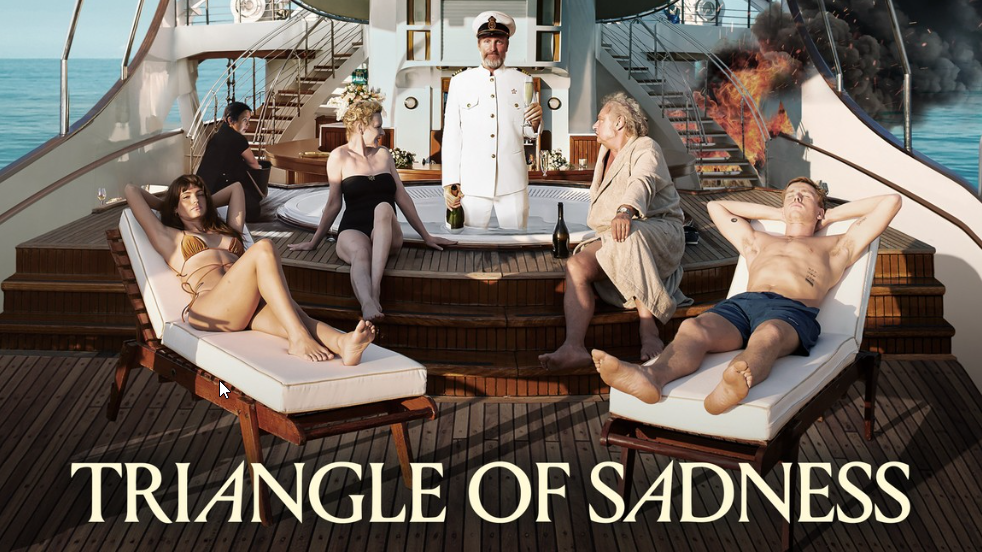

I was stunned that Ruben Ostlund’s tedious “Triangle of Sadness” not only won the top prize at the Cannes Film Festival but went on to snag three Academy Award nominations for Picture, Director and Original Screenplay.
Best known for his ski slope farce “Force Majeure” and art world mockery “The Square,” the Swedish writer-director begins this gross social satire by introducing two vapid, if photogenic models (Charlbi Dean, Harris Dickinson), an amiable elderly English weapons-dealing couple and a Russian oligarch, among others, aboard a doomed luxury yacht that is captained by a drunk Marxist (Woody Harrelson).
After an interminable interlude of mass vomiting during rough seas, the entitled influencers and uber-rich discover that their $250-million vessel has run aground, leaving them marooned on what appears to be a deserted island.
Since the pampered passengers possess little or no survival skills, they helplessly turn to the service staff, headed by Paula (Vicky Berlin). But it’s resourceful Abigail (Dolly De Leon), a toilet-cleaner, who asserts her authority, reversing the accepted social structure.
In an interview with “Entertainment Weekly,” 52-year-old Filipina actress Dolly De Leon noted that she has relatives and friends in cruise ship service: “There are 1.7 million Filipino workers sailing all over the world. I wanted to make sure that I would do right by them.”
Except for Dolly’s, the characters are superficial caricatures and – insofar as ‘originality’ is concerned – the plot is directly lifted from “The Admirable Crichton” (1957), a South Seas adventure/comedy about a British butler (Kenneth More) who takes charge after a shipwreck, based on J.M. Barrie’s 1902 stage play.
FYI: The title refers to the Botox-beckoning space between the eyebrows where frown lines are often formed – and the yacht scenes were filmed aboard the Christina O, which once belonged to Greece’s Onassis family. Languages spoken in the film include English, French, Swedish, Greek, German, Twi, Croatian and Tagalog.
On the Granger Gauge of 1 to 10 “Triangle of Sadness” is a smug, self-indulgent 6 – but, obviously, my negative opinion is in the minority on this one.

If there’s a Best ‘low key’ Actor Academy Award nomination this year, it belongs to Bill Nighy as Mr. Williams, a government bureaucrat whose life changes when he is given a terminal diagnosis in “Living,” Kazuo Ishiguro’s Oscar-nominated adaptation of Akira Kurosawa’s “Ikiru” (“To Live”).
Set in the 1950s, Mr. Williams is a reticent civil servant who commutes to London by train from his home in Esher, Surrey. He is in charge of the city’s stagnant Public Works Department, where he simply moves papers from one file to another with paralyzing inertia. He has been quietly grieving for his late wife for decades.
But when he is told by his doctor that he has incurable cancer, he’s determined to do something meaningful with the last months of his isolated, lonely life. That involves not showing up for work and going on platonic dates with Miss Margaret Harris (Aimee Lou Wood), a former employee who once referred to him “Mr. Zombie” and eventually becomes his only confidante.
Gradually he becomes aware of the need for a playground for underprivileged urban children. It was brought to his attention when a group of earnest women appeared in his office, only to be dismissed, shuttled from one city department to another.
Born in Japan and raised in Britain, Nobel Prize-winning novelist Ishiguro developed the period drama with biracial South African director Oliver Hermanus: “If you’re a writer, you learn a lot about your characters from the actors. Bill Nighy was a revelation. You realize a script is a little thing that people build things on. It’s a fantastic experience.”
Known for his minimalism and restraint, Bill Nighy is a veteran British character actor who has appeared in more than 70 films, including “Love Actually,” “Still Crazy,” “Emma” and “Pirates of the Caribbean: Dead Man’s Chest.”
FYI: Mr. Williams’ favorite Scottish song is “The Rowan Tree” written by Carolina Oliphant, known as Lady Nairne (1766-1845). It was first published in 1822 in R.A. Smith’s Scottish Minstrel.
On the Granger Gauge, “Living” is a subtle, self-reflective 7, playing in theaters.

Having grown up in Los Angeles, I have always been a bit terrified by the La Brea Tar Pits. This nationally registered Landmark is an active paleontological research site where natural asphalt has seeped up from the ground for many centuries, preserving the bones of trapped animals.
NBC’s sci-fi drama “La Brea” imagines hundreds of modern-day Angelenos suddenly surrounded by a massive sinkhole that drops them back to 10,000 B.C.
Just resuming after its fall finale in mid-November, the plot follows one family’s adventure in this prehistoric era. Disappearing as she’s driving teenagers to school are Eve Harris (Natalie Zea) and her son Josh (Jack Martin), leaving her semi-estranged husband Gavin (Eoin Macken) and daughter Izzy (Zyra Gorecki) searching for answers – which seem to be linked to a mysteriously glowing gash in the sky.
Since former-pilot Gavin has experienced cryptic visions of just such an occurrence, the Department of Homeland Security is eager to question him. One thing leads to another during the first season, as Gavin and Izzy find a portal to transport themselves back in time to reunite with Josh and Eve, along with Eve’s lover, Air Force pilot Levi Delgado (Nicholas Gonzales). That’s when things start to get a bit too cheesy.
Meanwhile, there’s an ever-growing cast of characters milling around a communal clearing: Ty (Chike Okonkwo), a psychiatrist with an incurable brain tumor; Sam (Jon Seda), a former Navy SEAL-turned-surgeon and his med-student daughter Riley (Veronica St. Clair); anxiety-riddled, perpetually stoned Scott (Rhan Mirchandaney); drug-dealing Lucas (Joah McKenzie); and LAPD detective Marybeth Hayes (Karina Logue).
Created by David Applebaum, this primeval fantasy desperately tries to be another “Lost” but becomes just too weird as the inexplicable, soap-opera-like absurdities mound. A saber-tooth tiger appears and disappears, followed by howling wolves. A huge bear corners Eve in a cave, and there’s a huge herd of stampeding bison heading for the clearing – all depicted in cheap CGI. On the Granger Gauge, “La Brea” sinks to a far-fetched 5, streaming on NBC, Peacock and Amazon Prime.











Recent Comments