
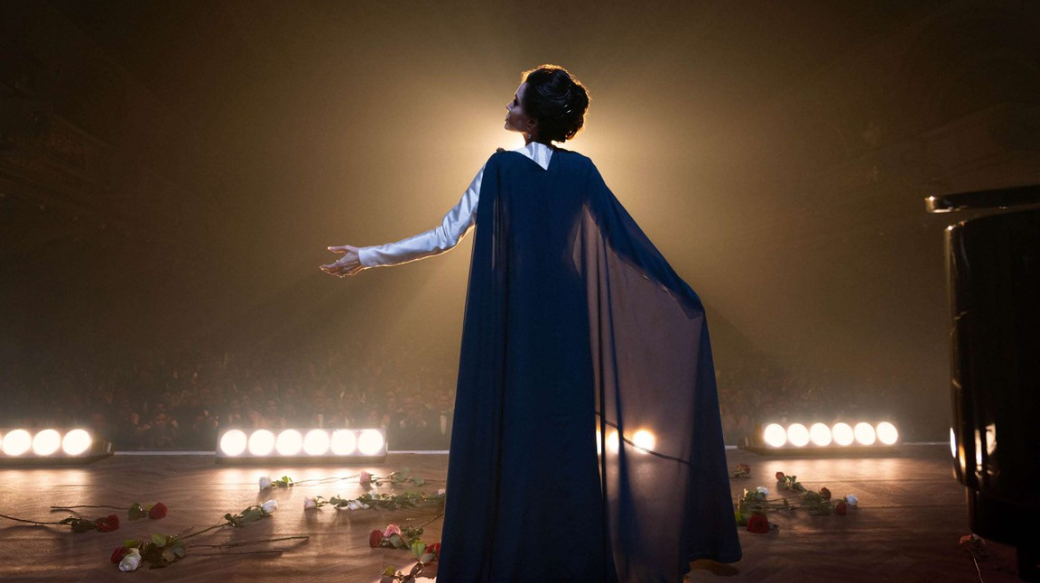
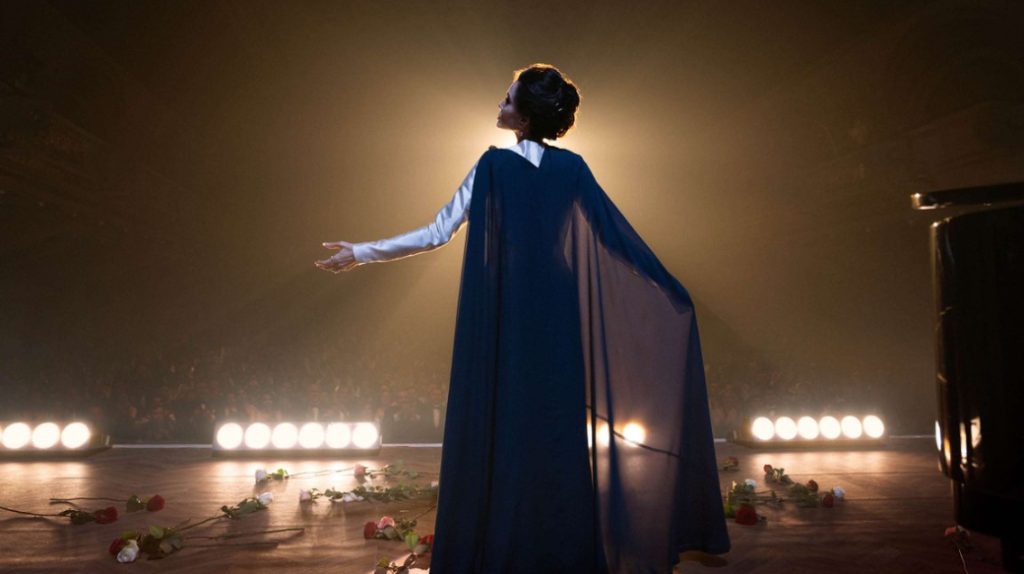
Prediction: Angelina Jolie will be nominated for a Best Actress Academy Award for her luminous, imperious performance in “Maria.” Back in 2000, she won as Best Supporting Actress for “Girl, Interrupted,” so it’s been more than two decades between trips to the Oscar podium.
Chilean filmmaker Pablo Larrain’s visually sumptuous fantasy about formidable Maria Callas begins in September, 1977, with a poignant death scene in her luxurious apartment in Paris, punctuated by her singing “Ave Maria (Desdemona)” from Verdi’s “Otello.”
Larrain insists that – after spending seven months in arduous vocal training – Jolie’s dubbed voice is blended with the opera diva’s, particularly during the scenes that take place at the end of Callas’ life when her soprano range was weaker.
Basking in adulation from her adoring fans and addicted to a powerful sedative marketed as Mandrax, then-53 year-old Callas tells her faithful housekeeper (Alba Rohrwacher) and butler (Pierfrancesco Favino): “As of this morning, what is real and what is not real is my business.”
So don’t expect meticulously researched details of a traditional biography. Instead, there are fragmentary flashbacks: Born in New York to Greek parents, Maria as a poor, fat teenager in Athens…Glorious ovations at La Scala…Her nomadic nine-year affair with predatory Greek shipping tycoon Aristotle Onassis (Haluk Bilginer), who paraded her like a trophy yet abruptly left her to marry widowed Jacqueline Kennedy.
“Perhaps we can speak a little about your life away from the stage,” an intrepid TV interviewer (Kodi Smit-McPhee) intones. “There is no life away from the stage,” Callas replies with tremulous vulnerability. “The stage is in my mind.”
Pablo Larrain will perhaps best be known for his trilogy of films speculating on the enigmatic inner lives of women so famous they go by one name: “Jackie,” with Natalie Portman portraying Jacqueline Kennedy Onassis, “Spencer,” with Kristen Stewart portraying Princess of Wales Diana Spencer, and, now, “Maria.”
If you’re intrigued, I highly recommend reading Sophia Lambton’s “The Callas Imprint: A Centennial Biography” (2023), which informed my evaluation of this film.
On the Granger Gauge of 1 to 10, “Maria” is an exaggerated yet elusive, elegiac 8, streaming on Netflix.
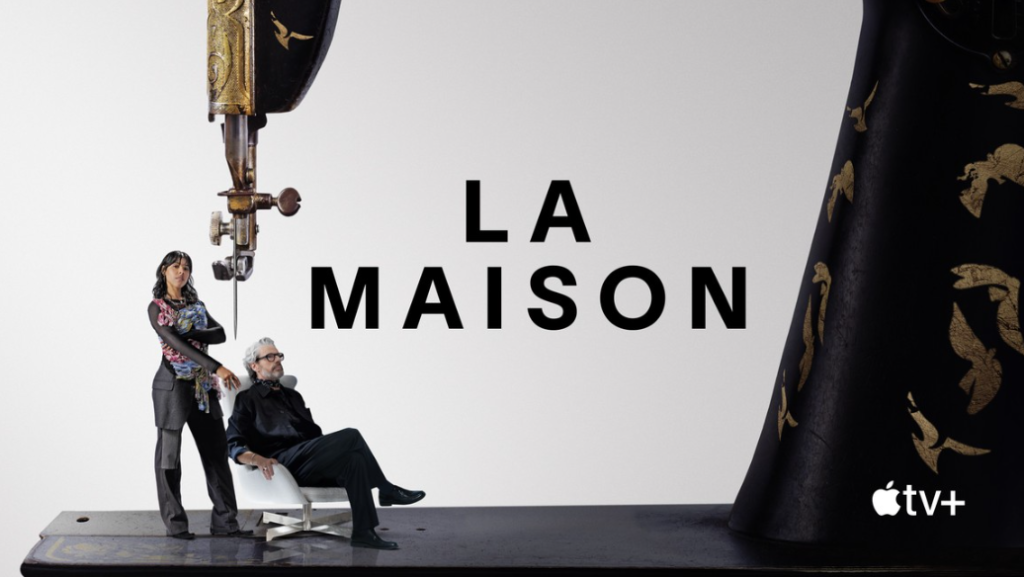
It’s been called “‘Succession’ but with better clothes” and/or “‘Emily in Paris’ for Grown-Ups” …either way, Apple TV+’s French series “La Maison” entices viewers into the century-old, ultra-luxurious, haute-couture empire that once belonged to Vincent Ledu, who has suddenly fallen out of fashion.
When an offhand racist remark ‘gone viral’ causes Ledu (Lambert Wilson) to lose control of his iconic label in an international scandal, his relatives circles like vultures, primarily his younger brother Victor (Pierre Deladonchamps) and his pampered thirtysomething nephew Robinson (Antoine Reinartz).
Complicating their inheritance claim is edgy Paloma Castel (Zita Hanrot), a visionary designer who arrives on the scene in order to learn more about her father Gino – the great love of Vincent Ledu’s life – who died when she was only two years old.
Championing diversity and sustainability, this outspoken orphan is welcomed by Perle Foster (Amira Casar), Vincent’s second-in-command/former muse, who tries to convince her boss that “a biracial activist young woman” is exactly what they need, particularly since their financial future is hanging by a thread.
Meanwhile, Ledu’s financial independence is threatened by uber-wealthy Diane Rovel (Carole Bouquet), a relentlessly avaricious predator who already controls a Bernard Arnault-like collection of luxury labels and desperately desires to acquire the Ledu brand – perhaps via her daughter Caroline (Florence Loiret Caille) who is married to Victor Ledu.
Created by Jose Caltagirone and Valentine Millville, this drama series offers behind-the-curtain insight into the unstable economics of the highest echelon of fashion which – for years – has been supported by sales of perfume and purses. With a minuscule client base (about 4,000 worldwide), it nurtures and endorses elitist designers – like Chanel, Dior, Givenchy, Gaultier, Schiaparelli, etc. – who meet the exacting, labor-intensive standards of Paris’s Federation de la Haute Couture et de la Mode (FHCM).
The first season concludes with ambiguity. There is anticipation for a second season, but that has not yet been announced.
On the Granger Gauge, “La Maison” is a sleek yet slow-paced 6 – with all 10 episodes now streaming on Apple TV+.




Recent Comments