
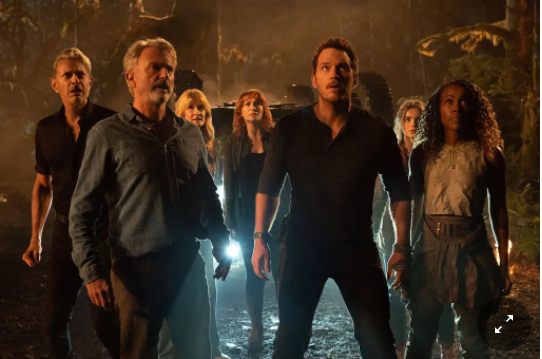
It has been almost 30 years since audiences were first awed by the sight of animatronic dinosaurs stampeding across the silver screen. Now “Jurassic World: Dominion,” the sixth installment, marks the return of the human characters who propelled previous sequels.
There’s paleontologist Ellie Sattler (Laura Dern), reunited with former partner Alan Grant (Sam Neill) and wisecracking philosophical chaos theorist Ian Malcolm (Jeff Goldblum). Add raptor wrangler Owen Grady (Chris Pratt) and former theme park operations manager Claire Dearing (Bryce Dallas Howard), foster parents of teenage Maisie Lockwood (Isabella Sermon), an orphaned clone with a unique genetic code.
In the four years since the Isla Nublar park blew up in “Jurassic World: Fallen Kingdom,” dinosaurs have roamed free, terrorizing cities and causing chaos. On the Western plains, animal behaviorist Grady herds herbivores, activist Claire advocates for dinosaur-rights and Maisie befriends the baby of a Velociraptor named Blue.
Meanwhile in a heavily guarded sanctuary in Italy, BioSyn’s sinister CEO Lewis Dodgson (Campbell Scott) with his aide, Ramsay Cole (Mamoudou Athie), is secretly developing huge, mutant locusts that will cause widespread famine, an ecological disaster that will allow him to control the world’s food supply. Corporate greed has become the villain, pushing cloned prehistoric beasts into the periphery.
An intriguing subplot involving Dr. Henry Wu (B.D. Wong) using Maisie’s DNA is briefly introduced and then discarded. Likewise, cynical cargo pilot Kayla Watts (DeWanda Wise) does a reluctant Han-Solo-ish hero bit then vanishes.
Director Colin Trevorrow wrote the nostalgic script with Emily Carmichael – and what’s been lost is the joyously dazzling wonder introduced in Michael Crichton’s 1990 novel and visually infused in Steven Spielberg’s spectacular original 1993 film.
Problem is: as a result of frenzied storylines, numerous gargantuan species and too many bumbling characters, there’s no emotional connection. And when two savage CGI apex predators finally grapple, it’s over a puny deer carcass. Perhaps this cautionary tale heralds the extinction of the once-beloved Jurassic franchise.
On the Granger Gauge of 1 to 10, “Jurassic World: Dominion” is a sentimental, yet overstuffed, superficial 6, playing in theaters.

In his 1998 film “Crash,” controversial Canadian filmmaker David Cronenberg presented viewers with fetishized and eroticized automobile collisions. Soaking up that controversy, just one year later Cronenberg wrote the original script for “Crimes of the Future.” Perhaps it was supposed to be a companion piece.
This time, Cronenberg presents a dystopian future when humans have lost the ability to feel physical pain. Perhaps because people eat and metabolize plastic, the human body has evolved, unpredictably growing invasive, nonfunctional organs. It’s called Accelerated Evolution Syndrome.
Working together, avant-garde performance artists Saul Tenser (Viggo Mortensen) and his partner/lover Caprice (Lea Seydoux) have developed a popular gimmick that involves her surgically excising an excess organ from his black-hooded body lying in a high-tech bed called a Sark module as the rapt audience snaps photographs.
They’re spotted by representatives of the shadowy, sinister National Organ Registry: Wippet (Don McKellar) and Timlin (Kristin Stewart), who burbles: “Surgery is the new sex.”
Then there are sycophantic technicians Berst (Tanaya Beatty) and Router (Nadia Litz), working for the company responsible for the remote-control equipment that Saul & Caprice use.
Meanwhile, Brecken (Sozos Sotiris), an eight-year old boy (whom we’ve seen munching plastic in the prologue) is smothered by his mother. His father (Scott Speedman) begs Saul and Caprice to use the child’s body in their act and reveal the truth about his death via an on-stage autopsy.
As nosy Detective Cope (Welket Bungue) lurks nearby, this subplot reveals an environmental warning that becomes increasingly relevant.
If gruesome, disgusting imagery appeals to you, warped Cronenberg offers a bizarrely graphic buffet of body horror, including stomachs sliced & diced and eyes/mouths being sewn shut.
After making “EXistenZ,” “A History of Violence,” “Eastern Promises,” “A Dangerous Method,” among others, this is David Cronenberg’s first feature in eight years. Yet back in 1970, he made another experimental film, also called “Crimes of the Future,” in which patients at a skin clinic used a dangerous cosmetic.
On the Granger Gauge, “Crimes of the Future” is an extreme, stomach-churning 3, definitely not for the squeamish, in theaters.











Recent Comments