
By Kerri Williams
WESTPORT – For Valerie Seiling Jacobs, the problem is all too real. Her neighbors rented out their home last summer to people who constantly blared music over loudspeakers as they gathered by the pool.
“It was so loud,” Jacobs told members of two Representative Town Meeting committees Monday. “We couldn’t get them to stop.”
Some RTM members are hoping to introduce an ordinance that would give residents like Jacobs some recourse.
Several members of both the Health and Human Services and Environment committees voiced support for an ordinance that would target “loud and excessive noise.”
The ordinance would be in addition to the one already in place that applies only to gas-powered leaf blowers, said Ellen Lautenberg, chair of the Environment Committee.
“There are a lot of other things that create noise,” she said.
Lots of noise, few controls
The only other proviso in the town’s ordinances that addresses noise applies to construction/repair work and the designated hours during which it is permitted.
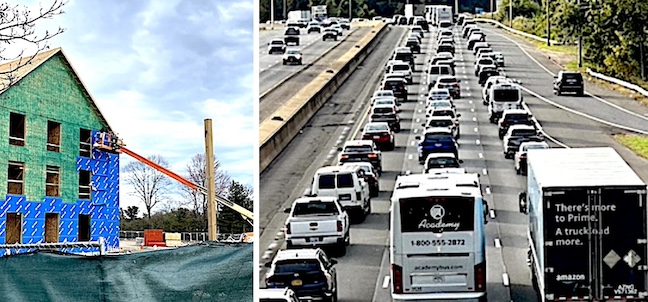
In addition to leaf blowers, committee members talked about disruptive noise generated by heavy equipment and construction, concerts, highways and music like Jacobs dealt with.
While members agreed that a certain amount of noise is inevitable, they said it would be helpful to have something in place for situations that can be controlled. Such ordinances already have been adopted in nearby communities such as Fairfield, Stamford and Greenwich, according to Wendy Batteau, chair of the Health and Human Services Committee.
In the past, noise ordinances have been hard to enforce because they set a decibel threshold to measure violations, according to some members. But the Fairfield ordinance, which was amended in 2023, uses more general language, Batteau said. “It’s quite comprehensive.”
Noisy network of highways
For another town resident, noise that proves most annoying is not so easily controlled. Bonnie Edwards said that the biggest issue is highway noise for a town, like Westport, sandwiched between Interstate 95 and the Merritt Parkway.
“There is continuous noise from the highways,” Edwards said, adding that she believes it can be a factor in health problems.
Other local sources of noise that would be harder to control include construction, especially in the downtown area, street sweepers, concerts at the open-air Levitt Pavilion and even the annual fireworks display over Comp Beach.
For Jacobs, an ordinance would be a way for residents to regain some control of noise issues in their neighborhoods.
“There is a lot of suffering due to noise,” she said. “And people don’t have any recourse.”
Kerri Williams is a freelance writer who has worked in journalism for years, including as a reporter for the Norwalk Hour and managing editor of the Norwalk Citizen-News.










The sound bleed from the Levitt can absolutely be mitigated – but it’s presently protected from accountability by a special committee of political appointees. That committee was originally intended to safeguard the interests of residents but the script was flipped years ago.
The crazy thing (and I have experienced this a few times) is that people can have parties in their backyards with DJs, musicians, full soundsystems, that are less restricted than Levitt Pavillion.
Fun fact: In response to resident complaints, the previous administration developed a comprehensive sound mitigation program for the Levitt. It was widely distributed amongst elected folks – and last seen resting comfortably on a shelf in town hall.