
By Linda Conner Lambeck
WESTPORT — Explicitly teaching students about social and emotional well-being is all well and good, but will students pay attention if the instruction doesn’t come with a grade.
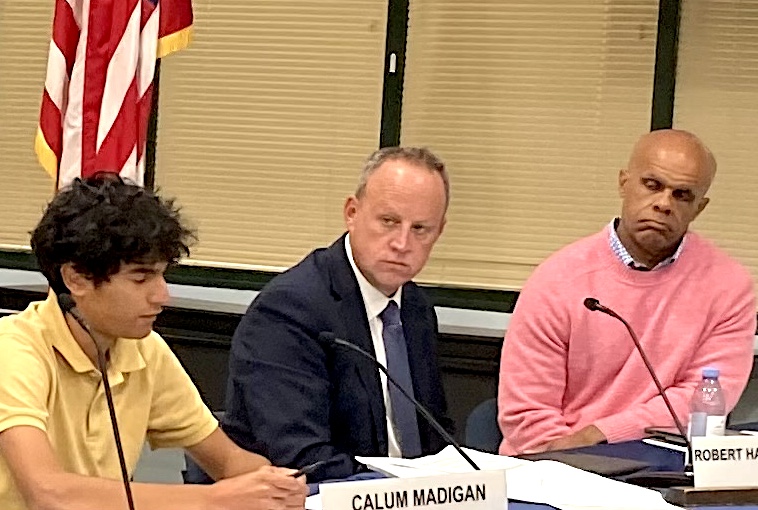
Calum Madigan, a Staples High School senior and student representative to the school board isn’t so sure, particularly at the high school level where good grades are everything.
“What will be the ‘so what’ factor to this?” Madigan asked during a Board of Education update last week on the district’s strategic plan as it relates to student well-being.
At the high school level, some of the instruction will be part of a required, but ungraded, “Connections” advisory group that all Staples students attend twice a week.
“A lot of students go into school and their sole motivation is getting good grades,” Madigan said. “Academic success, getting into a good college. They are going to do what it takes to get good grades.”
Better, he said, to incorporate the instruction into a class where they have to learn it in order to get a good grade.
But Madigan added that his question was rhetorical, and assured the board he agrees with efforts to teach students to regulate their feelings, use effective language to resolve conflicts and practice skills that will make them happier and healthier people.
Harsh reality: ‘Transactional’ high school is all about good grades
Supt. of Schools Thomas Scarice said Staples is so academically focused that finding time in the schedule to teach social and emotional learning, or SEL, lessons was a challenge. Connections seemed like a natural entry point for targeted lessons about things like stress management and having courageous conversations, he said.
The material will also be addressed in the district’s required health curriculum courses, and in a wellness seminar, which is an elective course. Both are graded.
A third way is to weave the topics into literature and social studies classes. “It’s a constant challenge,” said Scarice. “High school is transactional. You go in, do your work and you get paid with grades. That is the crass reality of the American high school.”
Board Chair Lee Goldstein said she disagreed with the notion that students are only in it for grades.
Board Vice Chair Dorie Hordon wondered how impactful some of the lessons will be if they are not related to a personal issue students may be going though.
“It is more abstract when you are learning lessons not happening to you. It’s not real,” Hordon said. “It is more impactful when you are going through something, and you get tools to deal with it.”
Making a far-reaching plan meaningful
Valerie Babich, the district’s director of psychological services, told the board that at the high school level, most students will already have been introduced to restorative practices and ways to express themselves. The concepts won’t be foreign to them, she said.
Assistant Supt. Anthony Buono said in some respects the material just imparts good communication skills and other helpful life skills.
Scarice said the school district’s overall Strategic Plan, developed largely during the pandemic, is ambitious and far-reaching.
On Nov. 2, the board will get a presentation on the growth mindset part of the plan. Last week, the focus was the part dealing with student well-being and on how to make students collaborative problem solvers.
Babich said that over the summer a clear scope and sequence for direct SEL instruction was developed to ensure all students are exposed to the material.
The elementary level already teaches a program called RULER, which teaches students to identify and regulate their emotions. Added to that, she said, will be some second step lessons, and select lessons from the Anti-Defamation League.
At the middle school level, all staff received training, and lessons will be given periodically at sixth, seventh and eighth grade on such things as mindfulness, tolerance, relationship and community building and digital citizenship.
As part of the high school initiative, in addition to instruction, an SEL Committee is looking to create a high-interest, culminating end-of-year activity that would involve all students with the aim of increasing belonging and fostering school and community engagement. Babich said a final decision on the activity has not been made.
Madigan said a competition between Connections classes might get students excited.
Giving students more chances for leadership, feedback
A second part of the Strategic Plan involves magnifying student voices by giving them more leadership opportunities and more chances to provide feedback on school practices and lessons.
At the elementary schools there are student leadership groups that meet monthly with the principal. The two middle schools have student advisory groups to share ideas and provide feedback to the principals monthly. The high school now has a Student Council with broader representation from the student body. The council meets twice a month, once monthly with the principal.
There are also two student representatives to the school board. In addition to Madigan, a senior, a second student representative is expected to be named shortly.
Beyond leadership opportunities, efforts are being made to solicit student feedback through surveys, focus groups and course feedback across the district.
At the elementary level that will include teachers delivering a brief lesson to third through fifth graders on the purpose feedback and how to give it.
At the high school this year, every teacher will solicit anonymous student feedback once a year.
Freelance writer Linda Conner Lambeck, a reporter for more than four decades at the Connecticut Post and other Hearst publications, is a member of the Education Writers Association.





Recent Comments