
By Thane Grauel
WESTPORT — Discussion of a proposed ordinance regulating gas-powered leaf blowers Monday drew a group of landscapers who want a say in drafting final language of the policy.
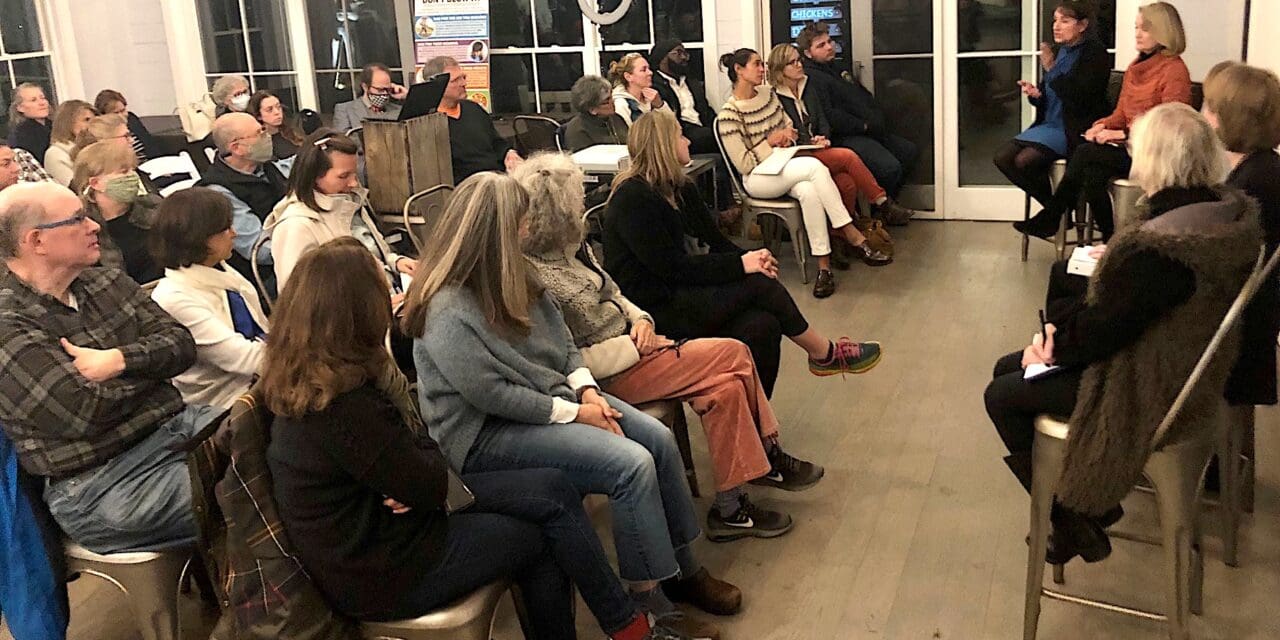
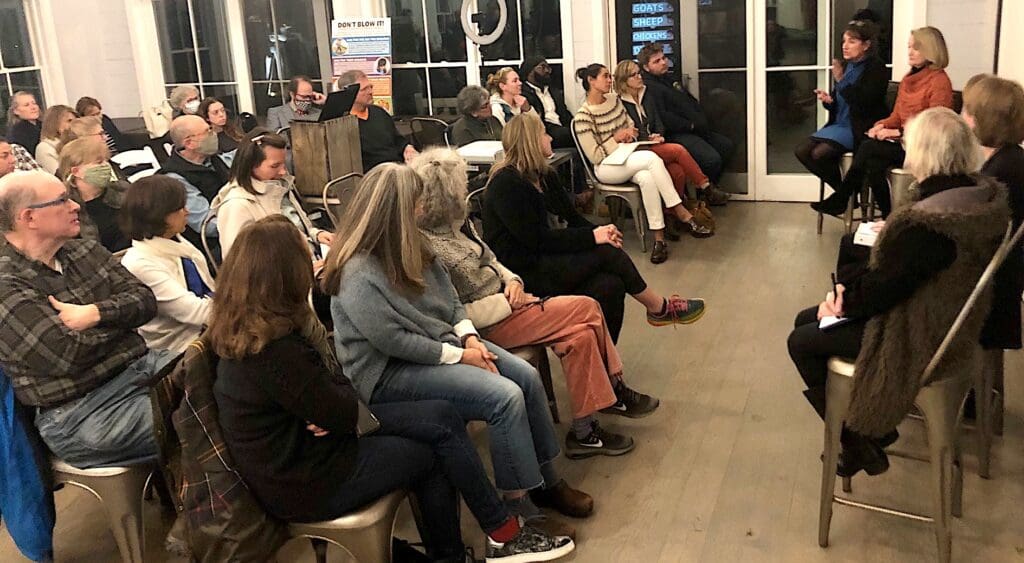
The program, attended by about 60 people, took place at Wakeman Town Farm. The crowd included landscaping company owners and workers who filled more than two rows of seating in the audience.
“It’s important to note that this is not a ban on gas-powered leaf blowers,” said Kristin Schneeman, a Representative Town Meeting member from District 9, and one of the ordinance’s sponsors. “It’s a seasonal restriction. This is probably the most common approach in places around the country.”
Leaf blower noise, pollution targeted
A PowerPoint presentation to the gathering showed that gas-powered leaf blowers aren’t just noisy, but very polluting.
One of the panelists, Valerie Seiling Jacobs, a lawyer and advisor with the non-profit Quiet Communities, said that using a gas-powered leaf blower for 30 minutes creates as much pollution as driving an F-150 pickup from Texas to Alaska.
The exhaust from leaf blowers contains several known carcinogens, she said, and they also are a main contributor to ground-level ozone.
“We have the worst ozone problem in the state of Connecticut,” she said. “During the summer, we had 12 days where the ozone level exceeded the EPA [Environmental Protection Agency] maximum. And not just by a little bit, folks, on five of those days were almost 30 percent over the maximum.”
Alice Ely, a master gardener involved with environmental causes, spoke about the effect gas-powered leaf blowers have on habitats.
“We have to rethink yard cleanup for the sake of all creatures,” she said. “Sterile gardens make for silent springs. We have to get rid of our appetite for perfect, manicured lawns.”
Ordinance still under review by RTM
If an ordinance is passed by the RTM, following more review by its committees and public hearings, Westport would join about 200 communities nationwide that regulate when and what equipment homeowners and landscapers can use.
The measure, as it stands now, would allow use of gas-powered blowers for two six-week periods annually — Nov. 1 to Dec. 15, and March 15 to April 30. The devices would be prohibited during all other weeks of the year.
Electric and battery-powered leaf blowers, which are not as noisy and less polluting, would be allowed year-round. There would be exceptions to the gas-powered rules for golf courses and public works projects, as well as during a state of emergency.
Gas-powered blowers would be restricted to one unit on properties smaller than an acre, two on parcels between one and two acres, and three on three-acre parcels.
Police would handle enforcement of the rules.
Landscapers concerned about scope of ordinance, cost to clients
John Sweeney of Westport, who owns a landscaping business, said the “a lot of the stuff you presented is somewhat factual, and true. But the way you’re spinning it into one, only leaf-blower, ban is a little bit concerning to us in the landscaping community.”
“We as landscapers need to be heard, which is what this is kind of about, but we also need to be involved with your decision making,” he said.
“There’s a lot of equipment, you can’t just ban one piece,” Sweeney added. “It’s like me taking your laptop away. It’s an efficient tool for the landscaper.”
Mike Switser of North Country Landscape Management, and representing the Connecticut Groundskeepers Association, said, “Many of you are probably used to pulling out the checkbook and writing big checks to clean big properties.
“I think it’s really going to hit a lot of people in the pocketbook, and a lot of those people may not be as well-heeled as some of the people who want to fight leaf blowers,” he added.
“I’m prepared to tell my clients it may be up to 75 or 100 percent more to clean the property” Switser said, contending that work would be more labor-intensive with electric tools.
Program organizers asked the landscapers to stay after the session ended so a meeting with them could be organized.










The noise level will not decrease because there will be many more electric leaf blowers and the meeting should have had a live demo of the kind of electric leaf blower that will be used. Believe me the bog ones are noisy.
Get a rake, stop being lazy.
The noise level is out of control. We should pass an ordinance that requires blowers to be below a certain noise level. Can’t wait.
Electric leaf blowers are just as noisy as gas powered ones. If you only have one leaf blower, it will take even longer to clear a property than 2 or 3 working together. So more emissions and longer periods of noise at a higher cost. It’s not fair to assume that everyone in this town can afford the drastic increase in pricing from this ordinance. This needs to be re-evaluated. They need to consider the keep costs for homeowners, and the livelihood of businesses in mind. Not just the environmental impacts.
If noise is such a big concern what about the traffic noise? Some cars have fittings on their sports car to make more noise, commercial vehicle make so much noise driving in residential area. The town doesn’t do anything to fibrils traffic or pollution or noise from cars that goes 24/7 but they want to control noise from gas blower that happen during day time just for few hours? Hope the town pay attention on real issues that creating problems to the community
I lived in a community that had a policy for leaf blowers. Only 9-5 on weekdays. Not. Allowed on weekends