

By John Schwing
WESTPORT — With early voting already underway in advance of the Nov. 5 election, candidates in three districts representing Westport in the General Assembly made their closing arguments Tuesday at a midday forum organized by the Westport-Weston Chamber of Commerce.
The event, which took place in the Westport Library, saw six contenders running in three legislative districts face off:
- Jonathan Steinberg, incumbent Democrat, and John Bolton, Republican, in the 136th House of Representatives District.
- Dominique Johnson, incumbent Democrat, and Peter Bang, Republican, in the 143rd House of Representatives District.
- Ceci Maher, incumbent Democrat, and Kami Evans, Republican, in the 26th Senate District.
The “open discussion debate,” as described by Matthew Mandell, the chamber executive director, differed somewhat from more traditional candidate debates. The question/answer/rebuttal format also allowed any of the candidates to chime in for what was designed to be a more free-wheeling discussion of the issues.
Many of the candidates’ answers, however, proved to be familiar and, in some cases, well rehearsed.

Bolton, as he has at two earlier debates, laid into Steinberg for “doing nothing” over the course of his 14 years in the legislature to replace the state’s 8-30g affordable housing law, which he called a “howitzer” pointed at towns like Westport.
A member of the town’s Planning and Zoning Commission, Bolton again promised to be an eighth planning and zoning commissioner in Hartford, bringing a “Westport voice” that needs to heard on the issue.
Steinberg defended his housing record, as he has previously, saying he repeatedly sought to change the law over the course of his legislative career. He said the law has primarily served “predatory developers” and that it needs to be replaced, adding that he has the clout to help make that change and to block other proposals that could be more burdensome for communities like Westport.
On the economy, Evans said a major factor limiting growth and employment is the “affordability” challenge facing area residents like herself, a single mother raising two children in an 850-square-foot home with energy bills that hit $500.
Maher said the state’s economy had expanded more than 3 percent over the last two years, buoyed by growth in new technology and bioscience businesses, as well as a rebounding manufacturing sector.
That figure was challenged by Bolton, who said the Federal Reserve has reported the state has suffered eight years of shrinking growth.
Contending for the seat in the majority-Norwalk 143rd House District, Johnson and Bang were squaring off the first time in Westport this election season.
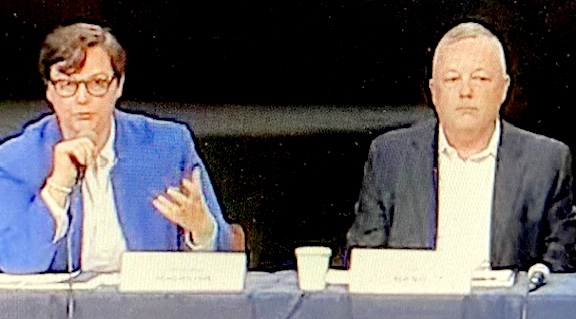
Johnson lauded the success of the state’s “fiscal guardrails” imposed amid a 2017 budget crisis, which she said has produced a record-breaking budgetary rainy day fund and allowed the state to pay down $8 billion in outstanding pension debt, producing interest savings of nearly $700 million and the biggest tax cut in state history over the last two years.
Bang, however, noted the state still has about $100 billion in unfunded pension liabilities, which he said means the state does not have the luxury of funding “additional feel-good” programs by adjusting the guardrails’ volatility cap tied to capital gains as Johnson suggested.
The biggest problem of what he called “one-party rule” for several decades, referring to Democrats’ legislative majorities, is that “you end up wanting to give free candy” to favored constituency groups. He advocated for the “tough medicine” of leaving the guardrails in place unchanged.
Maher contended the pension debt is $40 billion, not $100 billion as Bang said, although still “a lot, a lot of money.” But, she added, paying down the debt frees up money that otherwise would go to pay interest and allows for spending that is not “free candy,” such as for nonprofits that she said have become the frontline for various social services in the state.
Steinberg proclaimed himself “a champion” of the fiscal guardrails, which allowed interest savings that contributed to the recent tax cut and can be used in the future for things like infrastructure investments. Bolton, however, questioned if the state budget surplus is real or the product of “fancy accounting,” and contended if there had been “responsible legislation” over the last several decades there would be no need for fiscal guardrails.
On the question of reproductive rights, the candidates were broadly supportive of the state legislature codifying a woman’s right to abortion after the U.S. Supreme Court overturned the federal Roe vs. Wade guarantees.
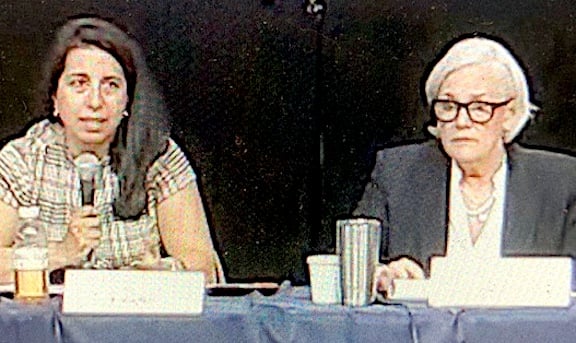
The discussion also prompted a deeply personal revelation by Evans. “I personally suffered a sexual assault at a young age, and that resulted in me having to have an abortion,” she said, which later resulted in “shame” she later felt about the incident. She called for more education about reproductive rights and related issues so people facing those challenges can make informed decisions.
Maher, a member of the legislature’s Reproductive Rights Caucus, said depending on the outcome of this year’s national elections, Connecticut may need to take the extra step of ensuring those rights by amending the state Constitution.
Additional attention also needs to be given to ensuring there are no restrictions imposed on IVF and frozen embryo procedures, Maher said, as well as the ability to prescribe mifepristone, a pill that can end a pregnancy, via tele-health consultations.
Johnson, in agreement, added that she feels she has fewer rights now “as a middle-aged woman than I did when I was born in 1977,” and promised to be “a fighter” to ensure younger generations have the freedom to make their own reproductive decisions. Bang, her opponent, agreed with the legislature’s decision to codify Roe vs. Wade and also backed IVF protections because of “personal experience.”
Steinberg said he is “intensely proud” of the legislature’s action to protect the rights of Connecticut women and medical professionals, but also those in other states like “wacko Texas” that have tried to impose sanctions on their citizens seeking care in states like Connecticut.
Bolton, who said he “absolutely believes in a woman’s right to choose and do what’s right for herself,” added some “reasonable limitations” should be considered. He said both sides of the debate should stop fanning the flames, and though he supports the results of the 1973 Roe vs. Wade decision, feels it was overturned in 2022 because the ruling itself was flawed.
And what Bolton called the “mantra” of “my body, my choice” for abortion rights is one that also should be applied to vaccination policies. Steinberg shot back that he was “pissed off” to hear Bolton draw an equivalency between the two issues, arguing that abortion is an individual woman’s choice while vaccine immunization is an issue that affects an entire community.
The candidates also discussed, and differed, on a range of other issues, including taxes, energy costs, jobs and workforce development, and bringing home “the bacon” to their respective districts from Hartford.
To see the full debate, recorded for the Westport Library’s YouTube channel, click here.








If it’s a Democrat, vote for it.
Due to the Democrat majority in the CT legislature, bills have been introduced and passed by the Democrats that have protected alien felons from deportation ( HB 5543), tied the hands of police who are trying to protect you (HB 6004), brought zoning changes that have already had negative effects on our town (8 30 G) and have plans to make even more onerous changes (Fair Share, Gen. Ass. Bill 6633). If it’s Democrat DON’T vote for it.
Let’s see what happens!
I AM NOT in Jonathan Steinberg’s campaign.
However, as a member of the electorate I find it disturbing when a candidate attacks an opponent with absurd and disingenuous generalizations in order to make themselves appear “strong”. It doesn’t. On the contrary it makes them look foolish. For Mr. Bolton to accuse Representative Steinberg of “Doing nothing” over 14 years to repeal or modify the 8-30g situation is so obviously uninformed and ludicrous, it is embarrassing. Clearly, such line of “bully pulpit attack” is a campaign strategy that Mr. Bolton must be enamored with.
Mr. Bolton should consider the fact that 14 years of representation has permitted development of important relationships, generated respect, and garnered significant rapport that Mr. Bolton can only dream of having…and his ubiquitous “Angry Man” temperament and self-serving accusations is unlikely to ever serve him well in any forum dependent upon developing partnerships and working with others across the aisle.
Memo to Mr. Bolton: No individual representative has the ability to change the 8-30g statutes – they can only work with others to try. This is not the ‘dictatorship” that Mr. Bolton seems to envision.
In addition, a representative of the people must have the greater interests of society in mind when making crucial far-reaching policy decisions. While there is a time and place for “individual liberty”, Mr. Bolton clearly cannot distinguish when societal interests must take precedent. His dangerous comment about critical vaccinations being a “personal choice” evidences a complete lack of understanding that vaccinations have revolutionized global health and saved more lives than any single medical breakthrough. In many instances the “greater good” is also “the individual’s good”. The cumulative number of childhood deaths averted as a result of vaccinations for diseases such as measles, pertussis, tetanus, diphtheria, TB, polio, yellow fever, etc. since 1974 has eclipsed ONE HUNDRED FIFTY MILLION CHILDREN. As one website states: “That’s 150 million children who will grow up, experience life, and contribute to the world; over 100 million sets of parents who were spared the tragedy of having to bury their children”. (Hannah Ritchie Our World in Data).
Mr. Bolton’s perspective, as reported by the Westport Journal was Ill advised and done without due consideration of the mortifying adverse societal repercussions that he apparently advocates. His perspective likely translates to his views regarding gun violence and an individual’s right to own assault weapons. There is no place for Mr. Bolton’s perspectives and his angry temperament in our representation.
In my opinion a candidate should not seek office to simply represent a political party, as seems to be apparent in this instance. While fresh ideas are always welcome, bullying, grand-standing, self-aggrandizing accusations and dangerous advocacies are not in anyone’s best interest – other than someone putting personal political aspiration over a community and societal welfare.
In my view, Mr. Bolton has disqualified himself with his own words and temperament.
Why not just focus on the positions of the candidates? Mr. Walshon clearly prefers Mr. Steinberg’s demeanor to Mr. Bolton’s. I personally find Mr. Steinberg to be rather imperious. If all the laws I previously mentioned, that have been implemented via the efforts of the Democrat majority, are to your liking, then I suppose you will vote for Democrats again. As for the “bully pulpit” accusation against Mr. Bolton, the person occupying the office would be the one with the power of the bully pulpit, which is Mr. Steinberg. Moreover, Mr. Steinberg’s 14 years of “relationships, respect and rapport” have not produced the results we should expect. Saying that we cannot expect to change the 8 30 G statutes begs the question as to how anything gets changed for the better with that type thinking. We send people to Hartford to get bad law changed and good law implemented. Clearly sending Mr. Steinberg and other Democrats back will give us the same bad laws with worse to come.
Ms. Wylie,
A bully pulpit might be more generally defined as “having a conspicuous position that provides an opportunity to speak out and be listened to”.
Using his position on the P&Z as a credential, and more importantly his position as the Republican candidate running for an important political office, Mr. Bolton was granted podium opportunities from which to impact the electorate towards his perspectives and advocacies. Yes, fortunately, he is not in a position that carries any weight. My utilization of the term “bully” was obviously more reflective of the strategy that he chose to use his time.
You say the you “expected more results” from Representative Steinberg’s efforts in Hartford…clearly that is a subjective opinion that again seems to misunderstand how the legislature works. And I never implied that the 8-30g statutes cannot be modified – but it requires the willingness of the disparate elected officials working towards that as a common goal and the leadership of our State executive. Mr. Steinberg is not capable of doing so on his own.
A strategy of blaming anyone and everyone with a D before their name has become tiresome, and is an insult to those in the electorate demanding honesty in those seeking to represent them. It has resulted in the comically absurd notion that Democrats created and then utilized two hurricanes to gain political advantage.
Which brings me to my final point.
I grant you that “Focusing on the positions of the candidates” has importance. My critique of Mr. Bolton’s malignantly dangerous “position” on vaccinations is one glaring example.
However thusly restricting one’s evaluation is an anemic and myopic approach to candidate evaluation, for we all know that pandering to the electorate is ubiquitous during political campaigns. An informed electorate widens its horizon to include critical “issues” such as a candidates character, comportment, prior history, legal tribulations, associations, motivations, aspirations, insight, capabilities, acumen, etc.. – issues that can be more predictive of what an elector will get than merely a candidates espousals and “promises” during a campaign.
That a candidate would espouse that there is an equivalency between a woman’s “right to choose” with vaccinations puts Mr. Bolton’s capacity to comprehend critical distinctions in question. It places his insight into communicable disease, epidemiology and scientific method, and the deleterious consequences of his position, in question. It illustrates a dangerous defiance founded in ignorance and lack of expertise. It elucidates deficient acumen, i.e. the ability to make good judgments, even when lives would be imperiled. A strategy based primarily upon anger, grievance, and unreasonable blame, while promoting that he’s the solution, is pretentious self-aggrandizement suggesting the motivation of personal aspiration.
Given your prior political commentary, editorial, and endorsements, that you would be the immediate defender of Mr. Bolton is certainly predictable.
However considering that your declared Mr. Camilo Riano to be “Just what the doctor ordered” for Westport – and he went on to lose that election to a candidate who was not even on the ballot (BY OVER TWICE AS MANY VOTES) – perhaps suggests that your endorsement might not be well received by any candidate seeking office. I imagine that Mrs. Tooker might even request your silence during any re-election bid.
My personal suggestion for what its worth (which may be nothing) is that rather than reflexively blaming and disparaging the candidates with a D before their name, our political leadership should vet their candidates better, and provide the electorate with more qualified and desirable options to consider. We all deserve far better than this incessant “blame game”, and what our RTC has recently presented.
I think you may have said it all with your self assessment that your opinion may be worth nothing. As for your first point, in a debate between one currently occupying an office and one seeking the office, the one with the more “conspicuous” position (office holder) would have the bully pulpit. John Bolton is hardly a bully in that or any other sense of the word and is merely presenting his case as to why having constant Democrat party rule should be reconsidered in light of the direction this state and town are going. I have tried to give information to the public that can be looked up via legislative records and assessed by them. They can then decide if they like the results of more crime, illegal felons moving into CT, low income housing projects going up all over town, etc, etc.
What Camilo Riano has to do with any of this, I really don’t know. However, I do know that he would have been a great choice for the BOE, in view if the fact that he was fighting another Democrat policy of DEI in the schools.
Accusing me and John Bolton of attacking and disparaging the Democrats by elucidating their policies and the results they have produced is absurd. These bills were introduced and passed by the Democrat majority. Own it.
I have yet to see you “elucidate their policies.” I just see unhinged rants.
With DEI “woke” and every other conservative bugaboo, you create your own definitions and then argue against your own words instead of taking on any reality with which you might disagree,
I mean, for at least a couple of years you have ranted about affordable housing, constantly laying blame on Westporters whose views threaten you, showing a baffling level of ignorance about something that is state law, not local mandate.
That you often veer into condescension when responding to those with whom you disagree is an almost transcendental level of irony, given how ill-informed you are, about these issues on which you rant.
You have yet to see me elucidate their (Democrat) policies? Refer to my previous letter in this thread in which I provided the legislative bill numbers which can be looked up and read. That would be called elucidation or a “clarifying explanation” (Webster dictionary definition).
You continually describe me as “ranting”. This is a classic case of what is referred to in psychology as “projection”, since the only one who sounds like they are “unhinged” and “ranting” is you.
Moreover, your ignorance is displayed when you absolve our local representatives of responsibility for the zoning changes that are destroying our town. We elect the representatives we send to Hartford. They enact the laws that the residents of the state have to live with. We have been sending Democrats to Hartford for a long time and the results are onerous zoning changes, criminal protection changes and sanctuary state changes that now, according to State Sen. Sampson, designate us as a super sanctuary state protecting illegal alien felons from deportation. If this is what citizens want, they can vote for more Democrat representation. I believe information is more important than emotional vitriolic attacks on me,which are completely lame and unsubstantiated (making up my own definition of woke and DEI) what?
There really isn’t anything more to say on this subject and I really don’t like to have to keep repeating information I have already provided. Remain ignorant if you wish.
Sharon, Can you provide any facts about the illegal felons moving in to CT?
I assume you mean immigrants? And they’re felons? Or are you confusing them with Trump the felon?
I sure can, HB5543. Protecting illegal alien felons (which is what I already said). If you like it, vote for more of it. It’s a free country. Nothing but common sense can stop you.
Sharon, Above you said illegal felons moving in to CT…. so I was curious as to your facts on this influx. So that’s false. The house bill I believe you are referring to was about local and state deportations. It said nothing about immigrants being felons. And not sure it passed, as there are may HB5543 and I don’t find that in the law. Nevertheless, just more incorrect fear mongering.
Boy, is this becoming tedious. It is HB5543 House session 2018 that reduced the number of days an illegal alien felons would be incarcerated here in CT. from 365 days to 364 days because 365 or more resulted in automatic deportation. Ask State Sen. Sampson for the details. The citizens should be fearful of what Democrats are doing.
Anyone who is confused on the issue of what Democrats want to do regarding illegal alien criminals, watch State Senator Sampson in Hartford 5/14/19. (You can find this on Youtube). The “Trust Act” originally made law in 2013 has undergone changes via the efforts of Democrats such as Gary Winfield (D) with whom he is debating the Senate version of the bill. These changes are not in the interest of the citizens of our state and are in direct defiance of federal law. Finding the details of these bills as they make their way through the House and the Senate is a byzantine process. The same numbers are used for different bills from year to year. Changes are also made from the House to the Senate, etc.
After watching this you will see that it is even worse than the way I described it previously.