
By Gretchen Webster
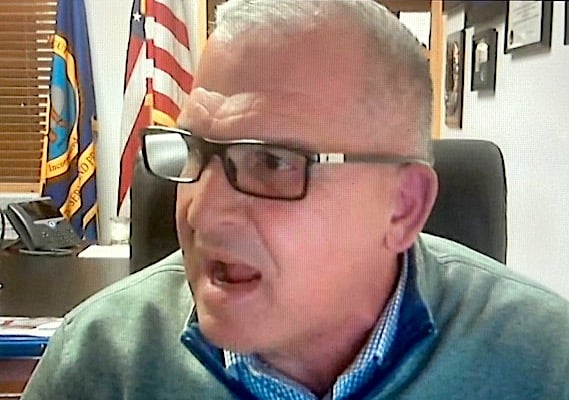
WESTPORT — A frank discussion about guns in Westport, the challenges police face in addressing potential gun violence, and how mental-health problems may trigger violent incidents, were topics of discussion when Police Chief Foti Koskinas met with TEAM Westport on Thursday.
Information revealed by the police chief shocked members of the committee, an advisory group to the first selectwoman on topics of diversity, equity and inclusion.
Gun permits: From 45 to 300+ annually
Koskinas, who joined the Westport Police Department in 1996 and became its chief in 2016, said in the past approximately 45 gun permits were issued annually in Westport.
However, he reported, “Over 300 gun permits were issued this year [in Westport], and are issued every year now.”
And the type of weaponry purchased more frequently by Westporters, such as silencers, is concerning, the chief added.
Koskinas said that Monday’s mass shooting at a July 4 holiday parade in Highland Park, Ill., should underscore how critical the issue is for Westporters, because the two communities are similar economically and culturally.
“What we see at the national level we don’t think would happen here,” the chief said, but cautioned, “The town of Highland Park has a structure very similar to ours.”
“We certainly do prepare for that,” he said of Westport police training for local mass-violence incidents.
Koskinas mentioned the irony that police have been encouraged nationwide to demilitarize their agencies, but “We are weaponizing our civilian community with military weapons and military-grade ammunition.”
The Police Department is working on policies to help promote gun safety in the community, including gun-lock programs, he said, and possibly a gun buy-back program.
Although Connecticut has a reputation for having strong gun-control legislation, not all municipalities agree on enforcement, and it is important “to deliver on the local level,” he said.
Public safety vs. privacy concerns
TEAM member Zoe Tarrant asked the chief how Westport citizens can learn about the number of guns in town and who owns them. “As a civilian … I’d like to know more about the guns we have in town and the military-grade weapons we have here in town. I don’t think the people of Westport are aware of what the police are up against,” she said.
Privacy issues prevent police from releasing that information, Koskinas responded, plus having the public know which households have guns could cause problems with weaponry thefts or negative reactions from a gun owner.
But police officers responding to a home have access to information about whether someone in that household is a legally registered gun owner, he said.
And Westport police put public safety ahead of privacy concerns, he added, especially when it comes to the town’s schools.
“We have an agreement with the schools that we will absolutely cross over the lines of privacy with public safety … sharing that information and having that relationship is more important than privacy … and if that information is not shared, you should consider me and the superintendent as a complete failure,” Koskinas said.
A constant concern over mental-health issues
Concerns about the connection between people with known mental-health issues and gun violence was mentioned by TEAM member Maggie Mudd, who asked about the process police use when they know that a resident has problems that could precipitate violence.
“It’s a daily occurrence,” the police chief said. “Shift after shift somebody is transported to the hospital for some kind of mental-health crisis.”
When faced with a resident exhibiting mental-health problems that could lead to violence, Koskinas said police have two options — refer the person to a hospital, or arrest the person and turn them over to the courts.
Any incident that is school related is shared immediately with the school district administration.
“What we’re seeing at the national level we see locally day in and day out,” the chief added.
Mental-health resources lacking
And while gun ownership has increased, mental-health resources have not.
“There is no place for these people struggling with mental health,” Koskinas said, noting that insurance often does not pay for adequate treatment in a mental-health facility and that other resources often fall short of addressing such problems.
Both Koskinas and Harold Bailey, the chairman of TEAM Westport, stressed that citizens must take more direct action to address the national gun-violence crisis, as well as racial and religious and gender discrimination “instead of thoughts and prayers,” Bailey said.
Koskinas said local protests on the Ruth Steinkraus Cohen Bridge on these issues are admirable, but that more should be done to directly address the problems.
“I hate to go to that bridge and see everyone say what they’re going to do, but never do anything,” the police chief said.
Gretchen Webster is a freelance writer and frequent contributor to Westport Journal. Learn more about us here.








Recent Comments