
Editor’s note: Following is an opinion essay submitted to the Westport Journal by Westport architect Joseph V. Vallone, titled, “Clarification of a major misconception: Our community does not yet have a design for a new school.”
_________________________________
Listening to the comments from the public during last week’s Long Lots School Building Committee meeting, I realized many citizens are under the false impression that a new school has been designed and the community gardeners are the only group holding up a groundbreaking ceremony.
- This is a complete misconception.
We, as a community, have no such building designed. The work product generated by the LL School Committee has yielded only what it had been charged to produce, a feasibility study.
Our feasibility study generated proposed construction budgets for various design scenarios and illustrated “placeholders,” such as a potential new building of approximate size, parking areas, and open spaces.
- Our community does not have a building design, we have a “back-of-the-napkin” sketch of where a new building of an approximate size and shape, may be placed on the site.
- The architectural firm hired to complete the feasibility study was not hired to design the new school.
- Drawings were provided merely to illustrate the appropriate building scale and its relationship to parking and open space.
This is a very important distinction given architectural floor plans have been circulated and some may be under the impression a simple P&Z approval will lead to a groundbreaking before autumn of this year.
- It is extremely unlikely a groundbreaking will occur by Sept. 1, 2024.
While elected officials, under intense pressure from the community, would like you to believe this is the case, I hardly believe this benchmark will be achieved.
- Today, however, we are at a seminal point in the process and the purpose of this document is to reach out to the current and future Long Lots Elementary School parents. Now is the time to start thinking about what our new school will look and feel like.
- Our community, but more importantly, current and future Long Lots parents, have a major question to answer; how low are you willing to set the bar for the design of a new school to expedite the process which will undoubtedly lead to ill-conceived, hasty decisions while concurrently, witnessing the opportunity to design and build a world-class school slip through your fingers?
During last week’s meeting (which was not recorded for posterity) I spoke as an architect with over 40 years in the design and development industry, about the appropriate next steps in the design process. My comments were dismissed by the committee, as expected, but they were intended to reach the community, particularly the Long Lots parents.
- I have publicly stated, early in the process, the site has adequate room for a new school, new ballfields, and sufficient parking all while maintaining the community gardens in their existing location.
- To the trained professionals in this industry, we understand that a feasibility study alone lacks sufficient analysis of a building massing, size, and location to prescribe land-use decisions. Restated: Without a serious set of schematic phase architectural drawings (remember, we have not yet hired an architect to prepare) of the proposed new building, we are unsure of the actual amount of available open space on the site.
What will the size of the new school’s footprint be?
The size of the building’s footprint will have a direct impact on the available open space.
Given the unique topography of the site, I have encouraged the investigation of a three-story, split-level design solution, without a courtyard, with a compact, energy-efficient building massing. P&Z members suggested investigating a three-story design solution during the December hearing for the 8-24.
While the capital expense of constructing a new school is a one-time investment, the cost of operating the school for the next 60-80 years should be a serious consideration for all Westport residents.
What could our new school look like?
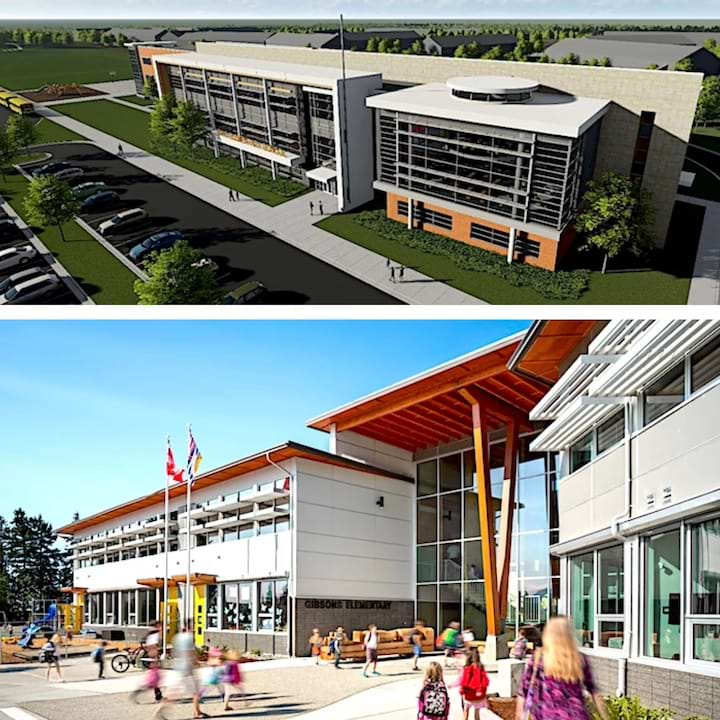
Without performing an extensive search, below is a link illustrating how other innovative communities are approaching new elementary school construction.
Prince William County in Virginia is one community that reflects the three-story building concept I am advocating our community seriously analyze. Note the absence of a courtyard which is more expensive to build, heat and cool (given its increase in exterior building skin, exposed to the weather elements) all while occupying a much larger footprint.

I am sharing one design solution intended to open our community’s eyes to a glimpse of state-of-the-art school design. My hope is to inspire our community to demand a progressive, innovative, cost-effective, state-of-the-art, world-class learning facility.

A second thought to consider is a design solution that involves mass timber construction. Wood is a very sustainable, renewable and non-toxic material. Again, the link is a case study for inspirational purposes only.
Have I misjudged my fellow residents, are we not a progressive forward-thinking community with vision? Are we so mired in politics we are in jeopardy of losing sight of this phenomenal opportunity for our children?
Next steps
We have arrived at a seminal moment in the journey. Our next step in this process is the solicitation of fee proposals for architectural services.
- Why would we not consider the practicality of one-stop shopping, to hire the architect based on a design solution and reflective fee proposal?
- Why not allow three or four innovative architectural firms to each design a solution to present to the community along with their professional services fee proposals as part of their submission? The site’s unique split-level topography demands a unique, custom-designed, innovative new school building.
- Why as a community, would we not simply “buy” the design through a design competition?
- Why is the community willing to forgo the opportunity to review multiple design solutions?
- Why “buy” the architect and gamble on the arrival of an inspiring, innovative, compelling, exciting, state-of-the-art design solution?
- Why not have a design competition while concurrently, securing professional architectural fees?
In my opinion, the most thoughtful way to approach our next step is to hand pick three or four architectural firms with a track record of innovative elementary school design, pay them a stipend of $15,000, give them the design program and six weeks to design and assemble their presentations along with their fee proposals.
Investing $100 million on a new school building shouldn’t involve a politically misguided, hasty process with the dominant paradigm being — just build something that looks like a school as soon as possible. That’s what the current process feels like to me.
Elected officials responsible for historically poor maintenance of school buildings, looking to placate angry parents who feel they deserve better, have responded with knee-jerk reactions. Yes, I believe it is that simple. There should be no reason for such hostilities, yet our community is drowning in them, feeding the false narrative that democracy doesn’t work.
Our town has a phenomenal public education system, and our children deserve a flagship new school design.
- Why should our community accept such a low bar of excellence?
Given the way the feasibility study phase of this project has unfolded, wouldn’t prudent, critical thinking lead us to demand better?
Joseph V. Vallone, A.I.A.
Westport





Thank you Mr. Vallone.
Thank you.
“looking to placate angry parents who feel they deserve better”
I wish you could see my disappointment. You make us sound like pitch fork wielders ready to storm the castle of the beast.
You know what we actually are? Tired, working parents with 1+ children who have been waiting for years for this school to be fixed. So while yes, of course we want a state of the art, sustainable, wood beam, organic, biodynamic, architectural digest school – we also just want one without leaks and wasps and asbestos and mold.
We’ve been waiting for 2 years. Nothing about this feels ‘hasty.’
Katie – I would respectfully say that the gardeners, who have for six months been saying “we support the rebuilding of a new school but simply want to also protect our twenty years of hard work in the process” understandably saw some pitchfork wielding this week, by people who were calling the Gardens a “private club,” were repeating the “school property” claim that the Town Attorney has long since addressed, were offering to bring their shovels, and were suggesting that the Gardens move to Bridgeport.
That is not to judge every parent by the worst behavior of some of them. But I have neighbors with two children in LLS who think that the idea of destroying the Gardens is horrible. So I don’t presume the loudest, this week, have spoken for everyone, either. “No more delays,” on some level, sounds like, “ignore State Law and mandatory approval processes and ignore planning and zoning regulations.” I get that you are frustrated with delays in general, but there is a process that needs to be adhered to – which protects everyone in Town, including the children who attend the schools.
I think that something underlying Mr Vallone’s important and broader point is that there is no school design. Folks sound as if they think a shovel could go in the ground tomorrow if a “special interest” (“different interest” and not an opposing one, would be more accurate) got out of the way, when that isn’t the case at all. The Administration’s process had been so bad (to the detriment of *everyone* in Town) and has created such contention, that *that* will create further delays, which will cascade, down the road.
Amazing and succinct. You have captured the essence of what has transpired.
Your ideas, repeated time and again, are worthy of review but have been repeatedly dismissed by the powers that be.
Your ideas are more thoughtful and expert than anything we’ve seen come out of this process.
Your ideas are good ones.
I hope the town will listen this time. We’ve already lost a year to underhanded maneuverings.
When I look at the two examples of schools built with 3 or 4 stories, it strikes me that in both cases they were designed this way because of space constraints. They were not designed that way because that’s the most optimal educational setting.
At Long Lots, we do not have space constraints, and the design proposed by the LLSBC can be built right next to an existing and functional building, which is a great challenge on and by itself.
Thank you for offering your help to find a solution, but we kindly do not want a school designed for the sole purpose of “saving the gardens” without consideration for the rest. The school is the priority and must remain so.
Prince William County Public School : “In an effort to make the new elementary school have a smaller footprint and be adaptable to the smaller sites that are available, this prototype has shifted from a two-story to a three-story design.”
Mass Timber Study : “As land values continue to rise, particularly in higher-density urban environments, schools with smaller footprints will become increasingly more necessary to satisfy enrollment demands.”
Katie,
Definition of Hasty: “Acting with excessive speed or insufficient consideration”.
Definition of Excessive: “More than necessary, normal or desirable; immoderate”.
While you are correct that the process the current administration decided to engage in has taken a good amount of time, formulating critical decisions prior to gathering all pertinent information is precisely that: “Hasty”.
It is not only hasty, it is inadvisable, irrational, inappropriate, and irresponsible.
In my opinion this circumstance is a stellar exemplar of the failure to prioritize monitoring & maintenance of Town resources, having anemic regard paired with insipid desire, followed by an endemic inability to efficiently problem solve, engage with available essential expertise, and the willful determination to hunker down within a fractured system in lieu of favoring partnerships and collaborations. We’ve seen this repeatedly (Baron’s South, Parker Harding, etc.) illustrating that lessons are not learned.
As I’ve opined before, often the common denominator is good people succumbing to a hubris that impedes optimal outcomes. It need not be this way.
NO ONE can deny that Mr. Vallone is merely looking out for EVERYONE’S best interests – students, parents, seniors, gardeners, taxpayers, and yes, even the current administration. It is unfortunate that for many reasons it’s taken too long to address the Long Lots Elementary School’s anticipated deterioration. However that is not Mr. Vallone’s fault. AND the circumstances we find ourselves in must not be allowed to dictate how we now move forward – how we now BEST move forward.
“Good enough” is, well, just that – good enough. That’s often the expectation and outcome of home “do-it-yourself” projects; and on occasion “good enough” suffices for an individual homeowner whose finances are limited and tenancy is singular.
However, in this instance, any path of “Good enough” is wholly inadequate and irresponsible. A replacement school is not for an individual homeowner who is willing to bear the consequences. This project is for the entire Westport community including a succession of generations to come. Spending $100+ million and doubling Westport’s debt MUST NOT fall prey to decision-makers lacking all pertinent information and alternatives.
Regardless of the understandable, appropriate frustration and concerns of the immediately impacted students, teachers and parents, giving in to impatience at this critical juncture – as tempting as it may be – is simply wrong and unsupported by anyone interesting in seeking the most desirable outcome.
WE ARE FORTUNATE that, as Mr. Vallone indicates, we still have the time and ability to do what’s right. A path leading to a best outcome has been presented. All it now requires is having the collective intelligence to take it – and possessing just a bit more patience. The optimal outcome, averting regrets, community consensus, and fiscal responsibility requires it.
Political expediency, community frustration, and parental emotion – no matter how understandable and sincerely expressed – is not anyone’s friend. The 28,000 residents of Westport are not lemmings – and despite pressures to do so, our leadership must not shuttle us en mass headlong in one direction without having all potential destinations in hand.
And, as difficult it may be for some to admit, or willing to articulate, everyone knows that.
Mr. Vallone, Thank you, thank you, thank you, for this superb analysis of the issue at hand.
I love your idea of a design competition, while concurrently securing professional architectural fees.
Thank you, also, for having the courage to state the obvious “It is extremely unlikely a groundbreaking will occur by September 1, 2024.” That needs to be repeated over and over again and stated by everyone involved – starting with First Selectwoman Tooker. We do ourselves a grave disservice by allowing Town Leaders to raise false expectations. This unrealistic target date is a false expectation!
Let’s proceed along the lines that you articulate here AND reinstate into this process the vital and important role of the Town’s Public Site and Building Commission (PSBC) which is filled with professional architects, engineers and builders – including, you for the past 8 years.
Let’s get this right!! I, and so many others, want to know what the PSBC thinks about all of this! What are their recommendations?
First Selectwoman Tooker, please be humble enough to learn from your mistakes and commit to correct the damage that your misguided pride has unleashed.
John F. Suggs
Copy of my letter to the P&Z today:
To whom it may concern: As a long-term Westporter, mother, taxpayer and gardener, I implore you to bifurcate the vote and move ahead as expeditiously as possible to get the desparately needed new LL school built. The current conditions there are totally unacceptable and our children, especially those with special needs, deserve significantly better. There is so much work to do beyond the feasibility aspect, to professionally and thoroughly assess the impact of the new construction and the potential moving of sports fields will have on water managment. This seems like a critical element that needs to be addressed before committing to moving the fields closer to neighbors. Again, bifurcation seems more prudent. And, that said, given the enormous investment involved and longterm implications of the ancillary property use, bifurcation would allow for a much better dialog and consideration of the totally separate issue of ancillary land use… with neither the gardens nor the multi-use fields relevant to elementary students, who will surely have wonderful playgrounds and the lower field for their use.
I believe we should proceed immediately with getting the school designed and built, and proceed with the due diligence for the long-term term futures of the sports fields, Westport Community Gardens and Long Lots Preserve.
And as an important aside, if we can preserve the gardens, I see no reason why the adjacent town property where the gardens reside can’t be fenced off, have a new and separate curb cut and a small separate parking area to assuage concerns about ‘security’. Both Saugatuck and Kings Highway elementary schools are surrounded by unfettered access from Riverside Avenue, the Post Road and even Assumption Church, which sponsors meetings like AA (by the way, Assumption is our family church). In addition, the vast majority of the gardening takes place after school hours, on weekends and during the summer when school isn’t in session so this cry of ‘safety’ from ‘the gardners’ is a relative non-issue.
Best regards,
Julie, Martin and Liam O’Grady
150 Compo South
Resident since 1969
Mr. Vallone,
You advocate for a three story building because it is more efficient and less expensive to build.
1) How much more efficient will a three story building be versus a two story building?
I did back of the envelope heat loss calculation and got around 10% improvement. And that’s with only 50% of windows on exterior walls. More windows will result in less of a difference
2) How much less expensive would it be?
You mention that a three story building costs less because there is less exterior wall and roof to build. I wonder how much this impacts the total cost. And while the statement is true, there will be more exterior wall area in three building story than two story building, and obviously much less roof area in three story. I am assuming that exterior walls costs more than roof area.
I think a good design looks at the trade offs to come up with most optimal solution. And that’s why it is important to know what the goals are. Your design seems to be driven by reduced footprint and costs. I don’t think these objectives should be the only criteria. We also need a school that looks like an elementary school and not a large structure in the middle of a residential area.
You also mention that there are other three story elementary schools in Westport. As far as I have seen, only Kings Highway is and the main reason is because it is built on a steep slope, and it is next to a business area.