
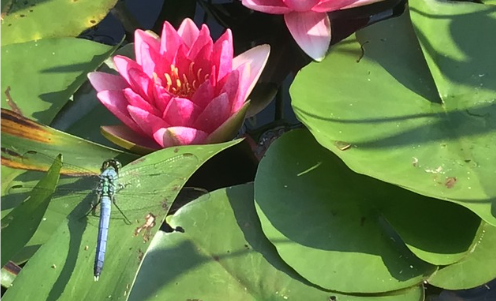
On a recent walk on my property, I slowed down to take a closer look at our pond. It’s hard not to be captivated by the bright pink lilies there at this time of year. And the sound of frogs croaking is almost musical.
But soon I found myself focusing on something else – myriad dragonflies darting about, sometimes hovering mid-air and other times striking a pose on a leaf or lily pad.
Wakeman Town Farm
Apparently, I’m not the only one. Two members of the Wakeman Town Farm committee told me this week that they have loads of dragonflies on their properties and that watching them is a favorite pastime.
Westonite Alice Ely, a UConn advanced master gardener, said that the insects gather on the brook of her property.
“I have tons of dragonflies visiting,” she said. “They’re so beautiful.” Trying to capture them in a photograph is a challenging but fun activity on a summer afternoon, she added.
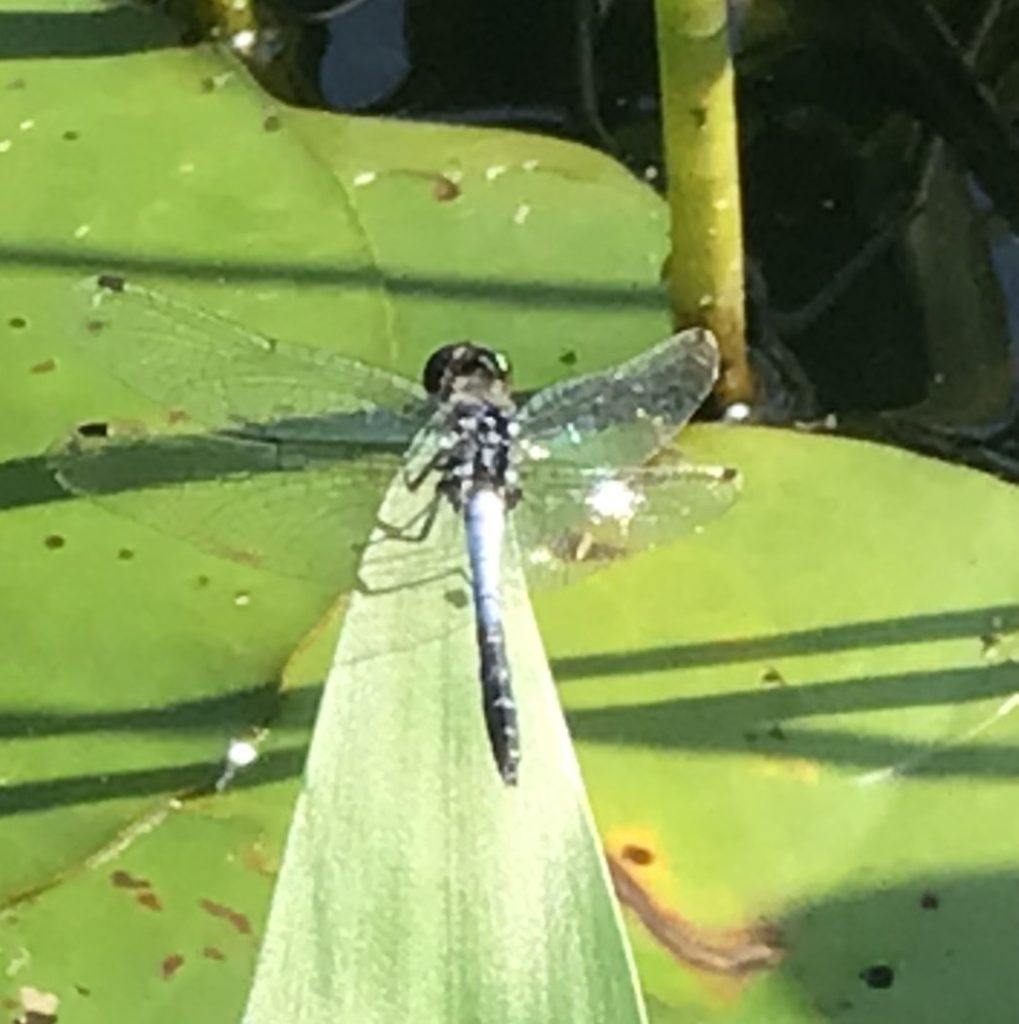
Paul Rossi, who is also very involved with Wakeman Town Farm, said that he sees dragonflies “flying all over the place” in his Westport yard, where he has lived for 29 years. Rossi is also a UConn master gardener.
“We have tons of them,” he said. “One of the benefits is that they are a natural predator of insects that you may not want.”
Predators
Dragonflies are not pollinators. They are predators during all of their lifecycles, according to Nathalie Fonteyne, the civics chair of the Westport Garden Club.
Dragonflies spend most of their lives as a nymph in the water, she said.
They eat insects and are a great control of the mosquito population. One adult dragonfly eats somewhere between 30 to100 mosquitoes per day, according to the National Park Service.
But there’s something more about dragonflies, something almost magical and prehistoric- looking about them. When I started researching them, I realized why. Dragonfly-like creatures evolved about 300 million years ago. The ones in our yards today are miniature compared to those early ones. Modern-day dragonflies have wingspans of up to about five inches, but at least one early relative had a wingspan of more than two feet.
I have noted three distinct sizes of dragonflies by our pond. The tinier ones dart about quickly and are much harder to capture on camera than the larger ones.
Vast array
But I was fascinated to learn that there are more than 3,000 known species of these insects and 150 of them in Connecticut. They belong to the order Odonata, which means “toothed one” in Greek, although dragonflies don’t have teeth but rather a serrated mandible that helps when capturing those mosquitoes.
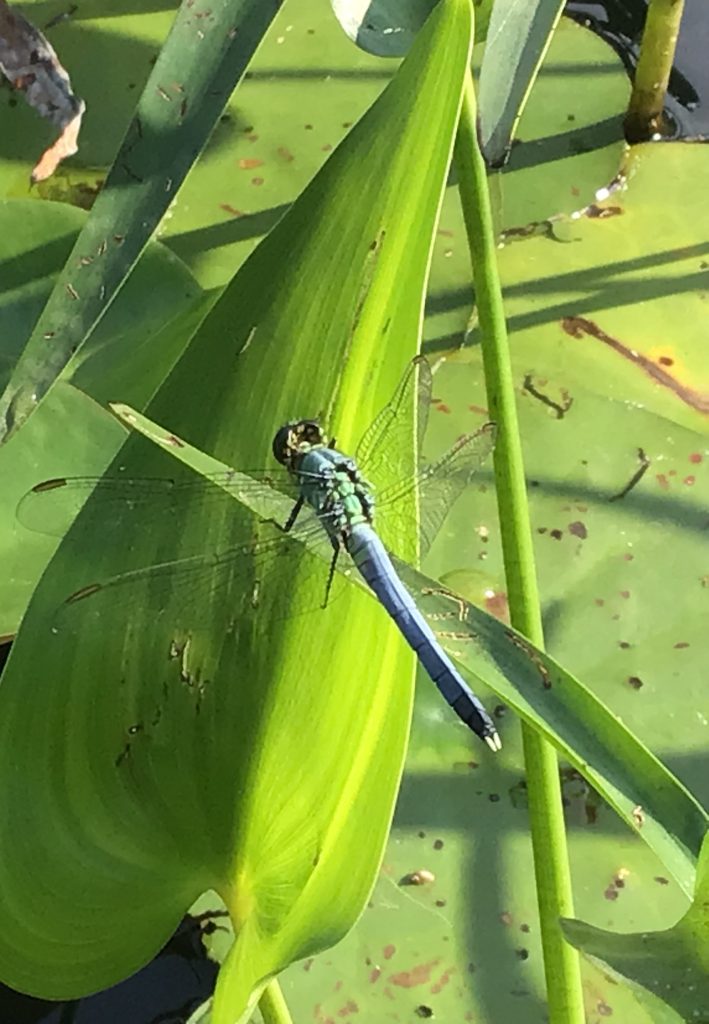
Damselflies, which have thicker bodies and bigger eyes than dragonflies, are fellow members of the Odonata family. One way to tell them apart is that dragonflies sit with their wings laid flat, while damselflies close them together.
One thing almost everyone notes about dragonflies is their amazing flying ability. They are among the fastest flying insects, reaching nearly 35 miles per hour. They appear to move effortlessly in every direction and can also hover midair.
A good sign
Having dragonflies in your yard is a good sign that you have a healthy ecosystem. They need clean water to survive. If you don’t have a body of water on your property, try adding a bird bath or fountain to attract them.
Other ways to attract dragonflies to your yard are: offering hiding spots such as shrubs or tall grasses near your water source, growing native plants, avoiding using pesticides as they can be toxic to dragonflies, and providing perches, such as flat stones or leaves. Some plants that attract dragonflies are white yarrow, swamp milkweed, pickerel weed, cattail, water lilies, and black-eyed Susans.
Because of their unique abilities and appearance, dragonflies are a favorite of many people and have come to be a symbol of change as well as hope or infinite possibilities. A former pastor of mine in Connecticut once told me that she places a dragonfly on top of her Christmas tree each year, and I can see why. What better way to enter the new year than to think about all the great possibilities that lie ahead?
So, if you’re lucky enough to have them in your backyard, I hope you spend some time this summer dancing with the dragonflies.
Want more?
Check out these Cultivating with Kerri columns:
- Cultivating with Kerri: dancing with dragonflies
- Creating your own memorial garden
- Spend a peaceful moment in Westport’s memorial gardens
- Chatting about conservation with Joe Gardener

Kerri Williams
Kerri Williams is an award-winning writer and journalist. She has worked as a reporter at the Norwalk Hour, as Living editor at the Darien News-Review, and managing editor for the Norwalk Citizen-News. For Westport Journal, she is a reporter as well as a gardening columnist, writing ‘Cultivating with Kerri.’ Williams moved from Connecticut to upstate New York in 2021.
Kerri Williams can be reached at: cultivatingwithkerri@gmail.com. Please let her know any ideas you have for this column or share photos of nature and gardening around town.











Recent Comments