
By Thane Grauel
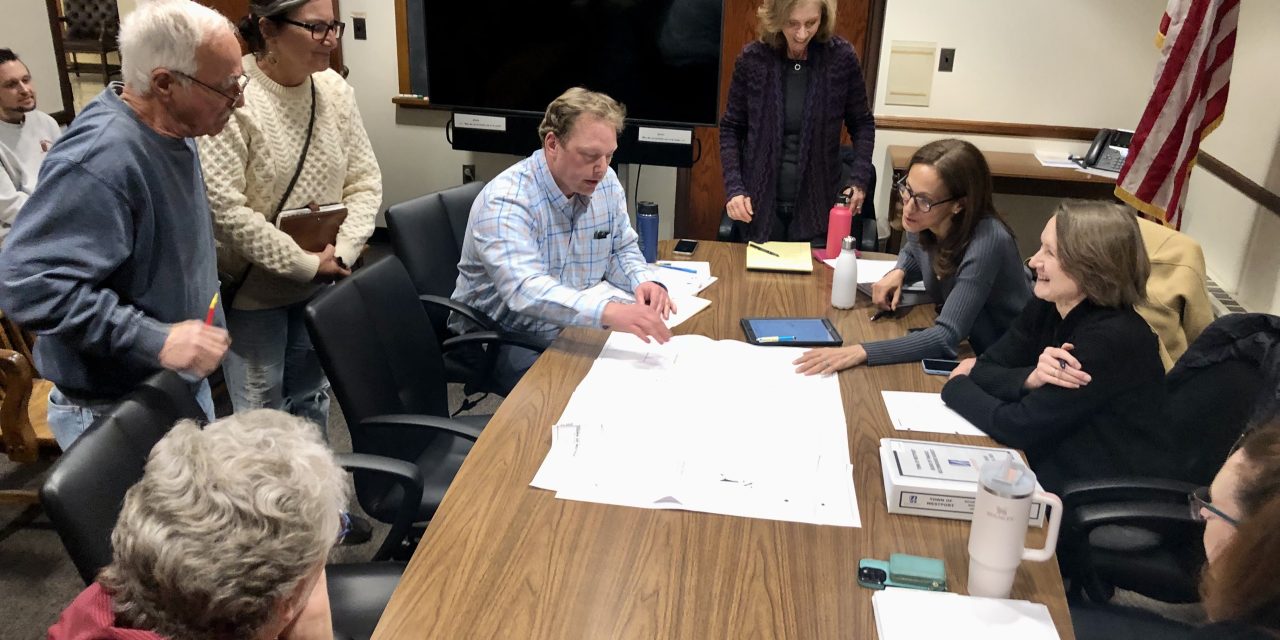
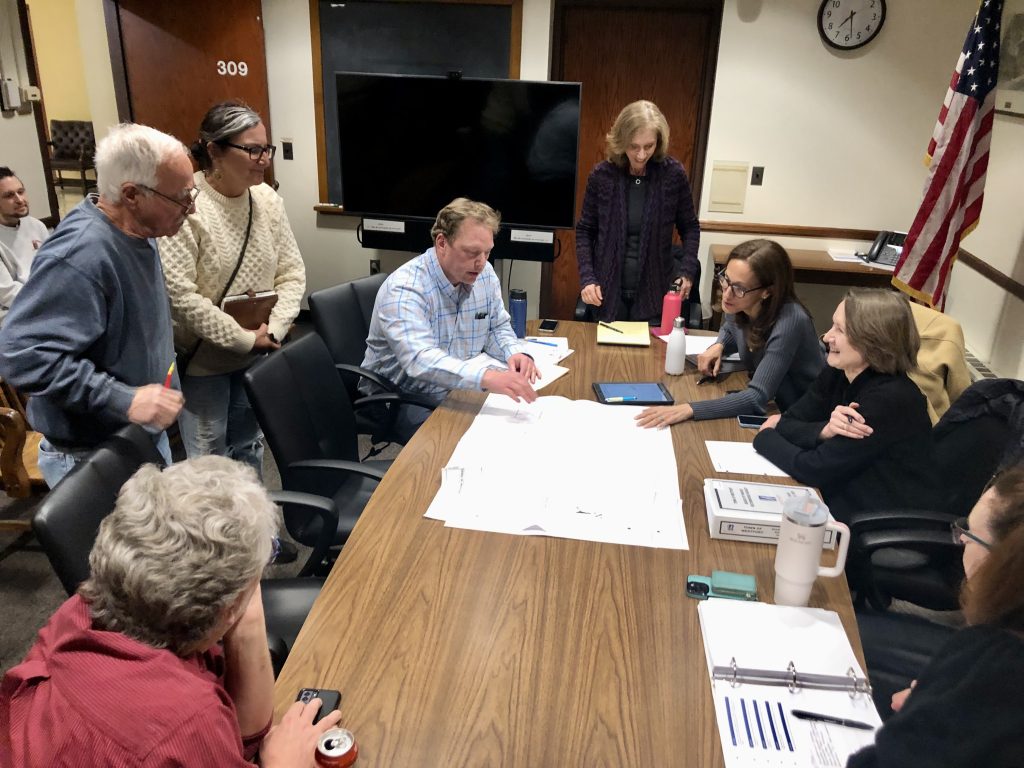
WESTPORT — Three members of the Tree Board attended a meeting of the Environment Committee of the Representative Town Meeting on Wednesday and challenged the notion that the tall trees on Jesup Green have little value.
The upper part of the green has been targeted for paving to replace some 40 parking spots that will be lost in the reconstruction of Parker Harding Plaza. The green space lost to parking on upper Jesup Green would be replaced between the lower green and the river under a future phase of the plans.
While the controversial proposal to redesign downtown parking, and alter Jesup Green, has obtained many approvals, it still needs the RTM to sign off on a $630,000 appropriation for design work.
The Environment Committee wasn’t asked to review the plan before the full body takes the matter up again May 8, but added Wednesday’s discussion to its agenda.
Chairwoman Ellen Lautenberg said some in Town Hall weren’t happy about that because it’s a school vacation week. As was the case with an RTM Planning and Zoning Committee discussion Monday, no vote was taken on the matter.
Conservation Director Colin Kelly said the Flood and Erosion Control Board and the Conservation Commission already have approved the plans.
Asked asked about the Conservation Commission’s approval, he said the body made a determination that the removal or relocation of the Jesup trees would not have a significant impact.
“But they’ll be gone,” said Claudia Shaum, District 5. “The impact will be that they’ll be gone.”
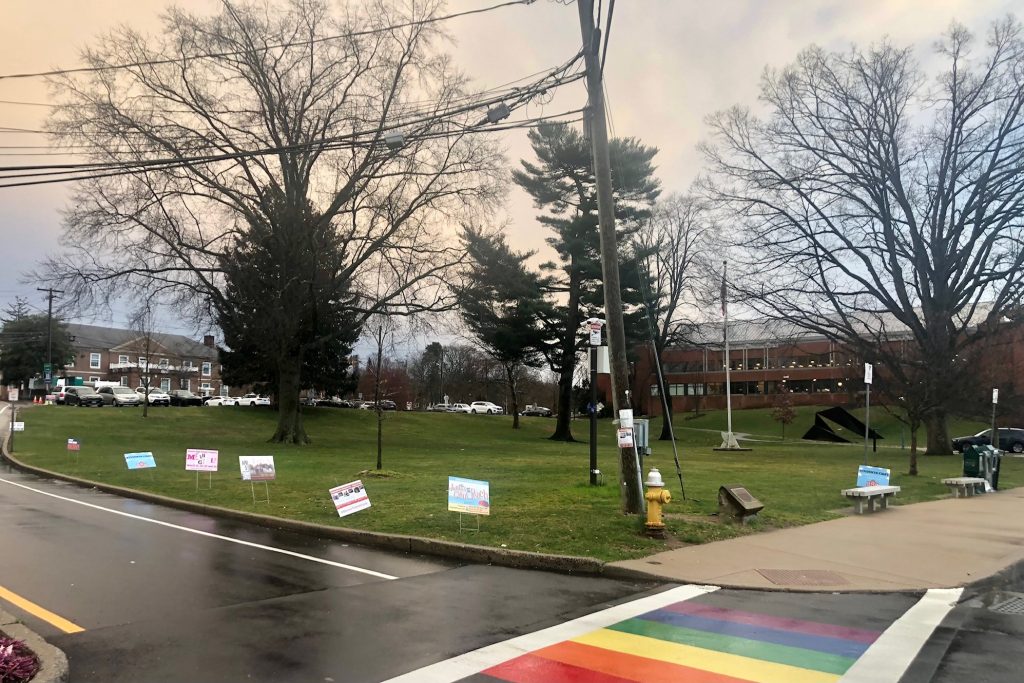
“Right, but there’s other trees around,” Kelly said. “The nature of the area along the river will not, in their opinion, be a significant loss.”
“All the trees that are proposed to be removed, except for one, are outside of our regulatory line, the waterway protection line,” he said.
“I’m not understanding, doesn’t the tree have value beyond … it’s not doing a job that makes it important?” Shaum asked. “But it’s still a tree being a tree, and that’s not enough of a job?”
“I understand that,” Kelly said.
“The Lorax,” Shaum said.
“Within the regulation it doesn’t say protect all trees,” Kelly said. “It’s protect the resource.”
In this case, he said, that was the river.
Three Tree Board members, Sarah Adair, Ted Picard and Dick Stein, attended the meeting.
Adair said that Public Works Director Peter Ratkiewich gave the board an overview of the plan March 21.
“We don’t vote, we don’t have a say,” Adair said. “So, we listened and asked questions, and got his input on it.”
“The problem that Westport seems to have is that they think, we’ll just replant new trees,” she said. “But typically, in the past, the maintenance … the money has not been in the budget to make sure those trees get to full maturity, like the large spruce that is codominant that will be removed, and not transplanted because of its structure.”
Codominant means the tree trunk has grown into two branches.
She said the trees are important to birds of prey.
“You’re limiting the range that birds of prey have to hunt,” she said. “They’re very territorial, our ospreys, our eagles, our owls, our other big large birds. They need those bigger, tall trees to land on. Just because there’s not a nest on there doesn’t mean they’re not important … They need them because the taller, mature trees are the trees that hold their weight.”
Stein said replacing the mature trees with new plantings wouldn’t be the same.
“Started over will never mature to anything in any of our lifetimes,” Stein told the committee. “We seem to consider large trees as a liability not as an asset.”
He said two oaks on the green, and perhaps the white pine, which is in the potential construction area, are between 90 and 120 years old.
“Westport was hardly a town then, when they started,” Stein said.
Stein said the large spruce at the top of the green, said to be a danger, could be cabled, costing a lot less than cutting it down and chipping it up.
“I question this whole process,” Stein said. “If the police station is going to move, that will give us 50 parking places, it’ll probably give us the 40 just where the police are allowed to park their private cars.”
“This whole thing, it just seems ramble along with a life of its own,” he said.
He said someone had an idea, and then people put a lot time into it, and that with so many hours being put into the planning, people are holding their ground.
“My question is, why even do this?” Stein asked.
He said that on Sunday he took another look at the trees that would lost.
“They’re all basically pretty healthy,” he said.
Shaum said she’d been told otherwise.
“Rumor is the wrong word, but I’ve been told by people those trees are all dead anyway, so cutting them down is not a problem,” she said.
“That’s just a flat-out lie,” Stein said.
“I was literally told that yesterday,” Shaum said.
“Go look at them,” Adair suggested.
“By whom?” Stein wanted to know.
Shaum said she’d rather not say.
Lautenberg said she’d write a report about the meeting.
“We’re not making a recommendation as to whether the RTM should vote for or against this appropriation,” Lautenberg said. “I think our job is to inform other RTM members or ask those questions in a broader public format so that we make sure that people hear the concerns that were brought up here.”
Thane Grauel grew up in Westport and has been a journalist in Fairfield County and beyond for 36 years. Reach him at editor@westportjournal.com. Learn more about us here.





Oak trees can live to 400 years old. They are environmentally significant. They remove CO2 from the air and provide both food and shelter for hundreds of animals, birds and insects. Environmental scientists say that planting and keeping existing oak trees is the best things we can do for the local ecological system.
Yes, we need more parking, but we need oak trees more than parking. Once the police station is moved Westport can provide parking in that area. A double decker lot in that location won’t bother people living nearby.
The flood and erosion control board, and the conservation commission always approve everything brought to them by the FSW!
They even approved the plan that still had no cut through in it, so with that in mind, their approval should be taken with a pinch of salt.
If flood and erosion knew what they were talking about they would have suggested a permeable paver product for the Parker Harding lot, because it is so obviously what is needed there.
https://www.truegridpaver.com/5-ways-to-reduce-parking-lot-design-costs-with-permeable-pavers/
Used all the time to alleviate flooding.
Plonking down some green is going to do nothing to combat flood and erosion there.
Every contractor in America ( except of course those bidding this job) knows this to be fact !
As for our beloved jesup green, and its majestic trees, it’s quite amazing this is even being considered as anything but near vandalism.
I’ll reiterate again that the merchants never heard nor knew nor suggested that jesup be sacraficed for parking.
I’m very confused by the stated % of the green being lost here.
Public works says 30% and the FSW says 17%.
I think this is like the $80 million parking garage that’s more likely to be $5 million.
I consider jesup green to be the square of grass and trees to the left side of the library if looking at it from the river.
I consider all the grass areas and flower beds beyond the pathway down to lower jesup are not part of “jesup green”
Nor are the grassy areas on the waterfront now with the picnic areas part of our jesup green, nor is the small patch of green going along the river or the non enforceable promise of more green down on jesup along the river in the future.
To me it looks like we are losing 50% of jesup green.
At least what residents in general consider to be jesup green.
The trees are majestic.
They are irreplaceable.
I hope when the demarcation lines are set to show the RTM where the retaining wall is actually going and it’s correct height, they will use the bright orange fencing which rolls out so a perception of the height is very obvious.
I also hope the % of actual jesup green lost will be clarified in a truthful manner.
In addressing the configuration of additional parking at Jesup Green please keep in mind that the area was once a landfill. When the current library was on the drawing board very little attention was paid to this. A remediation design was devised very late in the game. We should not now make the same mistake.
Disturbing landfill causes the release of methane gases and is noxious and unpleasant. Every effort should be made not to devise a parking plan that digs into the Jesup hill. Instead, as much flat area as possible should be used to avoid unnecessary disruption of the hill itself. This may have the added benefit of keeping the area closest to the library as attractive and serene as possible.
While I agree with Mr. Naylor regarding the importance of preserving Jesup Green, the land was acquired by the Town in 1937 and predated the landfill area beyond. It was not part of the landfill where the Levitt Pavilion and the library parking lot were constructed.
On the other hand, the parking lot between the Green and the river as well as most of the parking lot at Parker Harder were created by filling in land originally part of the river.
Also, according to historic record resources, one of the oak trees on Jesup Green was planting as a seedling from Connecticut’s famous Charter Oak. I hope the Town’s excellent Tree Board can identify the tree, which deserves to be preserved and commemorated with a plaque.
Great points made by all. The parking lot is not Jesup Green.
Also, people pushing this heinous crime upon our history, well, …they are constantly fudging the numbers.
The first selectperson was saying in her podcast last week that everything has already been approved, as if it is a done deal. Basically trying the shut down dissent through a technique of dismissal.
She claims that she wants downtown to be a destination. More on this destination concept after my bicycle ride…xox peeps…oooh there are so many facets to this concept and they have missed them all, because they dont really care and it shows
Divide and conquer. That is the strategy this administration has used successfully in every neighborhood that has fought back. Carolanne Curry and her neighbors at Hiawatha Ln. battled 20 years to prevent affordable housing in their neighborhood while the rest of us remained silent. So now, we will all live with a project just feet away from metro north Westport.
Morley Boyd doesn’t want headlights in his living room, so he objects to a parking garage being erected in his neighborhood. Do we band together ?
The Long Lots parents fighting for a new school now learning of their kids being bused to Kings Highway ,which incidentally needs only $1M in repairs having been built in 1926 while SHS built in 2006 requires $5 M infusion for repairs, object to busing which Scarice is mandating to achieve “parity.”
The iconic Inn at Longshore which should be on a historic DND list is now subject to major restructuring to become a Motel 6.
The Linxweiler legacy lesson is do not under any circumstances bequeath property to the town of Westport.
And don’t get me started on Dobin’s plan to transform the Baron’s estate to a tenement.
Bottom line,folks is we need to take back Westport. Band together. What affects your neighborhood, affects all of us.
The $600k+ funding request for the Jesup Green
Design —to chop down four mature trees and pave 30% of the green space — is expected to come before the RTM May 8 (with additional possible site visit meetings May 6 and 7).
ARPA funds are expected to be used (federal funds supposed to be used to mitigate the economic impact of the COVID pandemic). Westport as a town has prospered mightily post-pandemic due to an unnatural spike in population. Many Individual residents, however, are still trying to recover from the health and economic impacts of the pandemic in ways that do not include more parking. ARPA funds could be put to better use.