

By Gretchen Webster
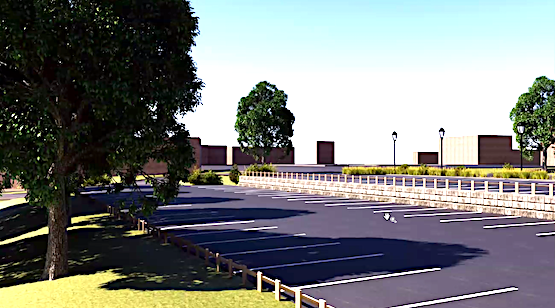
WESTPORT — A new plan adding 42 parking spaces at Jesup Green — two more spaces than 40 spaces lost under the proposed redesign of Parker Harding Plaza — was approved Wednesday by the Flood and Erosion Control Board.
The board previously approved a revised version of the Parker Harding overhaul last October, but that was before planners incorporated the option of making up for lost spaces by adding more spots at Jesup Green.
Although the flood board’s Wednesday vote was unanimous, several members expressed concerns during the discussion that a large grassy area in the Jesup Green area would be lost and that adding parking could cause flooding in front of the Westport Library.

“The fact that you are building a parking lot and taking away the grass is not good,” said board member Robert Aldrich. “It’s never good.”
An issue facing the Flood and Erosion Control Board, and other town boards that will act on the parking proposals, is there is not enough space to meet parking demands downtown. That means adding more parking inevitably will conflict with other goals, including providing green areas to help improve drainage and water management, town engineers Keith Wilberg and Ted Gill told the board.
“One of the goals [of the Downtown Plan Implementation Committee] was to provide more green space, but P&Z said parking space loss was more important,” Gill said of the zoners’ skeptical reaction to the earlier plan. “This board is never going to be in favor of removing green spaces.”
But Wilberg said the purpose of the parking plan for Jesup Green is “to maximize parking” for patrons of restaurants and other businesses on the Jesup side of Post Road East. “Parker Harding can only add so much.”
An environmental problem, Wilberg said, is that both the Westport Library and the Levitt Pavilion are thought to be built on what once was a landfill. Since water quality is a major concern of town engineers working on the Jesup parking plan, digging up soil that could be contaminated needs to be avoided, even if it means providing less green space for water quality control and drainage, Wilberg said.
“I’m hesitant because of the composition of that soil,” he said.
Board alternate Ricardo Ceballos was concerned that Jesup’s remaining grassy area could become a swamp under the new parking plan. Cebellos, an engineer, suggested that adding catch basin inserts would help mitigate problems that could arise when grassy areas are removed for parking. The basin inserts, designed to keep sediment, debris and other pollutants from entering the water system, would filter sediment from runoff and help address flooding, he said.
“I’m completely against you guys discharging more water into the park,” Ceballos said.

Wilberg said he liked the idea of using catch basin inserts, and that he and his team would examine that possibility. He primarily is concerned about the infiltration of water into the soil that could contain landfill materials. The library was built on pilings drilled into the landfill site to keep the building above contaminated soil, but the Levitt Pavilion is likely to be set more directly on top of landfill, he said.
Gloria Gouveia, a land-use consultant who was the town’s zoning enforcement officer in the late 1970s, said she believes the landfill area starts behind the library and not on Jesup Green itself.
Board members discussed possibly postponing action on DPIC’s plan for the additional parking in the Jesup Green area for a month to research the possibility of using catch basin inserts to help alleviate flooding and improve water quality.
But after Wilberg said catch basin inserts could be added to the plans after researching the issue over a week or two, the board voted unanimously to approve the project and pass it along for review by other panels, with additional information about catch basins later.
The Conservation Commission, like the Food and Erosion Control Board, had approved the project for Parker Harding, without the Jesup Green plans, last fall. The commission is slated to reconsider the resubmitted project at its next meeting set for 7 p.m. March 20 in the Town Hall auditorium.
Freelance writer Gretchen Webster, a Fairfield County journalist for many years, was editor of the Fairfield Minuteman and has taught journalism at New York and Southern Connecticut State universities.






Lost in most discussions about removing green space for parking is aesthetic quality loss to the area. Additionally, sediment controls need specialized routine maintenance which must be added to already stretch DPW resources. This plan, designed to ameliorate parking pressure will appear, when completed, a blight on the “Green”.
The Department may want to consider using pervious pavement to help alleviate flooding caused by additional parking.
Breaking news selectwomen ! THIRTY SEVEN YEARS AGO !!!!!
https://www.nytimes.com/1987/11/22/nyregion/westports-boom-strains-parking.html
New York Times 1987, yes I did say 1987. !
The only thing that’s changed since 1987 is that the imperial lot on Thursday during downtown merchants business hours and during employees need to park, hosts for free the farmers market, which may soon have to look for a new home.
The Baldwin lot lost 35 spots during a redo ! Just last year.
The lot across from Serena and lily saw a developer take 6 spots and sequester them for his tenants( no doubt realizing the s show about to unfold. ) though the agreement under which he got those spots was never fulfilled on his end. Parking which was promised never happened.
I guess he didn’t expect merchants to check up on this FACT.
And last but by no means least on top of the 35 lost in Baldwin, the 6 taken by default on a deal WHICH LEFT US ALL SHAKIN OUR HEADS, and failing to add more parking, as promised, the first and second selectwomen closed off church lane, an incredibly busy artery to get out of town and right hand turn onto Main Street, alleviating some traffic stress, and removing yet another 25 parking spots from the immediate downtown.
So let’s all count together !
35
25
6
66 spots disappeared from a town already on its knees where parking is concerned.
Westport conveniently counts ( I believe) 3 people per car when it does its math.
We all know this to be a phalacy, BUT let’s use those numbers.
66×3
198 fewer people can visit the downtown.
SOLUTION ;
Let’s re instigate 3 hour parking.
And in order to enforce it let’s spend 350,000 dollars on a “we got ya” system from some company in Texas.
GOAL:
To destroy the downtowns merchants business, with their ANTI BUSINESS PLAN, and to ensure out of towners go to more parking friendly towns where they can in fact spend as long as they want by paying to park, generating revenue for the town, and business for the merchants.
But no instead the selectwomen, who haven’t a bulls notion what it is to own and run and pay rent and taxes on a business on main street or post road and surrounding areas, have ensured 200 fewer people can visit the down town area.
And now in order to bully their plan through P&Z, they think taking away green space in jesup green designated open space and showing 42 miniature Barbie sized spots ( yes folks they clearly are moving away from the flood mitigation claims that adding green space on Parker Harding will somehow save us from floods) seeing as they are removing green space in jesup green in order to bully the P&Z into succumbing to their catastrophic plan, yes their business ruiner.
Here’s my suggestion fix imperial, put on the schlepper shopper bus of 1987, and when we establish imperial as a great place to park, with a regular bus service to and from Main Street, then apply to do the vanity project at Parker Harding.
Oh and now that all but 100 parking spots in downtown are 3 hour, Randy and Pete have promised us, not once but twice, “ on the record” they will show us where 1000 plus staff will park !
We look very forward to that information the moment they have it. I’m sure they must already have that information, after all who would conjure up such a plan without covering all their bases.
After all, without staff businesses cannot open their doors.
And without 8 hour parking staff cannot come to work 🙂
SMH
The thing that opened my eyes to the fiasco, was when abour 20 years ago, Drew came back from the pic meeting and said, “Todd, we have to count all the spots, in all the lots, at 5 different times, on three different days. Mark down on the spread sheet which spots are filled.”
I said, “Drew, I’m about to go to Oscars for coffee!”
“No, that can wait. Let’s go now.”
By the end of the week, it was really easy driving around downtown in Drew’s mini van, counting spots, drinking coffee and chomping on flagals.
The picture I saw of the parking situation amazed me. They had wanted to appropiate tens of thousands for the parking study.
Drew marched into the next pic meeting, told everyone what he discovered. It was amazing how he operated. He founded the downtown merchants in 1971. Eventually they kicked him out of his own organization.
He actually also had a very unique solution to the garbage dilemma at Parker Harding.
The fiasco was that no one listed to his solutions because every body had thir own cognitive bias. I knew right then that I could never become involved, like he wanted me to be, because the obvious solutions were ignored. They wanted to spend money, that wasnt theirs, on superficial vanity ego trip illogical nonsense croney outsider kickback deals, with no actual intrest in providing the parking spots the town was legally obligated to provide for the merchants downtown.
Their interests lay elsewhere.
I sat at the counter eating a slice…
I walked out back, sat by the river and sparked up a doobie… thinking about the 70’s … those day were gone…
Obvious solutions are ignored allllll the time. Profligate spending of everyone’s money and not theirs and kickbacks. Lol…. That is exactly what this is all about !
Corruption and bs.
Todd you are so correct. And we all know it.
Hell they know it.. just hope to bully their way into getting away with it.. over and over and over…
Til the special services ( taxing) district, becomes a thing……
Don’t forget to count the loss of 14 (is it?) parking spaces now dedicated to charging stations. Or that the only location downtown, with an observable INCREASE in parking spaces during this period of loss, is the private lot that serves the Nomade site.
Speaking as a Westport resident with no flesh in the game, I can’t help but wonder why no one (but me in the matter of the smoking Gunn House ) registered any documented concern about the loss of parking spaces while we were in the process of losing them.