

Editor’s note: this is part one in a multi-part series on affordable housing in Westport.
By Kerri Williams
WESTPORT – For some, affordable housing means being able to live and raise their children in the town where they work. For others, it’s about being able to age in the town where they have lived their entire lives.
But finding affordable housing in Westport is not easy, with long wait lists measured in years and not months. In a town where the average single-family home is valued at $1.8 million, that leaves many people who are tied to Westport without a way to live in Westport.
Housing pandemic
“We are having a housing pandemic,” said Carol Martin, head of the Westport Housing Authority. “And no one is calling it that.”
Last week, the P&Z Department presented to the Commission On People With Disabilities, the Commission On Senior Services and the Human Services Commission on the human side of affordable housing.
Many people have heard of the Connecticut statute 8-30(g), which incentivizes municipalities in Connecticut to reach a level of 10 percent affordable housing.
As of last year, there were 28 towns with more than 10 percent of housing stock considered affordable. There are 141 towns which, like Westport, are below that level.
The statute allows developers to bypass some local zoning rules in towns where less than 10 percent of the housing stock is deemed affordable.
In Westport, 3.97 percent of the town’s housing qualifies as affordable, according to Michelle Pirellie, director of Planning & Zoning. Of the 10,567 dwelling units in town, there are 420 affordable ones. While that’s a far reach from the 10 percent goal, the number is up from 2.5 percent in 2002.
But what qualifies as affordable housing in Westport? According to Pirellie, the unit must be affordable to households that have an income that is 80 percent of the state median, which, for a family of four, currently stands at $124,600.
Eighty percent of $124,600 is $99,680.That means that any household earning less than $100K qualifies for affordable housing. And that number is adjusted annually; and it rises with inflation almost every year.
To put this into perspective, here are three examples: Westport Police officers, Westport teachers and Westport school nurses.
Police officers, teachers, nurses
The 2024 starting salary for a Westport police officer is just under $73,000. With contracted pay increases, that officer would work in Westport for six years before breaching the “affordable” threshold. And that’s without inflation raising what’s considered affordable.
Westport teachers and nurses are even likelier to qualify for affordable housing. Nurses start their careers at just over $66,000 and teachers (with a BA) at $56,500. Their salaries grow at 3 percent or 4 percent (versus an officer’s 5 percent).
Unattainable goal
While the state goal for affordable housing is 10 percent of the total, many Westport officials believe that is an unattainable goal. “It’s almost impossible for small towns to reach 10 percent,” said Ira Bloom, town attorney, who lectures around the state about affordable housing. A big part of the reason is that most housing in small towns is made up of single-family homes, with multi-family developments only allowed in certain places due to zoning restrictions.
But towns can also meet a moratorium, or a certain number of affordable housing points, where they can, for a time, not be subject to 8-30g regulations. Points are given for certain types of units depending on how affordable they are.
Working toward a second moratorium
Westport reached a moratorium in 2019, which was valid until March of 2023. The town is working towards a second one, according to Pirellie.
In addition to the state mandate, Westport has its own regulation, creating an Inclusionary Housing Zone in 2011. This zone includes 80 lots, most of them along US Route 1. Ten of those lots have been developed. Examples include 785 Post Road East, 793 Post Road East and 1135 Post Road East. Under the IHZ regulation, 20 percent of the units in any multifamily development need to be affordable.
While some think the inclusionary zone is a good step towards creating affordable housing in town, others, like Martin, say even more should be done. She wonders why those numbers couldn’t be just the opposite, with 80 percent affordable housing in such developments and 20 percent market rate.
“I don’t understand why this isn’t on the top of every elected official’s agenda,” Martin said.
While the regulation intends for affordable units to be on the same site as the development, developers regularly ask the Planning & Zoning Commission to consider off-site affordable housing, using certain criteria to make their decision.
The proponents of on-site affordable housing say it provides a mix of people all receiving the same amenities. “There is an overall philosophy that on-site is beneficial to everyone,” Pirellie said.
On Oct. 6, the P&Z will be asked to consider Text Amendment 855, which would allow off-site affordable units in Inclusionary Housing Zone developments.
Where is affordable housing in town?
Since multi-family housing must be on town sewer, much of it is on the Post Road and Riverside Avenue, which have the bonus of being near public transport and shopping.
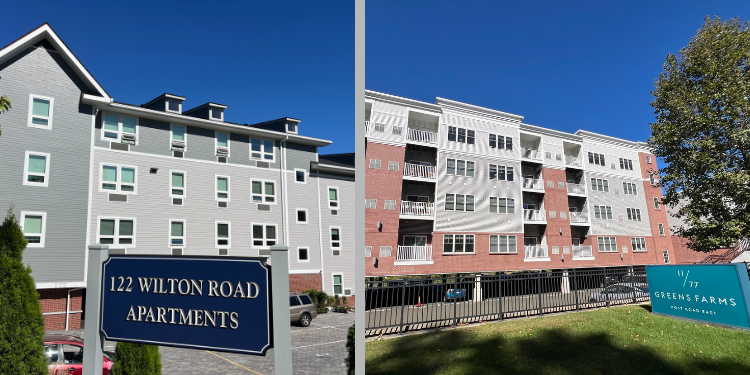
Of the 420 affordable units in town, 235 are government funded, such as Canal Park, at 5 Canal St., or Hidden Brook, at 1655 Post Rd. East, both operated by the Westport Housing Authority. Another 55 units are for tenants who receive rental assistance. One is a house with a United States Department of Agriculture (USDA) loan. Another 99 are deed-restricted private development projects, such as 1177 Post Road East (29 affordable units) and 122 Wilton Road (19 affordable units).
In two instances, the town has denied applications for affordable developments, which were later approved in settlements following decades of litigation. For a development to qualify as 8-30g, 30 percent of the units must be deemed affordable, with half of those affordable to those making 60 percent of the state median income.
Those two developments are 28-47 Hiawatha Lane, which will have 157 units, 47 of them affordable, and Cross Street, which will have 68 units, 20 of them being affordable.
While those developments were both controversial with neighbors, they still ended up approved with more units than were originally proposed.
Why are we here? Take a look back.
Danielle Dobin, a former Planning & Zoning Commission chair and current Board of FInance member, who helped write the town’s Affordable Housing Plan, said that 8-30g “allows the developer to do pretty much what they want.” She added that “it’s irresponsible to think that saying no will lead to a better outcome.”
To really understand the issue of affordable housing, Dobin said that one must look back at years past when discriminatory housing practices were common. Many people, who were not Christian or white, were subject to practices such as redlining, where they were not shown homes even if they could afford them.
“It’s where a lot of the opportunity gap comes from,” Dobin said.
Even well-known celebrities, such as Jackie Robinson, were subject to housing discrimination in the 1950s. After being denied housing in many towns in Fairfield County, the Robinsons eventually settled in Stamford where Dick Simon, co-founder of the Simon & Schuster publishing company, rallied support from neighbors and local clergy.
Even in more recent years, neighbors and town officials have often come out against affordable housing developments. “They just wanted to preserve old Westport,” Dobin said.
But with long waiting lists and more multi-family developments being proposed, the issue of affordable housing isn’t going away any time soon.
Pirellie said she spends roughly half of her time each week dealing with some aspect of affordable housing, whether it be proposals that include it, dealing with re-certifications, or people coming in to ask questions about it.
Glass is half-full
For Bloom, the outcome so far is a mixture, but he’s choosing to look at the glass half full.
“In Westport, we have done some very good things,” Bloom said recently. He pointed to the project at 1177 Post Road East, near his office, with its 29 affordable units out of 54, as one of those positives.
Even Martin has some hope that things will improve.
“This is a very caring and giving community,” she said, adding that bringing more awareness to the issue would be beneficial. “It’s hard because they are not here picking up the phones and listening to the people.”
Part two of the series will report on people living in Westport’s affordable housing and those on waiting lists to receive it.

Kerri Williams
Kerri Williams is an award-winning writer and journalist. She has worked as a reporter at the Norwalk Hour, as Living editor at the Darien News-Review, and managing editor for the Norwalk Citizen-News. For Westport Journal, she is a reporter as well as a gardening columnist, writing ‘Cultivating with Kerri.’ Williams moved from Connecticut to upstate New York in 2021.








Starting police officers in Westport get paid 30% more than starting teachers. A town’s priorities revealed.
Excellent article. Public awareness is half the battle and this series served that purpose well.
What a cringe to think a teacher with a BA starts on 56,500.
In fact it’s not that a starting police officer is over paid, rather a teacher is woefully underpaid.
I hope when vetting who gets affordable housing teachers and our seniors are at the tippy top of the list.
That might make life at least somewhat more affordable for teachers who play such a huge role in our children’s lives.
And for some seniors it might mean that they can stay in the town they contributed to their entire life.
I do not know how affordable housing is offered and who gets it but I’d like to think that thought like this goes into it.
In addition to our fine town employees in school, law enforcement, and health, there are Westporters like me who would prefer to live in our hometown that we love, if only we could afford it. Instead, I live in Black Rock.
— Doug Davidoff
Staples ‘75
douglass.davidoff@gmail.com
http://www.DougDavidoff.com