
By Thane Grauel
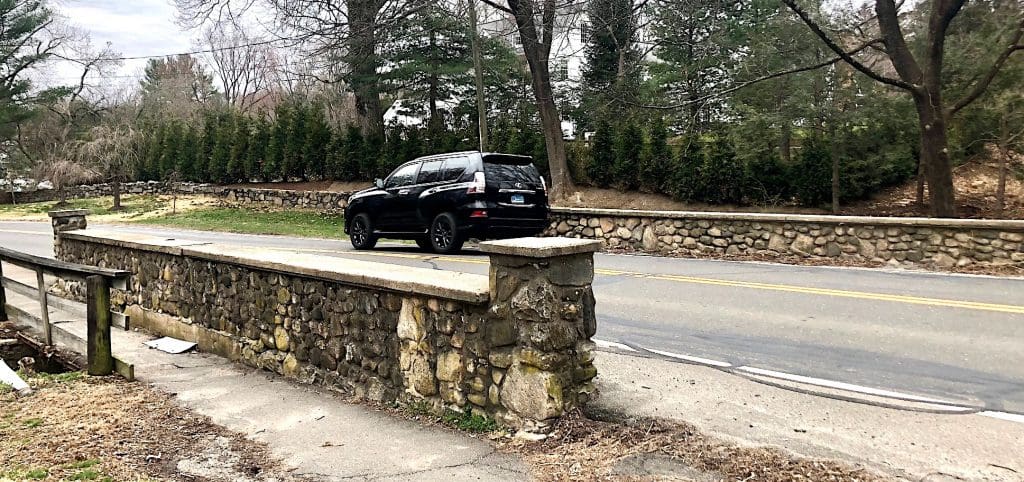
WESTPORT — A study of the town’s historic stone bridges, stalled by the COVID pandemic, is getting a renewed push by the Historic District Commission.
Stone Bridge Study Committee Chairman Scott Springer, at a meeting Wednesday night, said the effort to explore what can be done to preserve the structures, begun two years ago, was sidelined when the pandemic lockdown was imposed a few days later.
Bridges being surveyed are:
• Main Street at Willowbrook Cemetery
• Saugatuck Avenue
• Evergreen Avenue
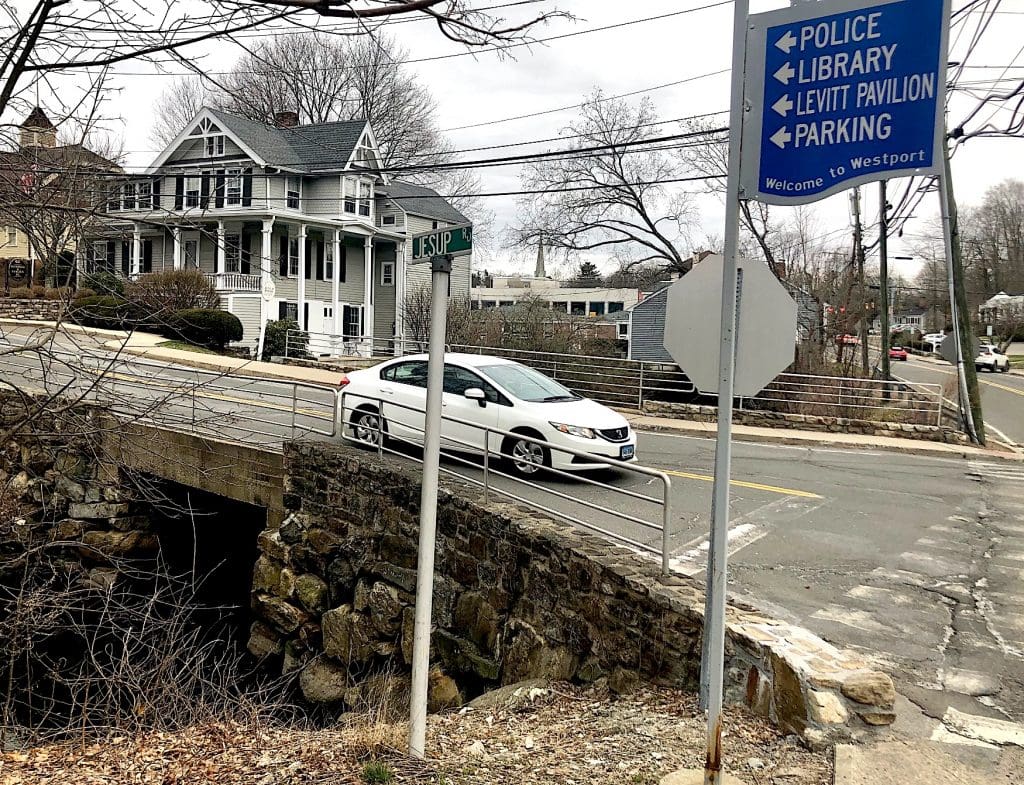
• Jesup Road over Deadman Brook
• Greens Farms Road near Center Street
• Cross Highway over Deadman Brook
• Long Lots Road over Muddy Brook
• Myrtle Avenue at Violet Lane.
Preservation needs to bridge a list of issues
Public Works Director Peter Ratkiewich, in a presentation to the panel on the stone spans, began with Willowbrook.
“This is not a bridge. This is a headwall,” Ratkiewich said. “There is a pipe that comes out of this from the drainage system that’s underneath the street. There is no other side to the bridge.”
Also, he said, it’s on private property.
“I couldn’t do anything with this if I wanted to,” he said.
Similarly, a Saugatuck Avenue span is not under town control. It’s under a state road.
“I have absolutely no jurisdiction over a state culvert,” Ratkiewich said. “They do their work when they decide to do it.”
Historic district impact
Evergreen Avenue bridge, he recalled, was purposely included in the Evergreen Avenue Historic District.
“Of all of the bridges on this list, that bridge is probably in the best condition that I may be able to go in and do some restoration on it, rather than any major replacement,” Ratkiewich said.
“Jesup Road is my next priority for a bridge,” he said. It’s on the DPW list for replacement and the town’s capital projects forecast. He said he believes the span is within the Jesup Road Historic District.
He said the bridge has been retrofitted over the years, and now has a concrete deck and aluminum rails from the 1970s.
Ratkiewich said that at a 2019 meeting with the committee, he suggested “to try to have you folks envision what you’d like this to look like, that would be more in character with this district, because this certainly doesn’t enhance anything at all.”
He suggested keeping some of the stones used in the abutments for reuse in reconstruction. Masonry, he said, has a hard time standing up to salt water, and the brook is tidal at Jesup Road.
He said the bridge is probably in the worst shape of any of those on the list, and that he hopes to begin the replacement process in the next year, aiming for construction in 2024.
Flooding takes a toll
Greens Farms at Center Street, Ratkiewich said, has suffered scour from fast-moving water during flooding, undermining the abutments.
“It’s a pretty bridge,” he said. “Stone masonry, concrete cap.”
“This is a bridge that cannot be surgically repaired,” he said. “So, I guess we need to find out what the significance of its construction is, but I don’t have high hopes that we can send a mason underneath and point-up the walls. That’s not the nature of the damage.”
The Cross Highway bridge over Deadman Brook, Ratkiewich said, has also been degraded by the velocity of water during flooding.
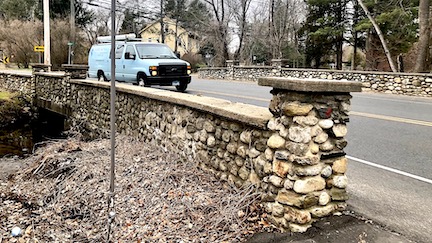
“This one I think there’s a hope of preserving it, maybe for like 20, 25 years or so, but I’d want to have a bridge engineer look at that and see what can be done underneath as far as scour protection without going too deep into the bridge.”
Ratkiewich said he’d rate Long Lots over Muddy Brook the second worst on the list.
“This bridge is in really rough shape,” he said. “I still would have an engineer look at it and see if there’s an ability to preserve something …”
The bridge at Myrtle Avenue and Violet Lane, which is a culvert, had been buffeted by serious flooding during major downpours, Ratkiewich said, but it’s in better shape than some of the others. He said a reconstruction project is planned.
Utilities, he said, including a telecommunications conduit and a sewer line, complicate matters during flooding. The sewer line catches debris and worsens flooding upstream.
They look appealing, but are they safe?
“They all look good from the top, but underneath is where all the problems really occur,” he said.
“Are they unsafe?” commission member Marilyn Harding asked.
“They are deteriorating,” Ratkiewich responded.
The state in 2016 did a screening of bridges statewide, Ratkiewich said, and Long Lots, Cross Highway, Myrtle Avenue and Jesup Road “did not fare very well.”
He also noted that preservation of bridges, rather than replacement, would probably not be covered under state funding. So funding the projects would likely be the town’s responsibility.
It would likely be more than a year before the Historic District Commission could obtain a state grant to study the bridges.
Ratkiewich said he could possibly incorporate preservation possibilities in a request for proposals that also looked at engineering requirements for the spans.
He asked what the committee wanted to do.
“We’re anxious to preserve them, obviously,” Harding said. “They are part of Westport’s landscape.
Springer worried about a Public Works-driven study that might conclude the bridges couldn’t be saved. Ratkiewich said he has a similar concern from the opposite viewpoint.
In the end, it seems the Bridge Committee agreed to let Morley Boyd, a former HDC chairman who lives on Violet Lane, volunteer to help with the bridge report, rather than delay it until state grants were obtained.






Clarification: It’s been four years and two months since the HDC voted to move forward with historic designation of the remaining handful of Westport’s unique stone bridges. Covid had nothing to do with the delay and there is no value in pretended otherwise. As an aside, it’s a shame that our public works department, by its own admission, never bothered to establish an inspection program for these assets – until now. At any rate, hopefully, the obstacles to moving forward have maybe been cleared. But we’ll see. One thing is clear: the HDC now understands that its job at this juncture, consistent with state statute, is simply to assess the historic merit of the bridges. Period.
Flooding is only listed in this article as contributing to damage to these historic bridges. With climate change and the impact of increased development we are seeing increased flood water that exceeds the capacity of these structures creating a public safety hazard as well. This is another element that must be considered for what to do with these bridges.
Art Schoeller
President
Greens Farms Association
Art, you seem to have possibly forgotten your previous enthusiastic support for the conservation of the historic bridges at issue. You might want to check your records from, say, February 2018.
It’s unfortunate that the author of this WJ article gave so much press to Mr. Ratkiewich’s opinions regarding the state of each of these bridges yet gave no press to the important comments made by Mr. Boyd regarding the value and importance of pursuing a historic study of them.
Wendy, thank you for your comment! I agree with them.
Each of these bridges deserves to be preserved..Lose Westport’s history and you lose Westport. The stonework we can appreciate throughout the town has a rich history.
As I just wrote to the HDC, the task of the HDC is to do their best to preserve that which is historic in Westport. These bridges are part of the history of New England and Westport. Whether they meet some official designation standard is not especially important. They need to be preserved. I am confident the HDC will approach their task on that basis. The first goal is preservation, after that the implementation issues hopefully can be addressed.
Don Bergmann