
By Thane Grauel
WESTPORT — The Planning and Zoning Commission on Monday took its first look at a proposed text amendment that would enable construction of 10 residential structures at the Glendinning Place corporate campus.
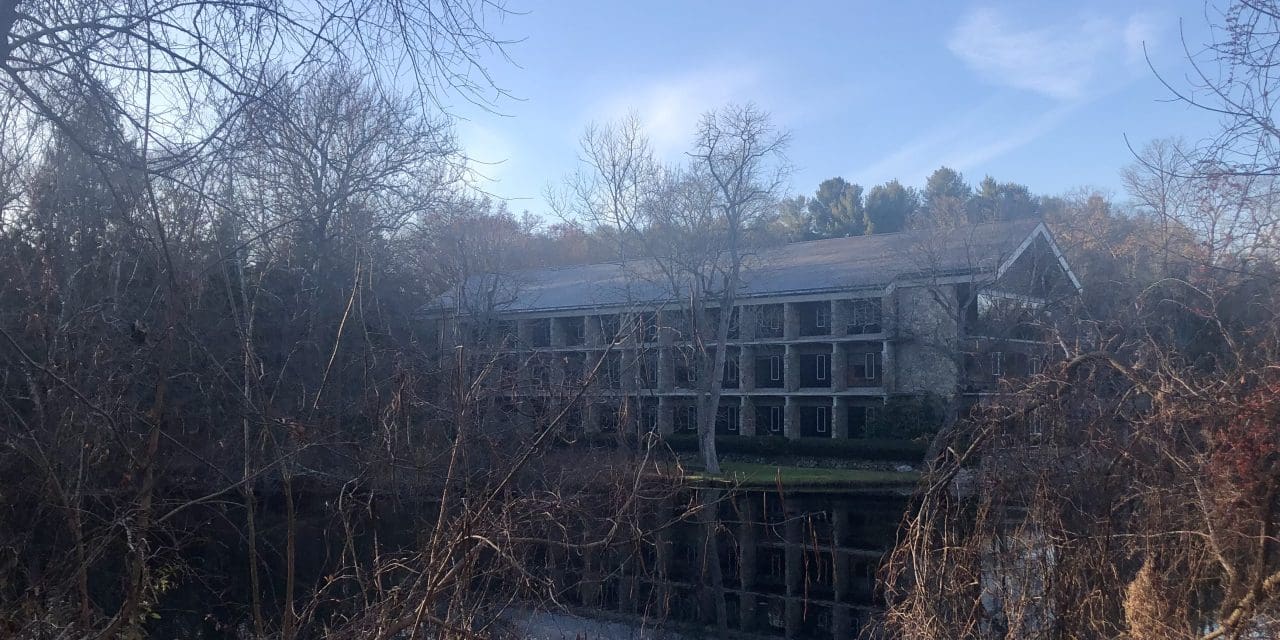
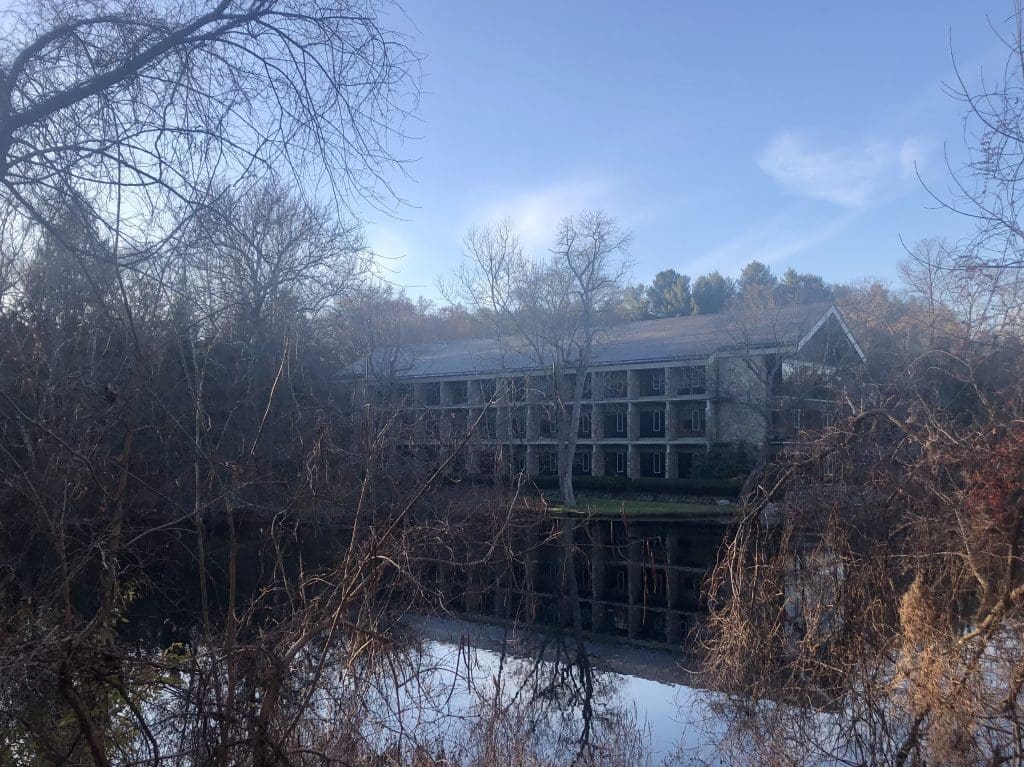
During a public hearing, it discussed the future of the old home of Bridgewater Associates, just north of the Merritt Parkway. The office building, built in 1966, will remain.
It appeared to have a warm reception from commission members.
But neighbors expressed concerns including traffic, the fragile environment where several waterways meet, and the ability of the land to handle septic systems.
And an uneasy focus appeared to be on the developer’s dedication of units for special needs housing, which would boost the town’s effort to reach another moratorium on the state’s 8-30g affordable housing guidelines.
The latest plan by Glendinning Westport LLC calls for eight detached market rate single-family homes on a northern portion of the property. Two other buildings would contain three efficiency studios in each to house five special needs individuals, plus a support staff person.
The inclusion of housing for people with special needs was a touchy issue, viewed suspiciously by some as a way to move the project along, welcomed by others.
“There’s a lot of really good housing here for people that need it,” said member Neil Cohn. “I think this use is in line with what should be in a residential neighborhood as it is.”
The town is seeking a new moratorium from the state’s 8-30g affordable housing legislation, which gives developers considerable leeway when building in municipalities that haven’t met the state’s benchmarks for affordable housing stock.
Land-use consultant Rick Redniss is handling the application on behalf of the owner, which bought the roughly 16-acre property for $10.6 million in September 2023. One of the principals is David Waldman of David Adam Realty in Westport. With partners, he developed Bedford Square and the Bankside House condos on Wilton Road.
Gloria Gouveia, a consultant hired by the neighbors, questioned the wisdom of housing people with special needs in a setting far from the services and amenities they might need.
‘These two buildings are being proposed in such isolated environments where the residents will not be able to walk anywhere, they will be completely, completely reliant upon someone providing them with transportation’
gloria gouveia
Gouveia mentioned she had two relatives with special needs and that she served on the board of STAR.
“As a relative of family members who depended on specialized housing for them to thrive, I have to tell you, the idea of creating two housing developments so remote from town services, from transportation, from medical needs, from shopping needs, from social needs, from recreation, from the need to be able to be able to engage in community events like parades or special events down on the green …”
“These two buildings are being proposed in such isolated environments where the residents will not be able to walk anywhere, they will be completely, completely reliant upon someone providing them with transportation,” Gouveia said.
She also objected to the application on the grounds it didn’t conform to the town’s Plan of Conservation and Development.
Planning and Zoning Director Mary Young noted that plan is something that needs to be considered by the P&Z, but, “It is an advisory document, it is not binding.”
The neighbors invoking concerns about locating people with special needs there, and how could they get around, did not play well.
“It’s a beautiful, beautiful neighborhood, and people with special needs should be allowed to live there,” Redniss said.
“It’s not the special needs housing,” said Jenn DeLeonardo, an abutting neighbor. “In fact, I would challenge you to make all the 10 of those special needs housing, then you would not hear a peep from me. It’s the eight market-rate homes that are coming along with the special needs housing. That’s the issue.”
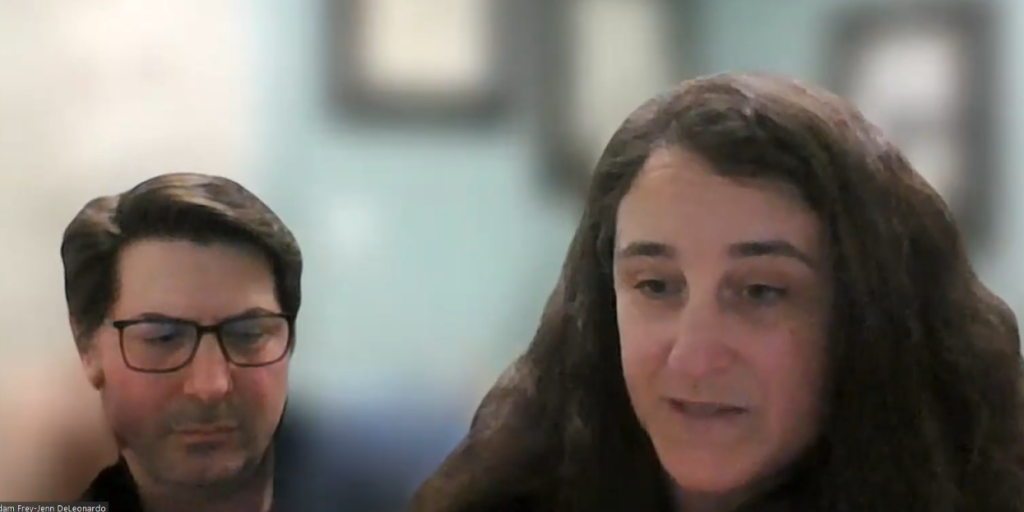
Neighbor Adam Frey said he thought it “disingenuous” to say the health district had positive feedback.
“They still had concerns about significant bacteria levels,” he said.
“I think your traffic study was incredibly disingenuous,” Frey said.
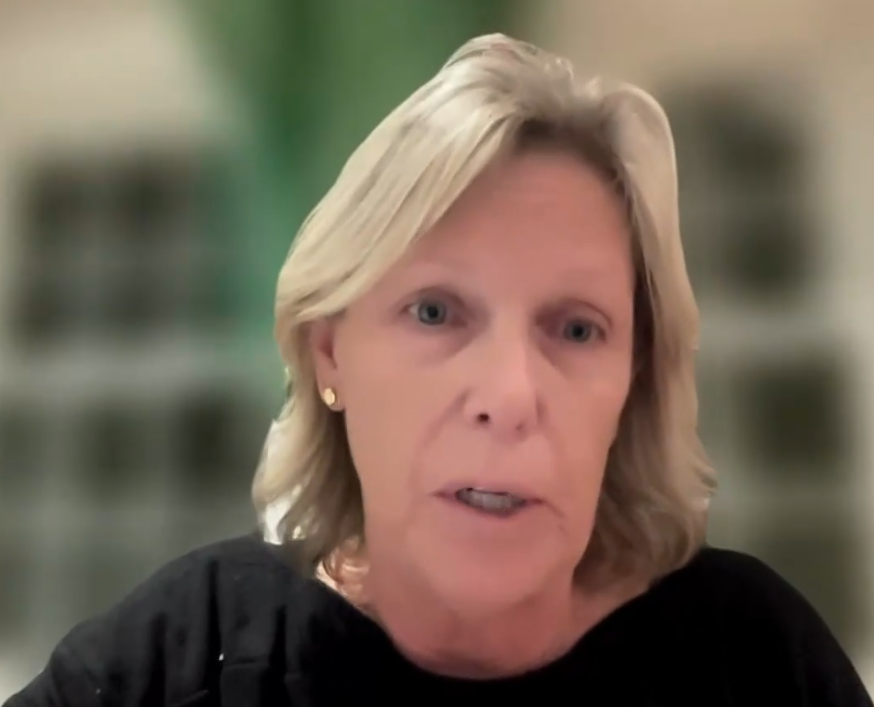
Kathryn Turley-Sonne, a mother a neuro-divergent adult, also spoke.
“I’d just like to say some of these comments about typical housing and typical transportation are a little naive,” she said. “Because there is not typical housing and there is not typical transportation for these neuro-divergent adults that live in our community.”
“Many of the parents in this community are sending their children a hundred-plus miles away to find housing and community. And it makes it really difficult to stay connected as a parent, as a community.”
“I’m so grateful to David and to his group that they are starting encourage this in our community, and to create opportunities in our community because there are none,” Turley-Sonne said.
“And to imagine that my daughter could live 10 minutes away from me is like a dream come true,” she said. “I would have no problem getting in a car and transporting them everywhere.”
‘To imagine that my daughter could live 10 minutes away from me is like a dream come true. I would have no problem getting in a car and transporting them everywhere.’
Kathryn turley-Sonne
Redniss told P&Z Chairman Paul Lebowitz he’d like to address some of the points made.

“This has been an unusual application with unusual comments,” he said. “I try to listen and understand where people come from, I’m having a little difficulty with some it here.”
“When you hear that if this were all special needs housing it would be OK, really?” he said. “An all-special needs housing on septic systems is OK?”
“An all-special needs housing in terms of the environment and the existence and the trees is OK, if it’s all special needs?” he said.
“So, there’s something wrong with market-rate housing,” Redness said. “So, that’s unusual …”
DeLeonardo tried to break in.
“Excuse me, excuse me,” Redniss said.
“A lot of times we hear that they don’t want the affordable housing in their neighborhood so it’s very unusual and we haven’t had a chance to talk or talk these things through.”
He said special needs housing would require septic, and all the same issues.
“With a lot of these applications, if not here, where?” Redniss asked. “Someone else’s neighborhood?”
He then detailed his history of working on affordable housing issues with the town.
“When you got your first moratoria,” he said of relief from the state’s 8-30g housing legislation,
“Seven out of the first 10 projects that got you those points I had the pleasure of working with you on.”
“So, when I’m called disingenuous, it really kind of rubs me the wrong way,” he said. “Disingenuous about traffic from 10 residences …”
‘To those who oppose this right now I would ask that you try to refrain from advocating on distance and transportation needs of those who live there. It’s patronizing and it does not come across well.’
john bolton
Lebowitz asked him to focus back on the application. “I know you’re passionate, so I appreciate that,” he said.
Member John Bolton wanted to weigh in before the commission agreed to keep the public hearing open.
“To those who oppose this right now I would ask that you try to refrain from advocating on distance and transportation needs of those who live there,” he said. “It’s patronizing and it does not come across well.”
“There’s also something called the Americans with Disabilities Act, and that’s something that someone could zero in on,” he said.
Thane Grauel grew up in Westport and has been a journalist in Fairfield County and beyond for 36 years. Reach him at editor@westportjournal.com. Learn more about us here.








Wait a second. Am I reading this correctly? The neighbors hired a consultant to basically say Westport should not allow people with special needs to live where they choose, e.g. 10 minutes from their parents’ house? As a land use expert, is she implying Westport needs to create a special zone for special needs adults that meets her definition of what she thinks will assure their well-being? If so, to quote Mr. Bolton: “It’s patronizing and it does not come across well.” IMHO
– Jeff Mitchell
Not at all, though the developer is trying to cast it that way. The neighbors are protesting the building of ten 4200 square ft. dwellings, a new 26 fort wide asphalt access road, and ten septic tanks on 3.25 acres of land that is not connected to town sewer and that will be at a 30 foot setback from the Aspetuck Land Trust nature preserve, 75 feet from the West branch of the Saugatuck river, right where it combines with the main Saugatuck and next to 4 acres of wetlands. The 3.25 acres are currently open space restricted and have been since the 1960s when the former Bridgewater office complex was built. This is not about opposing special-needs housing (2 of the 10 dwellings), it’s about opposing eight $2 million homes that the developer would like to cram on the land in contravention of existing restrictions, zoning regulations, and Westport’s Plan of Conservation and Development. Check out Westport’s current zoning regulation 32-97, which restricts special-needs housing to only town-owned land and Residence A zones. It’s Westport’s own zoning regulations promulgated by the Planning and Zoning Commission that are exclusionary and don’t allow special-needs housing in other zones, not the neighbor’s opinions. I don’t know why they chose to place restrictions on where special needs housing should be located, personally, I think it should be located anywhere in town where there is availability and desire, its the P&Z that chose to write the regs that way. If the P&Z looks at the big picture and judges that special needs housing is important enough to grant an exception to its own rules and cancel the open space restrictions that were put on this ecologically sensitive land, then great, the special-needs housing can be put in place and the developer could still get a couple of houses extra to make it worth their while without completely destroying the open space and clear cutting 3.25 acres of riverway. But cramming 8 additional 4,200 sq ft $2 million dwellings with septic systems and a road on 3 acres next to a river and wetlands in order to get an additional windfall of $16 million worth of real estate is not something the developer should be entitled to just because they’d like to do it. The restrictions on this land were well-known when they purchased the property, and they are pushing to see how much money they can make, which is their right as a business entity, but that doesn’t mean that the town is obligated to let them destroy restricted open space to help them to maximize their profit.
I cannot speak knowledgeably to the merits of this respected developer’s proposal at Glendinning, though it is clear Westport is in dire need of more affordable and special needs housing. The demand for luxury housing also outpaces supply.
However, I will say that the town has shown little regard for preserving open space, green space or native sanctuaries. Instead it pursues population growth, high density housing, more traffic and the demise of a quaint and quiet New England small-town lifestyle.
Taking a brownfield approach to development may serve us better, such as the developer’s brilliant repurposing of the Save The Children building. More of this, please.
To Toni’s point – there are a number of vacant office buildings on Riverside Avenue south of the Post Road that are empty and seeking new tenants. Why aren’t those being looked at to be used for affordable and special needs housing??
Can we be honest – the only reason this proposed development included the 2 special needs units, was to be able to cram in yet more giant houses in this ecologically sensitive area, hoping those approving, look the other way instead of honoring the historical designation of ecologically sensitive land. Once the open space is gone, its GONE. These natural areas are why we choose to live here instead of more dense areas of Connecticut.