
By Thane Grauel
WESTPORT — After agreeing on a definition of what constitutes public art, the Planning and Zoning exempted it from coverage calculations that apply to public and private properties.
Reviewing the issue last week, P&Z members also tried to preemptively close a loophole in the regulation that might lead inventive legal thinkers — in a town with no shortage — to propose that ordinary structures, such as sheds, are really “art.”
The definition of public art approved by the commission states, in part, that it comprises: “Publicly accessible installations of original works of art displayed primarily for public viewing and appreciation located on public or private property …
“… And may take a variety of forms such as sculpture, murals, photography, an artifact, or be a memorial, monument, or fountain” in a wide variety of materials.
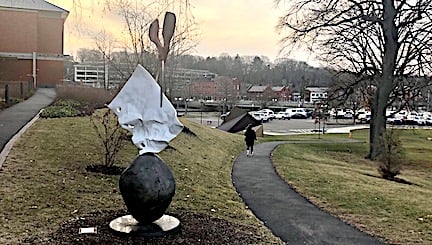
Sculpture outside library prompted change
Planning and Zoning Director Mary Young told the P&Z’s March 14 meeting the idea to allow leeway for public art came from the commission’s Zoning Regulations Subcommittee. She said at the end of the group’s meetings, the question is routinely asked, what else should be on its agenda?
“Nancy Diamond from the Westport Arts Advisory Committee was reminiscing about the multiple-step process involved in getting art donated to the town of Westport and placed on town property,” Young said.
“In particular, last spring, she had the opportunity to bring a sculpture to the library in the form of a ‘Rock, Paper, Scissors’ sculpture that required multiple meetings, in part, because adding another structure to the library was exceeding the allowable coverage, forcing her to seek relief from the Zoning Board of Appeals to add more coverage.”
Young said that could be avoided if public art was exempted from property coverage calculations.
First, Young said, a definition for public art was written with Diamond’s assistance. Then, the text amendment was created exempting it from coverage.
Can a shed be public art?
Young said Deputy Planning and Zoning Director Michelle Pirelli, in conjunction with the Town Attorney’s Office, suggested the commission “add language saying that any such art shall not be combined with any other use to ensure that a structure, for example, a shed, cannot be deemed public art and can be exempt from coverage.”
“I think it’s fantastic,” said commission member Amie Tenser. “I’m a big proponent of art. I think it’s amazing and we want to get more out there.”
“Seeing how great that Rock, Paper, Scissors sculpture looks at the library, and knowing how difficult it was, this hopefully clears the way to get more public art,” said member Neil Cohn.
P&Z member Patrizia Zucaro also supported the text amendment, and liked the added wording.
“I think we all know what art is, but I agree that some people can probably use it to construe different meaning,” Zucaro said. “But I’m wondering if that language she suggested actually would cover us?”
“What if someone said that shed was a piece of art, but they didn’t use it as a shed … would that fly as being a piece of art?” Zucaro asked.
Promoting art in public places
“I think that what’s really most important tonight is that the language of what is public art, and moving it away from structures is really important,” said Kathy Bennewitz, curator for the Westport Arts Advisory Committee.
“What is key is it aligns us with municipalities that have strong public art programs, such as Stamford and New Haven, and even New London,” she said. “And it really allows us to embrace art in a public sphere, which is all about engagement with the community.”
Regulating art a bad idea
Gloria Gouveia, a longtime Westporter and land-use consultant, spoke against the measure.
“I think this regulation a terrible idea,” she said. “I don’t think there should be zoning regulations at all for public art. I think legislating public art in any way that impedes the possibility of us receiving gifts of public art is not a worthy pursuit.”
She suggested instead having the Board of Selectwomen handle such requests.
“If you want to do public art a favor, don’t do any more regulation, especially not zoning regulation, please,” she said.
Architect Bill Achilles, who worked to get Rock, Paper, Scissors approved, said he favors any measure to “alleviate some of the time, energy and money spent on getting an approval for things that essentially everybody wants.”
The commission’s vote to approve the amendment was 7-0.


Getting permission to install public art is a wee bit tedious? Cry me a river. Try historic designation of town-owned cultural resources. Golden Shadows was slow walked for so many years by the Historic District Commission that the RTM had to step in and pass reform legislation to stop the shennigans. But then it turned around and buried the Golden Shadows initiative under something like two dozen public hearings of its own. And that was before even getting to P&Z. Finally, the worn out citizen petitioners got the picture and withdrew the application. I could go on: there’s the matter of the historic designation of Westport’s unique stone bridges. Years ago, the political appointees on the Historic District Commission voted to move forward with this initiative which, like Golden Shadows, was brought to them by the residents they serve. There were a few meetings and then, poof! Nothing. The bridges are threatened but no one knows what the Historic District Commission has really been up to all this time; its tortured written explanations defy reason – much less comprehension. And, it must be said that this is all going in flagrant violation of the very ordinance which was reformed to prevent such abuse in the first place.