
By Gretchen Webster
WESTPORT — Ensuring access to public buildings and services for people with disabilities, an issue often overlooked, has lately been at the top of the local news cycle.
Focusing the spotlight on accessibility issues was the debate late last year over including an elevator in remodeling plans for the Inn at Longshore, the town-owned building slated for $8 million worth of renovations under a 30-year lease granted to the Longshore Hospitality Group.
The matter came to a head when Planning and Zoning Commission members refused to sign off on a final aspect of the project until the hospitality group agreed to restore an elevator in the plans. It had been removed from the initially approved project because of the cost, according to the lease holders.
The issue also drew attention from others concerned about town-owned properties that are too challenging or impossible to use for residents with special needs.
After the town’s Commission on People with Disabilities wrote a letter to the P&Z expressing “significant concerns” about the lack of an elevator in the renovated inn, Longshore Hospitality officials promised to restore the elevator.
“The lack of an elevator poses a serious barrier to people with disabilities and those with permanent or temporary mobility challenges, thus prohibiting individuals with disabilities and mobility challenges from staying at the Inn,” the commission said in the letter, citing a 2017 case when the Inn at Longshore was found to have multiple violations of the Americans with Disabilities Act.
ADA regulations protect those with all kinds of disabilities, including the hearing and visually impaired, even parents pushing strollers, according to Stacie Curran, a member of the Commission on People with Disabilities. And yet, many people think only of wheelchair users when talking about accessibility, she said.
“From infants in strollers to senior citizens, we all need help with accessibility at some point,” she said.
In addition to the inn, there are other town projects in the works where ADA accessibility features have been incorporated from the beginning, and others that will include those considerations when remodeling is complete.
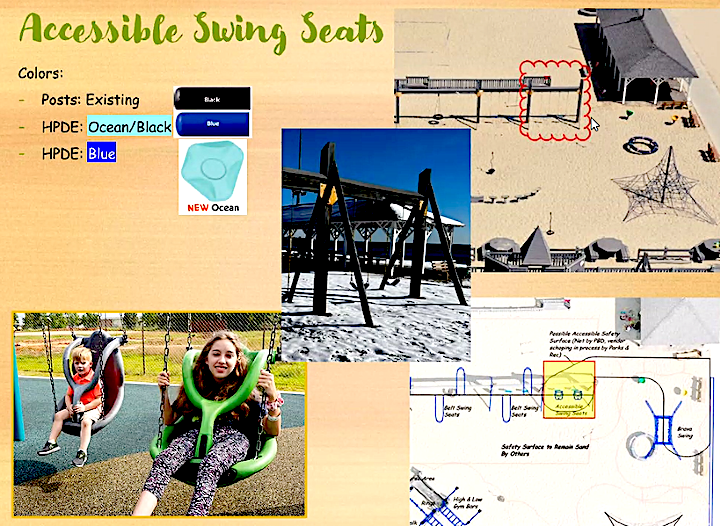
Part of the surface of the Compo Beach playground, for example, will be covered with a special material that allows wheelchairs to travel over the sand, which will be installed during reconstruction of the playground this year. Several pieces of equipment designed for children with special needs are also being added.
And plans to update the Parker Harding Plaza parking lot include making the parking spaces larger so that disabled people can maneuver better between cars, as well as adding ADA-compliant handicapped parking spaces.
Another change currently under consideration by the P&Z is a proposed amendment to expand the definition of “special needs housing,” to help increase the local inventory of housing for residents with disabilities. The amendment would “help provide an opportunity for a diversity of affordable housing options” in Westport, according to the proposal.
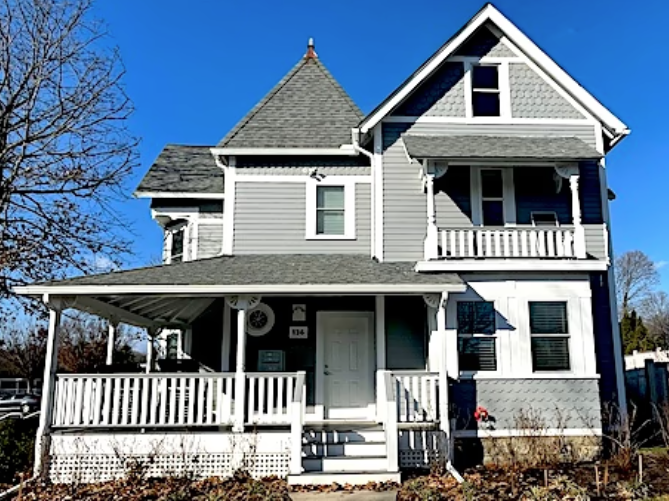
A town-owned house at 136 Riverside Ave. was renovated and opened in December 2023 as affordable housing for adults with special needs. The building, adjacent to Saugatuck Elementary School and PAL athletic facilities, is leased to Abilis, the nonprofit that organized a Jan. 1 “Polar Plunge” at Compo Beach to raise money for housing and other programs for people with special needs.
“Westport is really working to improve accessibility,” Curran said.
Peter Gold, a Westport Transit District director, agrees. “We provide service over and above the ADA requirements,” he said.
The transit district’s programs offer vans that are wheelchair accessible, he said. “All you have to do is put on the app that you want a wheelchair van,” and a disabled resident can be taken door to door anywhere in town, he said. Many of the district’s new Wheels2U minivans, which provide on-demand rides to and from the town’s railroad stations, also are wheelchair accessible.
Curran listed other accessibility upgrades made by the town, state and private property owners, including:
- Mobi mats: Ground access mats rolled out to give the disabled access to the beach and water.
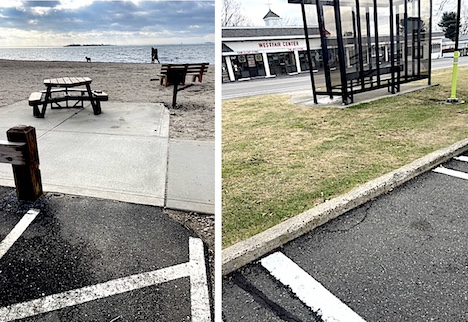
- A sidewalk with flat access to benches along Compo Beach, as well as a picnic table and barbecue that is wheelchair accessible.
- ADA-compliant bathrooms at the beach, and other Westport public buildings.
- Sidewalks paved in a white material along the Post Road to highlight the height difference between the sidewalk and the black asphalt road for the visually impaired.
- Retail, office and other public buildings with wide doorways and buttons to open doors for wheelchair users and others to gain access.
“All of those items create an opportunity to make it accessible for people,” she said.
But there is still room for promoting and adding accessibility features for those with special needs, Curran said. For instance, some stops for Coastal Link buses traveling the Post Road do not have ramps to get wheelchairs or riders with mobility issues over the sidewalk curb to the bus, even though the buses themselves “kneel” to make it easier for disabled people to climb aboard.
“Bus stops do not have a ramp to cross the gap between the sidewalk and roadway,” as train platforms do, Curran said. “That would make so much sense. It would give people [with special needs] more opportunity for independence.”
Freelance writer Gretchen Webster, a Fairfield County journalist for many years, was editor of the Fairfield Minuteman and has taught journalism at New York and Southern Connecticut State universities.







Recent Comments