

By Thane Grauel
WESTPORT — The Flood and Erosion Control Board voted Wednesday to prioritize the replacement of Greens Farms Road bridge and related work on Muddy Brook up to Post Road East.
The decision came as the Department of Public Works sought guidance on which of many flood-control projects should be pursued next.
Municipal flood boards were created by a state law in the mid-1950s. The Westport board’s purpose is to “prevent, correct, and arrest, erosion and flood damage within the boundaries of the town,” according to the town website.
Ted Gill, a public works engineer, told the board it would be helpful if the board chose one priority project. It would have to time to set others after that because bridge and culvert projects can take several years, he said.
Gill had given presentations to the board in recent months about the history of flooding studies and projects in town, and what was in the works.
Ranking flood-control projects
The board’s members were asked to consider four criteria when prioritizing:
• Cost of projects.
• Frequency of water “overtopping” roads.
• Number of structures in the 100-year flood zone.
• Constructability of the project.
Gill said Public Works Director Peter Ratkiewich suggested the last one.
“How realistic is it that we can actually do this?” Gill said of that issue.
“If there’s a culvert and it’s going to require us to get 15 different easements from 15 different property owners, and every single one of them has a different stake in it and wants something else out of it, that bridge could take us 10 years,” he said.
He said if another bridge replacement required only one easement, and it would solve problems for several neighbors, that might be more feasible.
One of Gill’s previous presentations to the board addressed problems over the years getting neighbors to buy into projects.
Flood-control projects not a cure all
He also noted that flood-control projects can’t always eliminate flooding problems. Some would require a massive undertaking.
“It’s not going to necessarily be something where I say, well, there’s 50 houses in the 100-year flood zone upstream of this culvert, and we’re going to go in and replace this culvert,” Gill said. “What I would drive home is that replacing the culvert and doing everything that can be done for flooding here may not mean that you get all 50 houses out of the flood zone. It may mean that you only get five houses out of the flood zone.”
“But that’s still a big win,” he said. “If you’re reducing that flood elevation by, say, 3 feet, I’m sure you can imagine having 5 feet of water in your house versus 2 feet of water can be a very significant difference.”
“Every foot adds a significant impact in terms of the possibility of structural damage to the house, the real property damage, the things that you have in the house,” he said.
Greens Farms project in the pipeline
Gill noted that channel work had been done upstream from the Greens Farms Road bridge, and that the Center Street span already has been replaced. Another chokepoint — the bridge carrying Hillandale Road over Muddy Brook — is now in the design phase after a contract was recently awarded.
Board member Robert Aldrich weighed in on the Greens Farms Road bridge.
“I don’t like seeing it defined as a single project, like a single bridge or a single culvert or something,” he said. “But the whole impact of Muddy Brook. Cleaning out the stream all the way up, getting people to cooperate, getting publicity on it, making a big impact, showing this is going to happen.”
He said the work might lower Federal Emergency Management Agency insurance premiums for property owners, and people should know that.
Gill said it would be ideal if property owners allowed the town to clear debris from their portions of the waterway, and if the culverts near Post Road East, including those under the state road and the property now home to a yet-to-open Amazon Fresh supermarket, could be replaced.
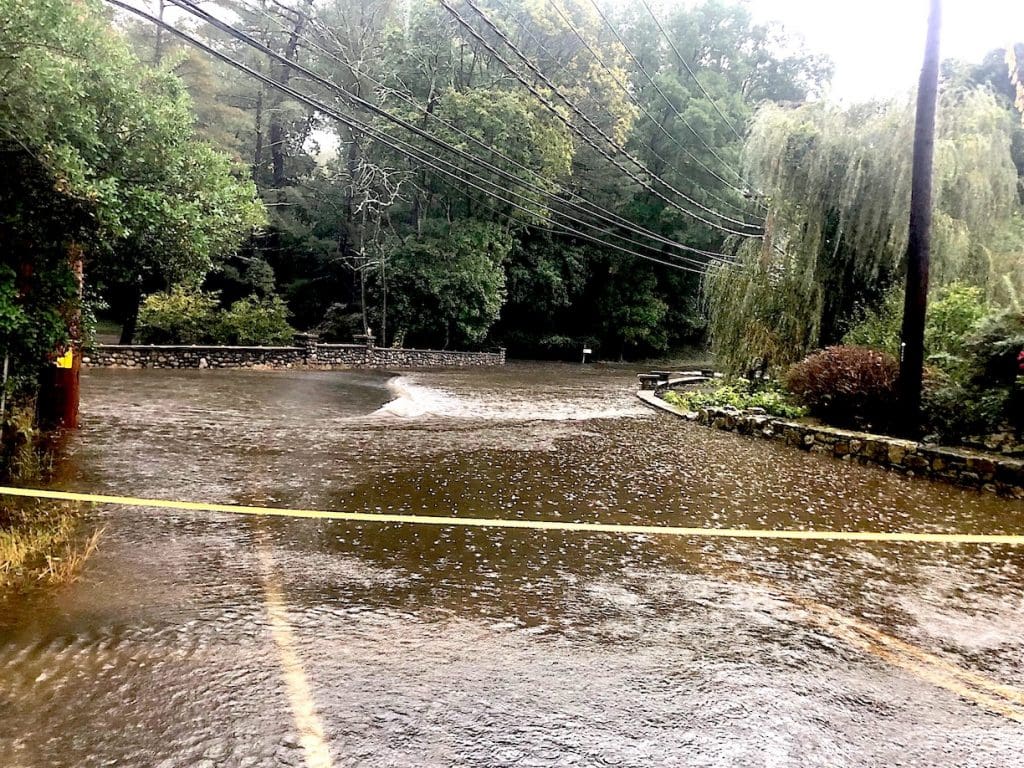
Torrential downpours have flooded Post Road East there, and blocked access to Greens Farms Elementary School.
Casting a wider net
Board member Aimee Monroy Smith said she would like a holistic approach, and suggested surveying residents about flooding priorities in a way similar to a recent survey about Longshore Park.
That comment sparked a discussion about the park survey, and criticism it received.
Smith thought it might be a good idea to erect signs at the sites of flood-control projects, telling people about the goals, similar to what you see some government projects.
There was also discussion of another serious flooding problem, downtown Westport when tidal waters jump the banks of the Saugatuck River.
Gill said a solution to that problem would have to be handled by the state, which has jurisdiction over the river. And, he said, even if the state allowed Westport to manage such a project, it would be far too costly for the town to do on its own.
Board Chairman William S. Mazo saw no reason to delay a vote and asked for a motion to make Greens Farms Road bridge/Muddy Creek the next flood-control priority. Members Smith, Aldrich and Phillip Schemel all voted in favor.
Thane Grauel, the Westport Journal executive editor, grew up in Westport and has been a journalist in Fairfield County and beyond more than three decades. Learn more about us here.











Typical government; one group of appointees trying to replace a bridge (the Flood Board) is, for some reason, not told of another group’s (the Historic District Commission) current work to landmark the very same bridge. Those efforts are not necessarily at cross purposes but you would think this would be the time for a discussion aimed at raising situational awareness and, hopefully, collaboration. Nope.
Morley is right. Based on the info presented in this article, neither the Public Works engineer nor its Director, Peter Ratkiewich mentioned the historic nature of this bridge to the members of the Flood & Erosion Control Board. In fact, of the few remaining circa 1910 stone bridges still remaining in Westport, this is the most beautiful due to its length, its gentle bend, and its setting. Perhaps if the board members had known this, they might have asked different questions and perhaps some may have changed the way they voted.
I was among the group of Westporters who first drew Westport’s attention to these bridges which are thematically unique to our town and amazing, century-old survivors. Having advocated for their preservation for years, I know that there are ways to deal with or divert flood waters through adjacent culverts without having to replace the bridge in its entirety. There are guidelines and engineering publications on how this can be done without ruining the dimensions and historic integrity of the existing bridge.
These problems can be mitigated without destroying this beautiful bridge. Let’s please insist on seeking alternate solutions to replacement.