
By Gretchen Webster
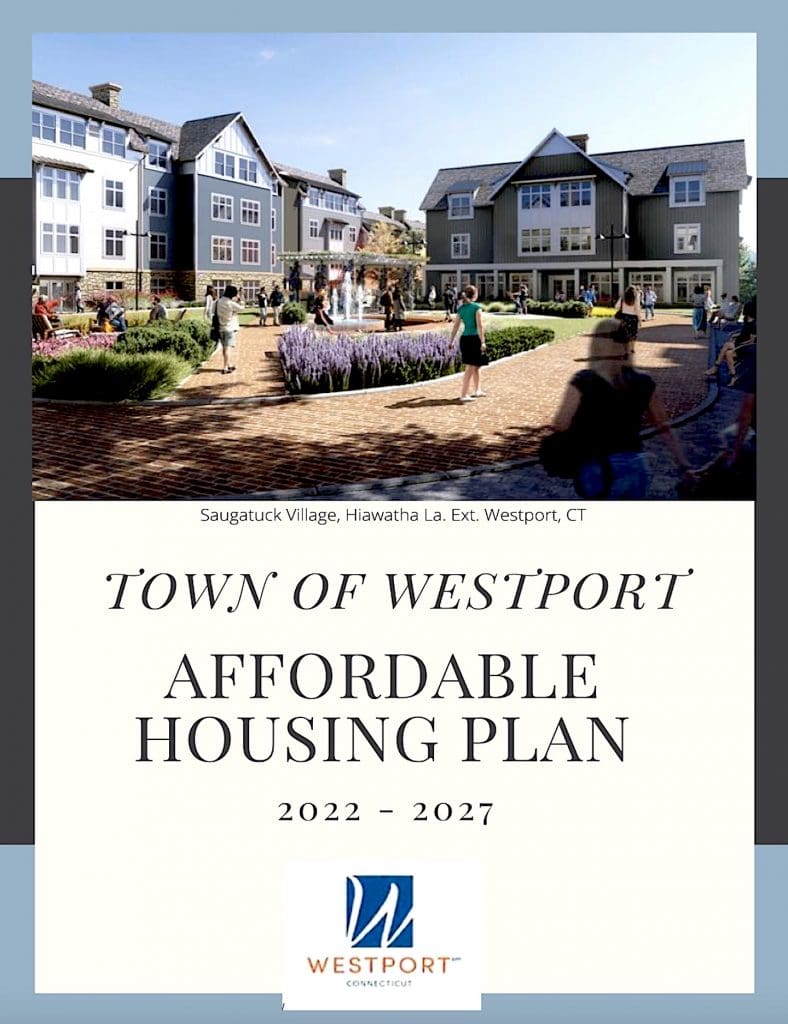
WESTPORT — The final community meeting on Westport’s draft affordable housing plan, held virtually Wednesday afternoon by the Planning and Zoning Commission’s Affordable Housing Subcommittee, met mostly with praise from the 30 people attending, many of whom were town leaders.
The few suggestions made for modifications in the plan will be reviewed at the P&Z’s meeting June 27 when a vote on adopting the plan is expected.
According to state law 8-30j, all state municipalities were supposed to have a draft affordable housing plan ready by June 1. Westport and many other communities missed that deadline, but state officials “confirmed that Westport has absolutely fulfilled their obligation,” Danielle Dobin, the P&Z chairwoman, said at Wednesday’s meeting.
“Myths” about affordable housing in Westport
More 1,000 people have responded to the draft version of the plan, she said, which has been posted for several weeks on the town website. There also has been a related survey on the plan posted here.
Dobin started the meeting by addressing what she called “myths” about affordable housing in Westport.
These include concerns that new developments in Westport are decreasing the percentage of “affordable” housing. Actually, some of the new projects include deed-restricted affordable units and are “bringing Westport more in compliance with the 8-30g law,” she said.
Another concern posted in the responses to the draft plan is that Westport does not allow multi-family housing. “There is multi-family housing all up and down the Post Road,” Dobin said.
The problem is that multi-family housing in Westport is not necessarily affordable when two= and three-bedroom units sell for $2 to $3 million or $10,000 monthly rentals. “I want to make sure that a portion of these multi-family units are affordable,” she said.
Suggestions: Sustainable, on- vs. off-site, offices as housing
Those attending the meeting brought up additional concerns with the draft plan, such as including the use of sustainable building materials in new projects, which was supported by Marcia Falk, an alternate member of the P&Z, and by Ross Burkhardt, a Representative Town Meeting member from District 3. “I know this could be added expense, but if we don’t do it up front it won’t happen,” Falk said.
Ellie Lowenstein, a former P&Z chairwoman, said that she thought the town’s affordable housing report is good, but that affordable housing units should not be isolated and grouped together. “Units designated as affordable should be scattered within market rate housing,” she said. Lowenstein also doesn’t like the idea of allowing developers to build affordable units required under the law off site from primary developments.
Another member of the public, Helen McAlinden, the president of Homes with Hope, a local nonprofit agency dedicated to ending homelessness, said she once agreed that offsite housing to meet affordability requirements was not a good idea.
“But now I see that no matter where the housing is in Westport, it allows the family to go to the wonderful Westport school system,” she said. “I would prefer on site [housing], but when it’s not possible off site is possible.”
Larry Weisman, a lawyer, said he favors using vacant office space to create affordable housing units. “There is a lot of vacant office space,” he said. “I think adaptive reuse of that resource should be emphasized.”
But Matthew Mandell, chairman of the RTM’s Planning and Zoning Committee, and executive director of the Westport-Weston Chamber of Commerce, cautioned that repurposing office space too quickly could be a problem if more workers return to on-site offices.
Mandell said he does favor deed restrictions supporting affordable housing, as well as most of the ideas presented in the draft plan. “This is a good document … Thanks for doing it,” he said.
Ellen Lautenberg, an RTM member from District 7, also praised the document, especially the use of town-owned property for more affordable housing, and both Michael Dinshaw and Burkhardt suggested that allowing smaller units or smaller lots would be more conducive to creating less expensive housing.
Although it might seem logical that subdividing larger properties into smaller lots would bring the cost of housing down, “The idea of smaller lots translating into more affordable housing doesn’t work here,” Dobin said. Some smaller lots, particularly those near downtown or the railroad stations, “tend to be the most expensive lots. Smaller lots do not equal less expensive in Westport,” she said.
What can the state do to help?
Westport officials should not be asking what they can do for the state in terms of affordable housing, but what the state can do for the town, said P&Z member John Bolton, one of the last speakers. Fairfield County taxpayers contribute a huge amount of funding to state coffers, he said.
“What is the state doing for us to help us make it more affordable?” Bolton asked. “It should be a two-way street. It’s not just about affordable housing, it’s about infrastructure. We have a problem. We’ll follow the law, but what is the state going to do to support us? …We can’t do it alone.”
Gretchen Webster is a freelance writer and frequent contributor to Westport Journal. Learn more about us here.








As suggested in the “affordable housing plan”, the Town should use the funds in the Town land purchase fund to acquire property which the Town would then cause to be used for affordable housing. This would allow for a larger percentage of units then the 20% number in 8-30g, would allow for the Town to determine the location of the units, and would allow the Town to impact the aesthetics of the facility. The Town land purchase trust fund has remained unused for many years, possibly from the date it was established.