
By John Schwing
WESTPORT — “191” proved an unlucky number for applicants seeking to win approval last week for signs at a Post Road West medical office building, a saga that so far has dragged on for seven months.
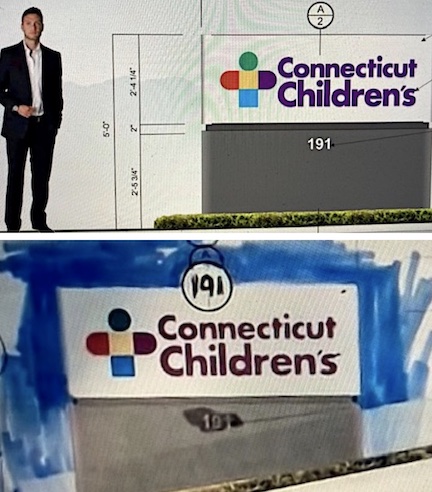
The latest setback for representatives of Connecticut Children’s Specialty Care Center took place at last Tuesday’s Zoning Board of Appeals meeting when a proposal for a roadside sign in front of the center’s building — at 191 Post Road West — was withdrawn for revisions after critical questions were raised by board members.
Only two weeks earlier, the free-standing, illuminated sign had won quick approval from the Architectural Review Board.
But before the sign could be installed, it still needed ZBA-issued waivers because of its size, its location within the setback of an abutting property and it lacks the required 100-foot minimum frontage along the street.
Plans for the Connecticut Children’s signs first encountered trouble before the ZBA in January.
At the time, Lawrin Rosen of Artfx, the center’s sign vendor, received a tongue lashing from board members over the installation of a large illuminated sign on the Connecticut Children’s building. That sign was installed without the required approval and at a height that violated zoning regulations.
So harsh was board members’ criticism that Rosen at one point exclaimed he felt as though he was facing “a group of alligators.”
The sign on the building subsequently was taken down and installed at a lower level, where it complied with regulations and no longer needed the ZBA to approve a variance.
On Tuesday, as Rosen presented plans for the second, roadside sign for Connecticut Children’s, he apologized several times for the earlier violation.
And although discussion of the proposal remained cordial this time, questions immediately arose over the application.
Rosen was caught off guard when informed the proposed sign also would a need a size variance, which he had not anticipated. The regulation on sign sizes calculates overall size using both sides of a double-sided sign, which rendered the sign Rosen said was just over 31 square feet, as measured on one side — and within the 32-square-foot limit — roughly twice as big as the regulation permits.
“I didn’t understand that it was two sides that were considered” in calculating a sign’s size, Rosen said.
But more pointed questions arose over display of the street address numerals “191” on the sign’s base, as well as the sign’s internal illumination.
Elizabeth Wong, the ZBA vice chairwoman, faulted the relatively small size of the 191 numerals, saying the street address would be hard to spot for drivers looking for the medical building. And because the 191 numerals were not incorporated into the illuminated portion of the sign, the address would be even more difficult to see, she added, particularly at night.
Wong also felt that by posting the address on the sign’s base the numerals could be obscured by snowfall during winter.
Michael Calise, a member of the public, raised several “concerns” about the roadside sign. He was critical of how the 191 numerals were displayed, as well as the sign’s internal illumination.
The address should be added to the top of the sign, Calise said, because “numbers are wayfinders, numbers are important to people who are in an emergency … They make a location easily understandable and they give certainty to where you’re going.”
Calise favored a sign that would illuminated externally, rather than internally, noting there are no other free-standing signs, with internal lighting, along the stretch of Post Road West from the town’s border with Norwalk to the Saugatuck River.
Renderings of the sign presented to the board, Calise also said, failed to accurately depict how the property’s slope would affect the elevation of the base. As proposed, he said, the base would be a “monument that’s going to have an exposed triangle of somewhere around 12 square feet” including both sides.
Jim Ezzes, the board chairman, also had “a problem with the numbers … number one, they’re too small, number two, they’re on the bottom.”
The “key thing here is the numbers, not the name,” he added, noting that people using a navigation system most commonly search for their destination using the address and not the name.
And when Rosen began responding, “I have a proposition …,” Ezzes cut him off, saying, “We don’t negotiate.”
Rosen then showed the meeting a quickly prepared, revised design for the sign, featuring the 191 numerals positioned above the Connecticut Children’s name, which he said also could be lighted externally.
“We’re happy to work with you,” Rosen told the board, and asked if a revised application resembling the new drawing were brought before the board would “make everyone happier.”
Ezzes interjected, “This is not ‘Let’s Make a Deal.’ I’m not Monty Hall, so we don’t make deals.”
Instead, Ezzes suggested that Rosen agree to continue the ZBA’s review of the application at a future meeting, returning with a “clean” plan reflecting concerns voiced about the submitted design.
After Rosen agreed with that suggestion, he also was told the sign’s revised design might first have to go back to the Architectural Review Board before the ZBA could continue its review.
Fellow ZBA members concurred with Ezzes’s suggestion to hold off voting Tuesday on the Connecticut Children’s application, allowing for a future vote on a revised design.
At Greens Farms, a gazebo for outdoor learning
In contrast to the consternation provoked by the medical building’s sign, another application on the ZBA’s agenda won quick approval.
The application involved a waiver sought by the school district to build a gazebo at Greens Farms Elementary School, 17 Morningside Drive South.
The gazebo — measuring 24 by 14 feet — will be financed by federal money allocated to the town through the American Rescue Plan Act. It will sit within a fenced, lawn area, according to the plans.
It is the first of the town’s elementary schools to get “an outdoor learning space,” as described by Elio Longo, the school district’s chief financial officer.
Similar projects will be planned at the four other elementary schools, all with the goal of supporting the district’s mission to enhance students’ social and emotional well-being, Longo said.
He noted that ARPA-funded outdoor projects — a ropes-course and fitness exercise facilities — at Staples High School and the two middle schools already have been approved.
A waiver for the gazebo was needed because the Greens Farms property, which has a significant amount of wetlands, already exceeds the total lot coverage allowed under zoning regulations.
The project, which drew few questions from board members, won unanimous approval.
John Schwing, the Westport Journal consulting editor, has held senior editorial and writing posts at southwestern Connecticut media outlets for four decades. Learn more about us here.










Recent Comments