

By Linda Conner Lambeck and Gretchen Webster
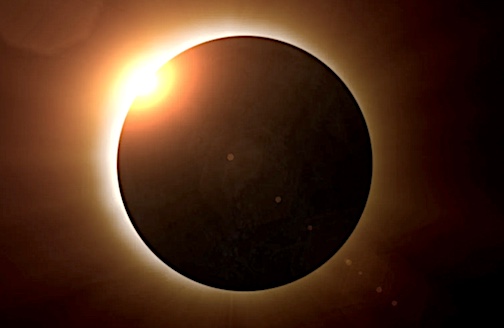
WESTPORT — Anticipation has sky-rocketed for a celestial phenomenon Monday the likes of which won’t be visible in these parts for decades.
A total solar eclipse is expected to turn Monday afternoon’s sunny skies to dusk as the moon passes between Earth and the sun, casting deep shadows over the region starting shortly after 2 p.m. until about 4:30 p.m.
At its peak just before 3:30 p.m. Monday, the eclipse over Westport skies is expected to be just over 90 percent complete.

For detailed information about Monday’s solar eclipse, including graphics, timeline and safety tips, check the NASA website.
Since there won’t be another total solar eclipse visible from Connecticut until May 2079, sky-watching opportunities are planned locally to take advantage of the rare sight.
As an educational experience, Westport public schools have distributed nearly 2,800 pairs of special glasses to facilitate students’ ability to safely view the eclipse.
And the Westport Astronomical Society and the Westport Library will co-host a public viewing, with volunteers on hand with telescopes and gear to ensure safe viewing of the skies.
Schools prepare for learning experience
Westport’s school district is handing out ISO-certified solar eclipse glasses and giving parents the option of picking up their children early in order to personally supervise their eclipse viewing.
“We look forward to making this event an educational experience that our elementary students will remember for years to come,” Assistant Supt. of Schools Anthony Buono wrote in an email to parents.
Although there was a solar eclipse visible from the U.S. in 2017, this one cuts a larger path across the nation. About 99 percent of Americans are expected to get a chance to see at least a partial view, according to NASA.
To prepare, the school district ordered 2,790 solar eclipse glasses for the elementary schools at a total cost of $2,694.93, so all elementary school students and staff will be able to watch the eclipse safely, Buono said.
Additionally, Buono said the middle schools and Staples also ordered glasses, although he was unsure of the number.
The special glasses are necessary because viewing any part of the bright sun without special filters can cause severe injuries to the eyes.
Classroom teachers and science coaches have prepared students through a number of age-appropriate lessons, practicing proper use of the glasses and sharing information about the eclipse.
Using Connecticut Department of Education guidance, the district plans to take students in grades three through five outside for a short period of time to observe the eclipse.
Pre-kindergarten through second graders will get glasses to take home, but will not view the eclipse outside while at school. Instead, they will watch it on TV.
Parents also have the option to pick up their children before the start of the eclipse to personally supervise eclipse viewing.
In anticipation of an increase in the number of early dismissals, Buono said families are asked to pick up students before 1:45 p.m.
Parents will also be allowed to remove their children from class as an excused absence for an “educational experience,” but are asked to notify schools in advance.
“It is also important for parents to remember that the eclipse will still be occurring when students are dismissed, between 3:10 and 3:45 depending on which elementary school they attend,” Buono wrote in his message to parents.
“While school staff will remind students that they should not be looking at the sun on their way home from school, we ask that parents also remindtheir children of this important safety rule.”
Expert viewing guidance from Westport Astronomical Society

Members of the Westport Astronomical Society will set up shop outside the Westport Library at 2 p.m. Monday to assist people seeking a safe, informed view of the eclipse.
“The safest way to see it is with us at the library,” said Dan Wright, a board member of the astronomical group.
Ironically, watching a total eclipse — when the moon moves in front of the sun and covers it completely — is somewhat safer than looking at a partial eclipse because more of the bright corona, or ring of sun outside the area covered by the moon, remains visible, he said.
The eclipse visible in Westport skies is expected to be slightly more than 90 percent complete.
“If it’s not a 100 percent eclipse, it is dangerous to look at it. And staring directly into the sun is never safe,” Wright explained.
“But there all sorts of great ways to safely see the eclipse,” he added, such as using certified safety glasses or specially equipped telescopes, which Westport Astronomical Society members will bring to the library.
“Just sunglasses or even welder’s glasses will not be the right way to see this,” Wright said. “We don’t recommend looking at the sun for any reason unless you have the right equipment.”
Viewing an eclipse, if done safely, is an amazing — even life-changing — experience, Wright said.
Other things to expect during the eclipse, he said, include the air will become darker and colder, and birds will chirp. Colors in nature may change, too. “The reds get bland and the greens get real bright,” he added.
And other planets in the solar system may become visible. Viewers should look for Jupiter near the top left of the eclipse, and a comet — officially called 12P/Pons-Brooks — should be visible near Jupiter, Wright said.
Peak time for the eclipse seen from Westport will be at 3:36 p.m. Monday, as the moon moves between Earth and the sun beginning at 2:11 p.m. and ending at 4:37 p.m., according to Wright.
Another near-total eclipse of the sun won’t be visible from Westport until May 1, 2079, he said, although there will be partial eclipses visible in 2028 and 2029. “But they will not be anywhere near as dramatic as this one,” he added.





Recent Comments