
Editor’s note: this story has been updated with details about the restoration of Earthplace’s budget.
By Gretchen Webster
Every time the beaches are closed in Westport – or anywhere in Fairfield County – there are some would-be beach goers who wonder: How clean is Long Island Sound? If the beach is closed today, will it be all right to swim there next week?
The answer is not exactly either yes or no, according to Nikki Spiller, director of Harbor Watch at Earthplace, a nonprofit group which has diligently studied Long Island Sound for nearly 40 years. Beach testing is continuous in the summer and municipalities are very careful to close beaches on days when it is necessary, she said, and to keep them open on days when it is safe to swim.
Beach closures
“They know what is at stake if they allowed people to swim,” when bacteria counts are high, she said of a town’s decision to close beaches. And many towns close beaches automatically after heavy rains. “It’s important for people to know that bacteria counts can be variable,” especially at the tide line where the tide washes in and out. “It doesn’t mean if a beach is closed one week that it should be closed every week.”
Westport beaches were closed three times this summer, including for five days over the weekend of July 11. But despite these closures, testing performed by Harbor Watch suggests that Long Island’s ecosystem is actually improving.
Quality improving
The statistics on the health of Long Island Sound are encouraging, making the waters safer at beaches, Spiller said. “We’re definitely seeing significant improvement in most waterways … the bacteria concentrations are reducing,” she said. “The water quality is improving in Long Island Sound.”
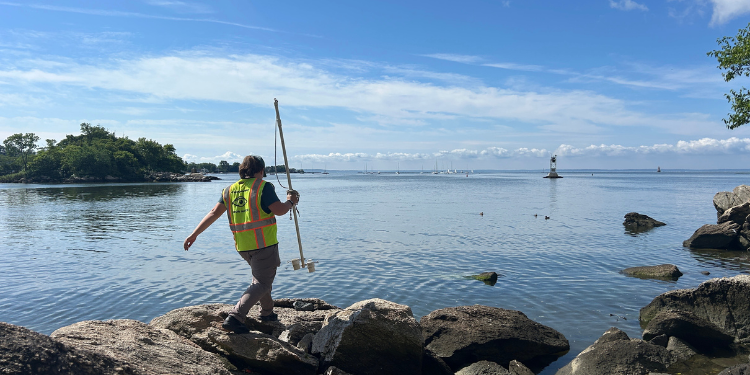
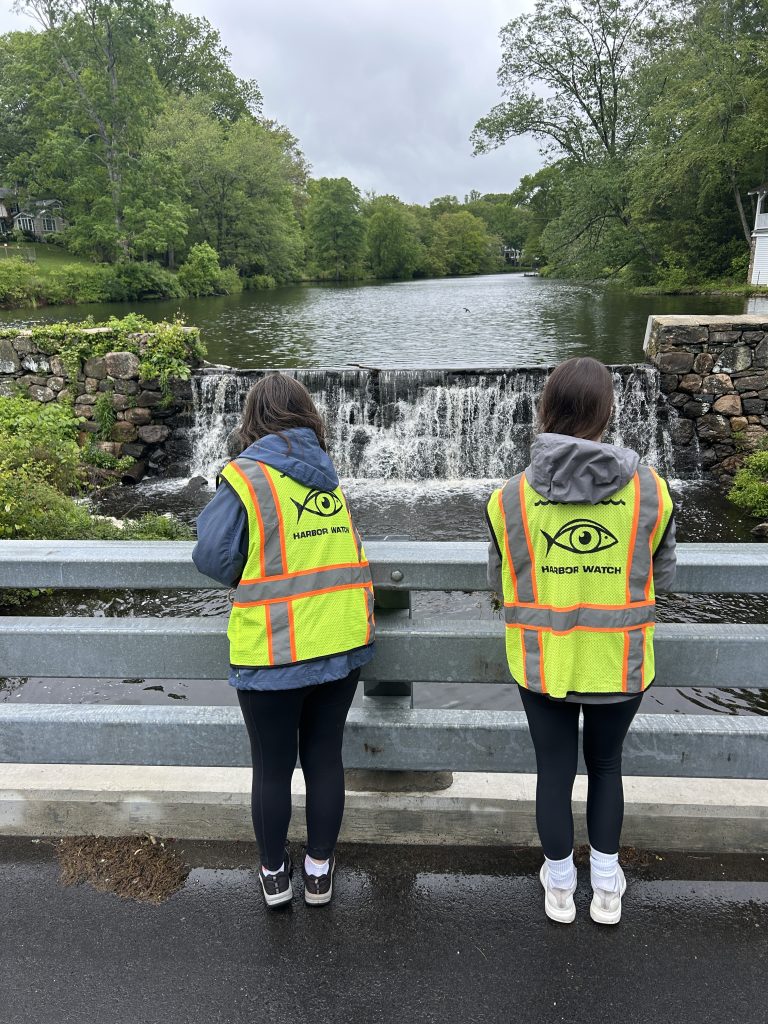
Although testing at beaches is up to each municipality and is usually done by members of a town’s health department, Harbor Watch carries on continuous testing of the waterways throughout the towns clustered around the Sound from May through September, though not beaches. This includes rivers and ponds, marshes, harbors and other bodies of water.
“Our mission is to improve water quality and ecosystem health in Connecticut,” Spiller said.
Testing, testing, testing
The research organization tests for two bacteria: E. coli and enterococci. Neither of them are necessarily harmful, she said, and are often present without consequence in both humans and other mammals. But the presence of those “indicator bacteria” in water “is indicative of other pathogens,” and are used to indicate the presence of other, less friendly, pathogens, which are more difficult and more expensive to measure through water testing.
When tests show an increase of bacteria in the sound or the waterways that feed it, Harbor Watch works with municipalities to locate and cure the pollution problem, like a failing septic system, or crack in a sewer pipe, she said. The town’s public works or health departments and other town officials often get involved in helping to identify and clean up the pollution source, she said. “We’re trying to stop pollution before it enters the Sound.”
In Westport, Harbor Watch researchers work very closely with the town’s Conservation Department and Conservation Director Colin Kelly to locate and eradicate sources of pollution, she said.
Historical record
Yearly reports on the organization’s test results are available on the Harbor Watch website, where bacteria collection figures are compared to normal data readings. Harbor Watch also studies other long-term trends such as bottom-dwelling creatures in the Sound, salt marsh studies, and testing of the waters in the harbors on the Sound including Saugatuck Harbor and Norwalk Harbor.
The population of winter flounder, for instance, has declined significantly, she said, information that was obtained as a result of a Harbor Watch study.
Funding
Like other non-profit organizations, Harbor Watch has lost some federal funding for its research this year, Spiller said. The organization’s 14th annual Cocktails and Clams fundraiser was held this past spring to help raise funds.
In March, the Westport Board of Finance also cut $25,000 from an Earthplace and Harbor Watch appropriation. But the funding was restored in May by the Representative Town Meeting, after testimony from the public and RTM members in support of Earthplace.
“We’re always looking for donations and looking for ways to work with municipalities to do this important work,” Spiller said.

Andy Brophy
Andy Brophy is an experienced Fairfield County journalist. Andy was a staff writer at The Connecticut Post for 10 years. He also wrote for the Norwalk Hour, Fairfield Minuteman, Fairfield Patch and weekly newspapers in Westport, Fairfield and Norwalk. When not reporting, Andy enjoys playing chess and listening to pianist Art Tatum. .






Recent Comments