
By Linda Conner Lambeck
WESTPORT — Good news, bad news can be found in data from the latest survey of drug, alcohol and lifestyle issues administered last February to a representative sample of the Westport school district’s seventh through 12th graders.
Overall, Westport students are drinking, smoking and using drugs less than they did in 2021, according to the self-reported data.
Still, Westport youth continue to drink significantly more than peers around the region and across the country.
“Be aware that Westport culture is not necessarily the norm,” said Margaret Watt, prevention director at Positive Directions, a locally based counseling agency that collaborates with the school district and the town’s Department of Human Services to conduct the survey, which has been administered periodically for more than 20 years.
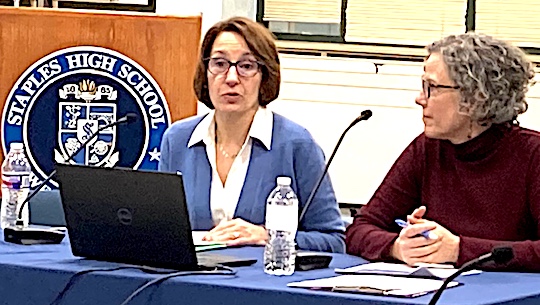
Findings of the “2024 Youth Survey” were presented at last week’s Board of Education meeting.
This time, the survey was taken by 717 students in the district, including as many as 49 percent of eighth graders and 16 percent of high school juniors. The board was told the sample was strong enough for the data to be considered reliable.
Key findings
● Three of four Staples students reported they did not drink within 30 days of filling out the survey.
● Nine of 10 Staples students say they don’t use cannabis or vape.
● Although the number of students who reported using alcohol, marijuana or vaping has dropped since 2021, the numbers from three years ago were alarmingly high — 36.5 of seniors now vs. 63.9 percent of seniors in 2021.
● Alcohol use among Westport high school seniors is 1.6 times the national rate.
● Tobacco use overall is down to 1 percent, but there was an uptick in nicotine use among juniors and seniors since the last survey was given.
● Asked only of high school students, fewer than 10 respondents reported using other drugs like hallucinogenics, meth, heroin, fentanyl or cocaine.
● White youth report three times higher drinking rates — 30 percent — than non-white youth.
● Students in special education are three times as likely to use marijuana or vape than other students.
● LGBTQ youth report using tobacco or vaping double the rate of other students.
● In survey categories other than substance abuse, during the past year some 23 percent of Westport survey takers say they have gambled, 12 percent have texted while driving and 8 percent have been a passenger in a car driven by someone under the influence.
The parent factor
This year’s survey asked students who do report substance use how they get it, where they use it and whether their parents know.
Some 39 percent of respondents who drink say they do so at home while their parents are present.
And 54 percent of students who say they drink, indicate they did so with permission from an adult relative.
Watt told the school board that students who say their parents disapprove of substance abuse are three times less likely to use them.
Parents “can make a difference by role modeling and clear communication,” Watt said. “Parents have the biggest impact.”
By junior and senior year in some households, however, Watt said there seems to be a normalization that teens can drink at home “to be ready for college.”
That, she said, is the wrong way to approach the issue.
Ninety percent of individuals who end up with a substance-abuse problem started using before the age of 18, the board was told.
What should school officials tell parents, asked board Chair Lee Goldstein. Behaviors happening in Westport are not happening at the same rate in other communities, she was told.
Area communities such as Darien, Fairfield, Trumbull, Stamford, Norwalk and Greenwich all have taken similar surveys in the past two years.
Westport, Watt said, had the highest percentage of seventh graders who drink alcohol — 7 percent — among all of them. The closest was Fairfield, where 4 percent of seventh graders drink.
“So we are almost double,” Watt said.
Data from the survey is shared with teachers, mental health staff, school administrators and the athletic director.
Valerie Babich, the school district’s coordinator of psychological services, said information from the survey also could lead to possible changes in what is taught in health classes.
Both Calum Madigan and Souleye Kebe, student representatives to the Board of Education, said the instruction they have received focused as much time and emphasis on other drugs than on alcohol.
“It’s clear that alcohol is the bigger issue,” Madigan said.
Board Vice Chair Dorie Hordon said it is important to continue to emphasize how deadly some drugs, such as fentanyl, can be.
Freelance writer Linda Conner Lambeck, a reporter for more than four decades at the Connecticut Post and other Hearst publications, is a member of the Education Writers Association.







Recent Comments